


 ACCESS
Mini-Review
ACCESS
Mini-Review
Volume 2, Article ID: 2026.0014

Nicholas Foley
nick_foley@hms.harvard.edu

Alexej Dick
ad3474@drexel.edu

Simon Cocklin
s.cocklin@wriwindber.org

1 Department of Biological Chemistry and Molecular Pharmacology, Blavatnik Institute, Harvard Medical School, Boston, MA, 02115, USA
2 Drexel University College of Medicine, Philadelphia, PA, USA
3 Chan Soon-Shiong Institute for Molecular Medicine at Windber, Windber, PA, USA
* Author to whom correspondence should be addressed
Received: 11 Mar 2026 Accepted: 09 Jun 2026 Available Online: 09 Jun 2026
This article is part of the Special Issue Epigenetic Regulation of Tumor Immunity
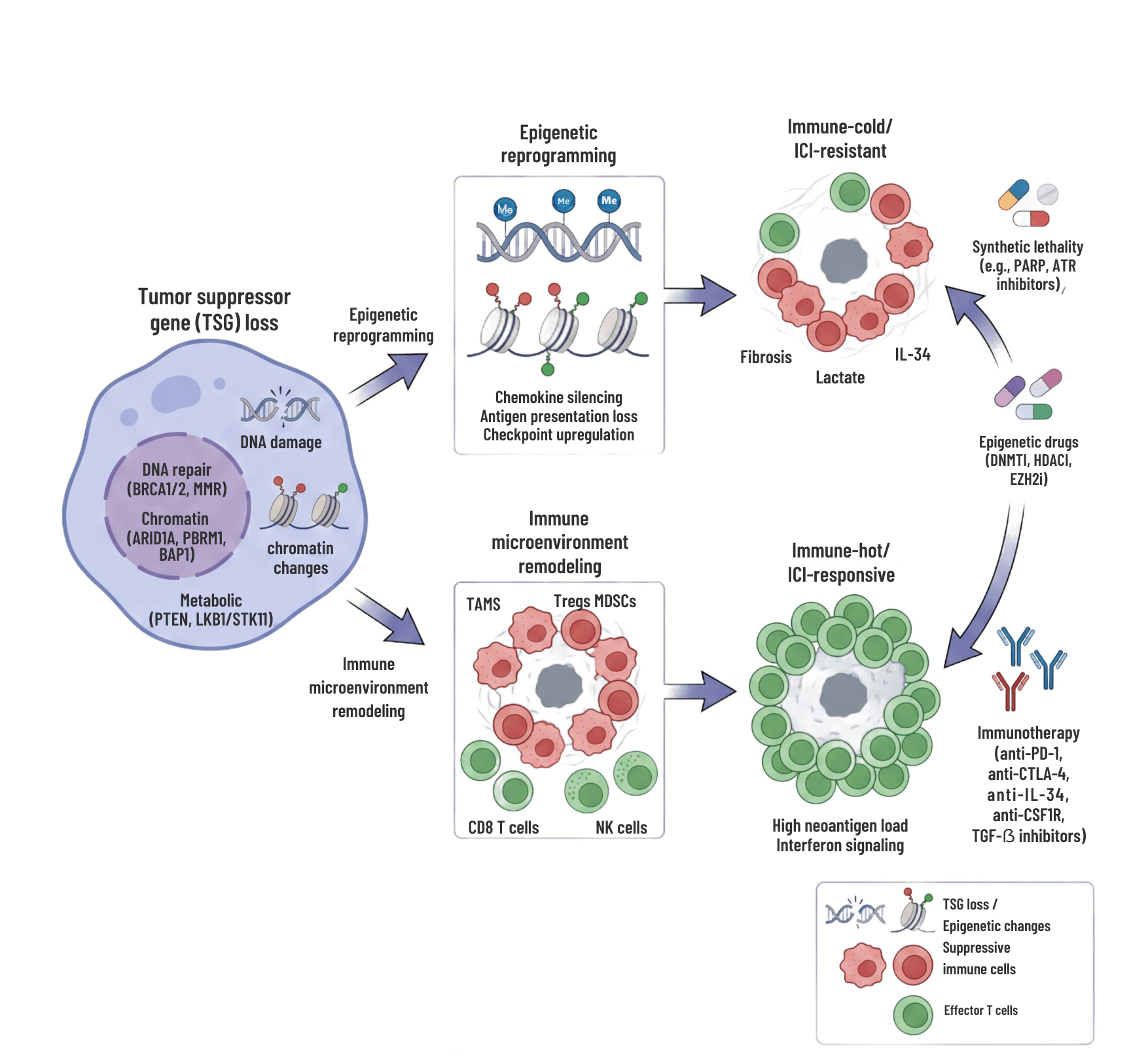
Tumor suppressor gene (TSG) inactivation is a key driver of cancer development. In addition to disrupting cell-intrinsic functions, inactivated TSGs significantly reshape the tumor microenvironment (TME). Loss of TSG activity through genetic mutations, epigenetic silencing, or deletions often allow cancer cells to escape immune detection and reprogram nearby stromal and immune cells, creating an immunosuppressive environment and leading to therapy resistance. In particular, TSG loss influences interactions between tumor and immune cells by altering cytokine profiles, regulating immune checkpoints, and inducing epigenetic changes that collectively weaken anti-tumor immune responses. This mini-review explores how TSG inactivation influences immune modulation and epigenetic programming within the TME. We examine how TSG loss promotes immune evasion and “cold” tumor immune phenotypes, and how it causes epigenetic changes that sustain pro-tumor gene expression patterns. The review highlights emerging therapeutic strategies, including synthetic lethality approaches, epigenetic therapies, and immunomodulatory treatments aimed at reversing the immune-epigenetic effects of TSG loss. A deeper understanding of immune-epigenetic reprogramming caused by TSG inactivation emphasizes the importance of integrated treatments that restore immune surveillance and promote tumor suppression within the complex TME.
Disclaimer: This is not the final version of the article. Changes may occur when the manuscript is published in its final format.