
 ACCESS
Research Article
ACCESS
Research Article
Volume 2, Article ID: 2026.0034

Cyprian Obinna Azinta
azinta.acom@gmail.com


Onyekachi Stephen Nnamani
nonyekachi865@gmail.com

Ogochukwu Cornelius Nevo
ogochukwu.nevo@esut.edu.ng

Department of Chemical Engineering, Enugu State University of Science and Technology, Enugu, Nigeria
* Author to whom correspondence should be addressed
Received: 15 Apr 2026 Available Online: 31 Jul 2026
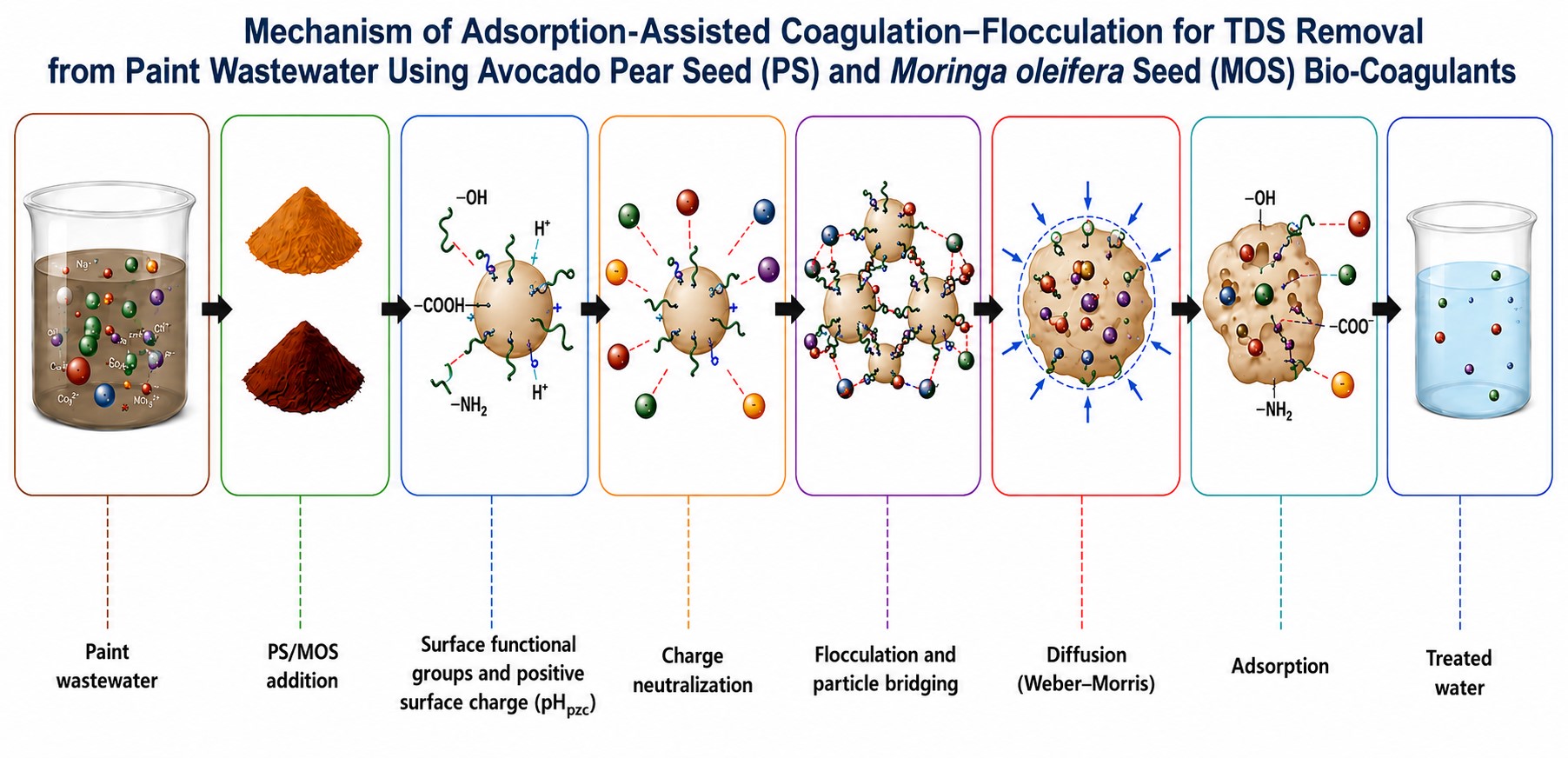
In this study, avocado pear seed (PS) and moringa oleifera seed (MOS) were processed and characterized by proximate analysis, Fourier transform infrared (FTIR) spectroscopy, and point of zero charge (pHpzc) determination before they were applied as bio-coagulants for the treatment of paint wastewater (PWW) with high total dissolved solids (TDS). Coagulation–flocculation was employed as the primary treatment mechanism, with adsorption investigated as a complementary removal process. The characterization confirmed the presence of functional groups, protein and carbohydrate associated with coagulation–flocculation, and the relatively high pHpzc values implied positively charged bio-coagulant surfaces at the optimum treatment pH, which enabled charge neutralization and electrostatic attraction of dissolved species. The effects of pH, coagulant dosage and contact time on TDS removal were studied using coagulation–flocculation tests. The initial TDS concentration of the raw PWW decreased from 2524.43 mg L⁻¹ to 165.54 mg L⁻¹ (93% removal) and to 100.13 mg L⁻¹ (96% removal) after treatment with PS and MOS respectively. The treatment data were subjected to adsorption, kinetic, diffusion, and equilibrium isotherm analyses. The analyses revealed that both bio-coagulants followed the pseudo-second-order kinetic (R² > 0.98) and the Langmuir isotherm (R² > 0.99) models, showing that adsorption was mainly through surface interactions on available active sites. Although MOS achieved a higher overall TDS removal, PS exhibited slightly more favourable adsorption behaviour. These results show the potential of avocado pear seed and moringa oleifera seed bio-coagulants as promising, biodegradable and environmentally sustainable alternatives to the conventional chemical coagulants for industrial wastewaters treatment.
Disclaimer: This is not the final version of the article. Changes may occur when the manuscript is published in its final format.