


 ACCESS
Research Article
ACCESS
Research Article
Volume 3, Article ID: 2026.0032

Mircea Ţălu
talu.s.mircea@gmail.com

1 Department of Computer Science, Faculty of Automation and Computer Science, The Technical University of Cluj-Napoca, 26-28 George Barițiu St., Cluj-Napoca, 400027 Cluj, Romania
2 SC ACCESA IT SYSTEMS SRL, Constanța St., no. 12, Platinia, CP. 400158 Cluj-Napoca, Romania
Received: 23 Sep 2025 Accepted: 16 Mar 2026 Available Online: 17 Mar 2026
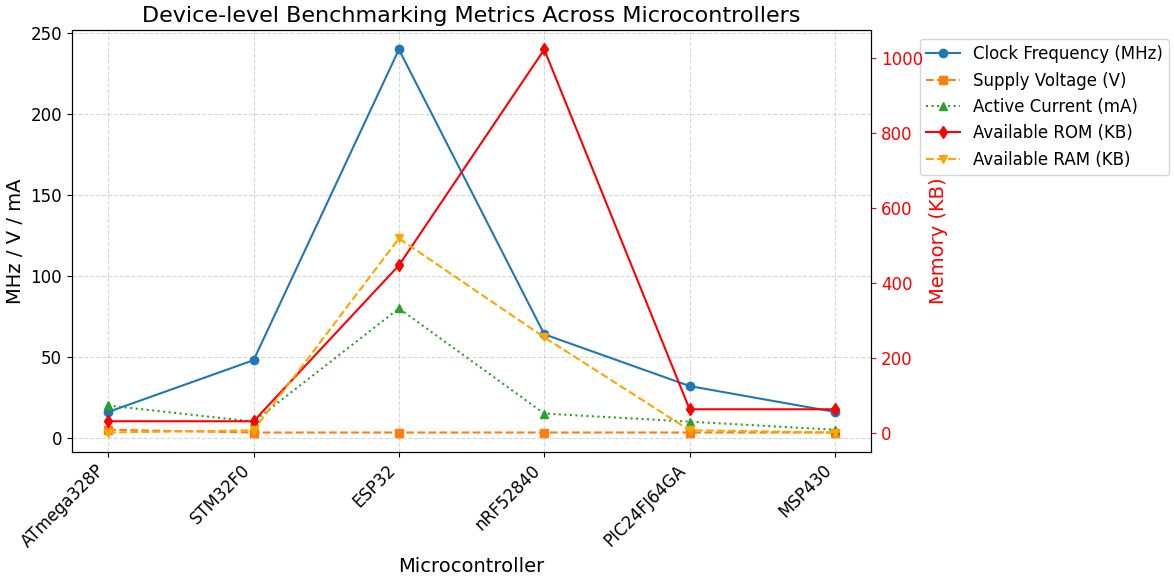
This study benchmarks a temporal DNA-based key derivation function (DNA-KDF), against eleven lightweight block ciphers (PRESENT-80, ASCON-128, SPECK-64, TWINE-80, HIGHT, SIMON-64/128, LED-64, QARMA, LEA, SEPAR, and BORON) on six representative IoT microcontrollers (ATmega328P, STM32F0, ESP32, nRF52840, PIC24FJ64GA, MSP430). Performance evaluation covers execution latency, memory footprint, throughput, energy consumption, and security metrics. Results show that SPECK-64 and SIMON-64/128 achieve the lowest latency (0.72–2.08 ms) and highest throughput (up to 1200 kB/s), confirming their efficiency in constrained devices. DNA-KDF demonstrates moderate latency (1.03–2.47 ms) and throughput up to 1000 kB/s, outperforming ciphers such as TWINE-80, HIGHT, and BORON on several platforms. Its memory demand (2.50 KB ROM / 0.32 KB RAM) is higher than classical designs but remains feasible for modern IoT nodes. The energy measurements show that DNA-KDF consumes between 3.2 and 6.9 μJ, which falls within an acceptable range. Its energy use is similar to HIGHT and lower than that of PRESENT-80 and SIMON-64/128. The security tests demonstrate good performance, with an avalanche effect close to the ideal value (49.8%), high entropy values (7.98–7.99 bits per byte), and strong sensitivity to key changes. These results indicate that DNA-KDF provides a level of security comparable to ASCON-128. When compared with AES-128, DNA-KDF runs about 50% faster and requires approximately 25% less energy. The findings suggest that DNA-KDF is a practical and effective additional security solution for mid-level IoT devices, offering a good balance between new design concepts and real-world efficiency.
Disclaimer: This is not the final version of the article. Changes may occur when the manuscript is published in its final format.