

APA Style
Albab Fawwaz Alfarras. (2025). Effect of Conjugated siRNA-Gold Nanoparticles on Antibiotic-Resistance Integron Class I Gene. GenoMed Connect, 2 (Article ID: 0020). https://doi.org/10.69709/GenomC.2025.194301MLA Style
Albab Fawwaz Alfarras. "Effect of Conjugated siRNA-Gold Nanoparticles on Antibiotic-Resistance Integron Class I Gene". GenoMed Connect, vol. 2, 2025, Article ID: 0020, https://doi.org/10.69709/GenomC.2025.194301.Chicago Style
Albab Fawwaz Alfarras. 2025. "Effect of Conjugated siRNA-Gold Nanoparticles on Antibiotic-Resistance Integron Class I Gene." GenoMed Connect 2 (2025): 0020. https://doi.org/10.69709/GenomC.2025.194301.
ACCESS
Research Article
Volume 2, Article ID: 2025.0020

Albab Fawwaz Alfarras
albab.f.ibrahim@kus.edu.iq
Forensic Science Department, College of Science, Al-Karkh University of Science, Baghdad 10011, Iraq
Received: 24 Aug 2025 Accepted: 20 Dec 2025 Available Online: 22 Dec 2025 Published: 27 Dec 2025
Background: This study investigates the application of gold nanoparticles (AuNPs) as a delivery platform for small interfering RNA (siRNA) to achieve targeted gene silencing. Methods: This study used commercially available AuNPs, characterizing them through techniques such as Field Emission Scanning Electron Microscopy and X-ray diffraction. This study investigated the effectiveness of these AuNPs in delivering siRNA to bacterial cells, particularly Pseudomonas aeruginosa, without conjugation compounds. Results: The results show that the AuNPs were uniform in morphology, with smaller particles showing a nearly spherical shape, and their size increased from 5 nm to 100 nm. The tested concentrations of AuNPs did not affect viability of P. aeruginosa. The efficiency of conjugation was confirmed using gel documentation, and the silencing of the antibiotic resistance integron gene (intI) in Pseudomonas aeruginosa was evaluated using a plating method. The results demonstrated a high transformation frequency, with a significant percentage (100%) of colonies showing complete transformation from resistance to sensitivity. Conclusion: The findings indicate the potential of using AuNPs as a delivery system for gene silencing in genetic engineering, particularly for combating antibiotic resistance in bacteria.
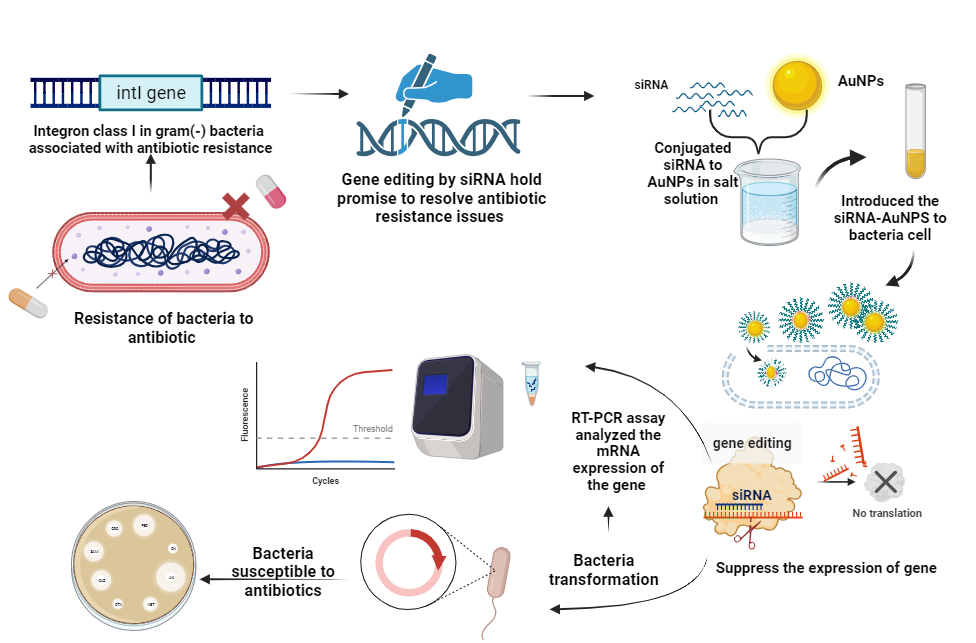
The concept of “gene silencing delivery systems” refers to techniques used to transport small interfering RNA (siRNA) to specific locations to achieve efficient, targeted suppression of gene expression. Various delivery techniques can be employed to achieve gene silencing, including viral and non-viral vectors, antibody-based delivery, dual-targeting systems, nanotechnology-based systems, specific ligands, and combination therapies. These methods aim to improve siRNA delivery to target cells and protect siRNA from degradation. Nevertheless, there are obstacles to using siRNA, including transport mechanisms, stability concerns, off-target effects, specificity issues, and potency limitations [1]. One of the main challenges in the field of RNAi-based therapy is developing a delivery method that meets all the requirements for clinical applicability [2]. The important role of delivery systems in facilitating gene silencing in bacteria lies in their ability to deliver siRNA molecules efficiently and accurately to targeted bacterial cells. The use of nanoparticle-conjugated siRNA represents a highly promising strategy for inducing gene silencing, owing to its numerous advantages, including simplicity of manufacture and chemical characterization, high packaging capacity, lack of immunogenicity, and potential for tissue selectivity. Nanoparticles have garnered considerable interest as non-viral gene transfer vectors. This has positioned them as a viable alternative to the widely utilized viral vectors [3]. Nanoparticles can protect siRNA from degradation and enhance its transport to specific cellular targets [4]. Various types of nanoparticles are used to deliver siRNA, including lipid-based, polymer-based, gold, and iron oxide nanoparticles. The conjugation of nanoparticles with siRNA can be achieved through either covalent bonding or electrostatic interactions. The utilization of nanoparticles for the transport of siRNA has demonstrated encouraging outcomes in the field of cancer therapy, with several siRNA-based pharmaceuticals having passed evaluation in clinical studies [5,6]. There are numerous potential biological and biomedical applications for metal-based nanoparticles, including gold, silver, platinum, iron oxide, and quantum dots. They are presently being thoroughly studied to take advantage of the qualities that make them a viable option for future clinical applications [7,8]. Gold nanoparticles possess distinctive optical properties and are easy to produce and modify. They may be selectively and cooperatively coated with nucleic acids using either covalent or non-covalent conjugation methods [9,10]. Covalent attachment of nucleic acid strands to gold nanoparticle cores, typically 13–15 nm in size, is achieved through the use of thiol moieties [11,12]. This method is applied to DNA and siRNA, which can be attached directly to gold cores or to gold cores that have been polymerized. It has been demonstrated that coating nanoparticles with hydrophilic molecules like polyethylene glycol (PEG) reduces immunological activation and extends circulation time as a common anti-fouling technique [13,14]. Ligand density, hydrophobicity, avidity, and length must all be considered and tuned for effective nanoparticle targeting [15,16]. Another important characteristic of nanoparticles is their size, with research indicating that they are most effective when measuring between 100 and 250 nm in diameter [13]. Therefore, this study aims to investigate the key characteristics and conjugation efficiency of gold nanoparticles with siRNA for use as a delivery system in genetic experiments.
2.1. Characterization of Gold Nanoparticles (AuNPs) Colloidal gold nanoparticles (AuNPs) with a diameter range of 5–20 nm, weight concentration of 100 ppm, red color, and spherical morphology were supplied by Via Carbon Nano Materials (VCN) Co. Ltd. (Iran). The AuNPs were used as a delivery system for siRNA to bacterial cells. To assess the structural and optical properties, as well as the conjugation capability of AuNPs, a variety of tests were conducted, as outlined below: 2.2. High-Resolution Scanning Electron Microscopy Using Field Emission (FESEM) FESEM was used to investigate the morphological features and microstructure of the AuNPs. In FESEM, an electron beam is focused on the material under test to generate images via surface scanning. The atoms of the material interacts with the electron beam, resulting in the generation of a single electron, which provides information on the composition and surface morphology [17]. 2.3. X-Ray Diffraction (XRD) XRD was used in this study to evaluate the physical properties, composition, crystal structure, and phase identification of the AuNPs. XRD uses the remarkable interaction between monochromatic X-rays and crystalline samples. These monochromatic X-rays are produced by a cathode-ray tube and then filtered. The radiation is then precisely focused on the sample. The interaction between the sample and incident rays generates positive interference (and a diffracted ray) under appropriate conditions. Line broadening in the XRD pattern indicates nanoparticles [18]. 2.4. Monitoring of Cell Viability After Treatment with AuNPs by Oxidation-Reduction Assay The minimum inhibitory concentration of gold nanoparticles against bacterial cultures was analyzed using the Resazurin dye in 96-well plates (7-hydroxy-3H-phenoxazine-3-one 10-oxide). When resazurin is chemically reduced by aerobic respiration generated by cell growth, it changes from blue and non-fluorescent to pink and highly fluorescent, indicating cell viability. The P. aeruginosa cultures were diluted to 5 × 10⁵ CFU/mL overnight. In successive columns of a microtiter plate, the gold nanoparticles were diluted 1:2 in LB broth from a starting concentration of 100 ppm to an end concentration of 3.125 ppm. In each well, 100 μL of diluted bacterial suspension was thoroughly mixed with 100 μL of the gold nanoparticle solution, with seven replicates performed for each AuNP concentration (100, 50, 25, 12.5, 6.25, and 3.125 ppm). The experiment includes two control groups: 100 μL of LB broth without cells and 5 × 10⁵ CFU/mL heat-killed cells. The plates were then incubated at 37 °C for 24 h. After incubation, color change was assessed. 20 μL of 0.015% resazurin solution was added to each well and incubated for 2–4 h to observe a color change. On completion of the reduction of resazurin to resorufin, indicate the presence of a live cell [19]. 2.5. Conjugation of Gold Nanoparticles to siRNA Modified Method Gold nanoparticles conjugated with designed siRNA were used to induce silencing of the target gene (e.g., the integron gene intI) in Pseudomonas aeruginosa. The conjugation efficiency was optimized by preparing different concentrations of sodium chloride (NaCl) (3, 2, 1.5, 1, and 0.5 M). The experimental procedure involved the following steps: Preparation of Gold Nanoparticles: 3 mL of gold nanoparticles were mixed with 2 mL of 3M NaCl in a 10 mL tube. The mixture was incubated in a shaker incubator for 30 min at 60 °C. Addition of siRNA: 20 μL of siRNA, prepared by dissolving in nuclease-free water to achieve a final concentration of 100 picomol/μL, was added. The tube was returned to the shaker incubator for an additional 10 min. Incremental Addition of NaCl: 2000 μL of residual NaCl concentrations were added incrementally under the same incubation conditions: 500 μL of 0.5 M NaCl (added in 250 μL portions every 30 min). 500 μL of 1 M NaCl (added in 250 μL portions every 30 min). 500 μL of 1.5 M NaCl (added in 250 μL portions every 30 min). 500 μL of 2 M NaCl (added in 250 μL portions every 30 min). Detection of Conjugation by Gel Electrophoresis: Gold-siRNA conjugates were subjected to electrophoresis on 1.5% agarose gels. Electrophoresis was conducted for one hour at 100 V. Gels with conjugated gold nanoparticles, unconjugated gold nanoparticles, and free DNA of different lengths were run. siRNA–AuNP conjugates were visualized using a gel imaging system, and samples were loaded with reversed electrode orientation (cathode-to-anode) for nanoparticle migration assessment. This approach enabled assessment of the efficiency of gold nanoparticle-siRNA conjugation. The use of gel electrophoresis facilitated the visualization and confirmation of successful conjugation [20]. 2.6. Silencing of the intI Gene by Conjugated siRNA The experiment involves silencing the intI gene in Pseudomonas aeruginosa isolates using siRNA conjugated to gold nanoparticles. The process begins by culturing the bacterial isolates on cetrimide agar plates and incubating them overnight at 37 °C. Bacterial suspensions are then prepared in Brain Heart Infusion Broth (BHIB) from the plate by taking a loopful. After a 24-h incubation at 37 °C, 200 μL of bacterial suspension adjusted to 0.5 McFarland is inoculated into 7020 μL of a conjugated salt solution. This solution was prepared in advance, and the entire mixture was incubated in a shaker incubator at 37 °C for 24 h, as determined by previous experiments to be the optimal conditions for gene silencing. 2.7. Replica Plate Method to Study the Effect of Gene Silencing on Antibiotic Resistance The process involves culturing a loopful of a silencing suspension on a cetrimide agar plate to obtain single colonies by streaking, followed by an 18-h incubation at 37 °C. Identification of these cells was performed by replica-plating colonies onto three MH agar plates: one master plate without antibiotics and two plates containing different types and concentrations of antibiotics. The selected antibiotics are added according to CLSI 2021 guidelines [21], considering the antibiotic resistance of isolates before silencing. A grid petri dish is used for MH agar plates. Single colonies are transferred using a sterile toothpick, spotted in the center of squares on both master and antibiotic plates, and incubated at 37 °C until colonies form. Silencing frequency is determined by counting colonies inhibited on an antibiotic-containing MH agar plate. 2.8. Antibiotic Susceptibility Test by Disk Diffusion Method The disk diffusion method (modified Kirby–Bauer) was used for further susceptibility testing on Mueller–Hinton agar. Inocula were prepared in sterile saline and adjusted to 0.5 McFarland (≈approximately 1.5 × 10⁸ CFU/mL). Plates were uniformly swabbed, and antibiotic disks were applied using sterile forceps. After incubation at 37 °C for 18–24 h, inhibition zone diameters were measured in millimeters. Results were interpreted according to CLSI (2021) guidelines. 2.9. Statistical Analysis SPSS software (v24.0) was used for statistical analysis of the data. The Pearson chi-square test was performed to identify significant variations in the parameters, which were presented as frequencies and percentages. It was determined that p ≤ 0.05 was significant.
3.1. Characterization of Gold Nanoparticles (AuNPs) Gold nanoparticles (AuNPs) were identified at the Chemistry Analysis Center (CAC), Baghdad, Iraq, using the following tests as a confirmatory step to verify the size, shape, and purity of the nanoparticles used. 3.2. High-Resolution Scanning Electron Microscopy Using Field Emission (FESEM) Based on the surface investigation, topographical analysis was carried out, and FESEM pictures were taken. The gold nanoparticles were homogeneous, as seen by the FESEM pictures (Figure 1). Other than that, it was found that particles are nearly spherical in shape at smaller sizes and get larger as they get closer to 5 nm. AuNP morphology is thought to be a crucial factor influencing cellular uptake; research has shown that spherical GNPs have a higher rate and extent of cellular uptake than rod-shaped ones. Size also plays a significant role in determining the GNPs’ half-life [9]. 3.3. X-Ray Diffraction (XRD) The XRD technique is used to determine the crystalline structure and grain size of nanoparticles. The diffraction patterns acquired for the AuNPs are shown in Figure 2. The XRD pattern showed characteristic crystalline peaks of gold nanoparticles across a 2θ range of 10°–80°. Diffraction angles of 31.67° and 45.41° are a form of face-centered cubic (FCC) crystal, which has a value of hkl (111) and (200). This data corresponds to JCPDS No. 01-089-3697. 3.4. Cell Viability After Treatment with Gold Nanoparticles An oxidation-reduction experiment was used to assess the viability of P. aeruginosa exposed to different AuNP treatments. Cell viability was indicated using the redox-sensitive dye resazurin. Metabolically active cells convert the non-fluorescent blue resazurin into the fluorescent red resorufin. Resazurin cannot be reduced by non-living cells, which is a sign of cell death. The cells are viable based on this obvious change in color and fluorescence. AuNPs were added to freshly cultured and diluted bacterial cultures in LB broth (approximately 5 × 10⁵ CFU/mL) at concentrations of 100-3.125 ppm. The results show that the vitality of P. aeruginosa is unaffected by changes in AuNP concentration, with seven replicates per isolate (Figure 3). It is not recognized that AuNPs possess intrinsic antibacterial properties. Au is an extremely uncommon, inactive, and non-toxic metal to microorganisms [22,23]. Gold is a versatile metal that may bind a wide variety of ligands. The antibacterial activity of nanoparticles (NPs) depends on their size. The specific antibacterial mechanism of larger nanoparticles is not yet fully understood; however, their adsorption to the bacterial cell membrane increases membrane tension, inducing mechanical deformation that can ultimately lead to cell rupture and death [24,25]. 3.5. Detection of the Conjugation of Gold Nanoparticles to siRNA by Gel Electrophoresis Conjugating siRNA to gold nanoparticles provides several advantages, including improved cellular uptake, protection of siRNA from degradation, and the potential for targeted delivery [26]. However, the process requires careful design and optimization to ensure effective binding, delivery, and gene silencing outcomes. Employing a gel electrophoresis experiment, siRNA-gold nanoparticle conjugates were carefully investigated. Gels with conjugated siRNA-AuNPs appeared as a fluorescent band in gel wells, unconjugated gold nanoparticles migrated in the opposite direction to normal DNA migration, whereas free siRNA, due to its small size and low staining signal, was not clearly detectable. The red-stained bands of the siRNA-AuNPs were directly visualized using a gel imaging system (Figure 4). A vast array of biomolecules, such as DNA, RNA, proteins, peptides, medicines, genes, and other molecules of therapeutic importance, can be targeted, intracellularly trafficked, and delivered by gold nanoparticles, which are remarkable molecular transporters. Due to their physicochemical properties, they do not induce significant cytotoxicity [12,27]. Several research groups have developed ways for functionalizing gold and other nanoparticles utilizing oligonucleotides, either alone or with modifications [20]. 3.6. Frequency of the Transformed Pseudomonas aeruginosa Silenced by siRNA-AuNPs The process involves attaching siRNA molecules to the surface of AuNPs, which act as carriers to protect and transport the siRNA to the target cells. Nanoscale gold particles can enter cells by binding to pore proteins and passing through the pore. The siRNA-AuNP conjugates are introduced to target cells, and the AuNPs protect the siRNA from deterioration, promote endosomal escape of the siRNA into the cytoplasm, and promote cellular uptake through endocytosis. Targeting the intI gene of P. aeruginosa to determine whether the system can induce gene silencing efficiently. Very little research has been conducted on this approach to date. The replica plate method was used to determine whether variant colonies growing in the presence of the antibiotic showed high resistance to it before treatment with siRNA-AuNPs. This technique enables the selection of bacterial cells subjected to gene silencing and facilitates the determination of transformation frequency. In this technique, we selected five isolates to test the efficiency of siRNA to inhibit the intI gene (P.A6, P.A11, P.A24, P.A32, P.A61). To study the phenotypic effect of silencing, the original layout of bacterial colonies is preserved when they are moved from one plate to another. Silencing the intI gene resulted in the disappearance of the colony when incubated in the presence of antibiotics (AK and CE) (Figure 5). In contrast, the same colony was present on the master plate, which was free of antibiotics. The transformation frequency was higher with amikacin: the results showed that colonies of isolates (P.A 6, P.A 32, P.A 61) were completely (100%) transformed from resistance to sensitivity, while in isolate P.A24, 98% of colonies transformed to sensitivity, whereas 100% of the colonies in isolate P.A11 remained resistant to amikacin. The plating method also revealed that the frequency of transformed colonies on plates containing ceftazidime was lower than that observed on amikacin-containing plates, with transformation frequencies ranging from 2–10%, as illustrated in Table 1. This phenotype alteration was transient, and the silencing was forfeited upon subculturing. Results of this study showed there is a very highly significant difference (p < 0.001 ***) between transformed (resistance) and non-transformed colony (resistance). Additionally, pre-treatment with siRNA markedly reduced the bacterial load, as all colonies exhibited poor growth on antibiotic-containing plates. This effect can be attributed to the action of siRNA on bacterial cells. These results are similar to those obtained before by [28]. These findings highlight the potential of siRNA-based strategies to prevent or reduce bacterial infections. The increase in antibiotic-resistant bacterial pathogens not only complicates the treatment of infectious diseases but also imposes a significant financial burden on healthcare systems. Furthermore, it compromises medical procedures that rely on effective infection prevention, including surgery, cancer therapy, organ transplantation, dental care, and the management of premature infants [29]. To keep up with the rapid rise in antibiotic resistance, new approaches are being explored to continue producing new medicines. Antimicrobial oligonucleotides might theoretically offer the greatest range of efficacy while carrying the lowest risk of irreversible resistance [30]. Class 1 integrons carry many gene cassettes that confer resistance to beta-lactam and aminoglycoside antibiotics; therefore, the majority of integron-positive isolates may develop resistance to these antibacterial agents [31,32]. Class 1 integrons harbor many genes for antibiotic resistance and play a significant role in the spread of antimicrobial resistance in medical environments [33,34]. Frequency of transformation on replica plate after silencing the intI gene. The asterisks (***) indicate that the values are statistically highly significant. 3.7. Phenotypic Changes Associated with intI Gene Silencing Depending on the isolates subjected to silencing by the designed siRNAI, only the transformed colonies were selected from the master plate using the replica plating method. These colonies were tested for antibiotic sensitivity using the agar disk diffusion method according to CLSI recommendations (CLSI, 2021). The antimicrobial effect of gene silencing on P. aeruginosa was evaluated using the agar disk diffusion method. A clear difference in susceptibility patterns was observed before and after silencing (Table 2). Post-silencing, all isolates demonstrated a marked shift from drug resistance to increased susceptibility. Specifically, the isolates, which were previously resistant to Piperacillin and showed intermediate resistance to Aztreonam, became sensitive to both antibiotics after treatment. Additionally, their response to Amikacin improved, shifting from resistant to intermediate susceptibility (Figure 6). Antibiotic susceptibility before and after silencing. CAZ: Ceftazidime, FEP: Cefepime, TOP: Tobramycin, CN: Gentamicin, AK: Amikacin, CIP: Ciprofloxacin, LEV: Levofloxacin, MEM: Meropenem, IPM: Imipenem, CL: Colistin, ATM: Aztreonam, FO: Fosfomycin, P: Piperacillin.
Isolate No.
Master Plate
Plate with Amikacin
Plate with Ceftazidime
Colonies
Resistance
Sensitive
Frequency of Transformation
Resistance
Sensitive
Frequency of Transformation
P.A 6
50
0
50
100%
45
5
10%
P.A 11
50
50
0
0%
45
5
10%
P.A 24
50
1
49
98%
49
1
2%
P.A 32
50
0
50
100%
48
2
4%
P.A 61
50
0
50
100%
49
1
2%
p value
p < 0.001 ***
p < 0.001 ***
ISOLATE No.
Sensitivity Before Silencing
CAZ
FEP
TOP
CN
AK
CIP
LEV
MEM
IPM
CL
ATM
FO
P
P.A 6
MDR
R
R
R
R
R
S
R
S
R
S
I
R
R
P.11
PDR
R
R
R
R
R
R
R
R
R
R
I
R
R
P.A.24
MDR
R
R
S
R
S
S
R
S
S
R
P.A 32
XDR
R
R
S
R
R
S
R
S
R
S
R
R
R
P.A 61
XDR
R
R
R
R
R
S
I
S
S
R
S
R
R
ISOLATE No.
Sensitivity after silencing
CAZ
FEP
TOP
CN
AK
CIP
LEV
MEM
IPM
CL
ATM
FO
P
P.A 6
R
S
S
R
S
S
S
S
S
I
R
R
P.11
R
R
S
S
R
R
R
R
S
R
I
R
R
P.A.24
R
R
S
S
S
S
S
S
S
R
P.A 32
R
R
S
S
R
S
S
S
S
S
I
R
R
P.A 61
R
R
R
R
R
S
I
S
S
R
S
R
R
The importance of including suitable controls, like gold nanoparticles alone, is recognized. In this study, cell viability assays were conducted following treatment with AuNPs, and no significant cytotoxicity or growth inhibition was observed. This supports the biocompatibility of AuNPs in these experimental conditions. However, these results suggest that the phenotypic changes are unlikely due to general cellular toxicity, although Integron gene expression was not directly assessed. Accordingly, an AuNP-only control for integron expression was not included, which is acknowledged as a limitation. Therefore, although the observed increase in antibiotic sensitivity is most likely attributable to siRNA-mediated effects, the potential role of AuNPs alone in integron regulation cannot be entirely excluded.
In conclusion, the results underscore the significance and effectiveness of non-viral particles as carriers for delivering nucleic acids into bacterial cells while maintaining cell viability. The findings suggest the promising capability of delivering siRNA particles to bacterial cells. The transformation from antibiotic-resistant to antibiotic-sensitive colonies underscores the crucial role of particles as reliable carriers of nucleic acid molecules, protecting them against enzymatic degradation.
°C
Degrees Celsius
µL
Microliter
AK
Amikacin
AuNPs
Gold Nanoparticles
BHIB
Brain Heart Infusion Broth
CAC
Chemistry Analysis Center
CE
Ceftazidime
CFU
Colony-Forming Unit
CLSI
Clinical Laboratory Standards Institute
DNA
Deoxyribonucleic Acid
FCC
Face-Centered Cubic
FESEM
Field Emission Scanning Electron Microscopy
GNB
Gram-Negative Bacteria
GNPs
Gold Nanoparticles
IntI
Integron Class 1
JCPDS
Joint Committee on Powder Diffraction Standards
LB
Luria-Bertani Broth
M
Molar
MDR
Multi-Drug Resistance
MH
Mueller–Hinton
MTP
Microtiter Plate Method
NaCl
Sodium Chloride
NPs
Nanoparticles
PEG
Polyethylene Glycol
ppm
Parts per Million
RNA
Ribonucleic Acid
SDs
Standard Deviations
siRNA
siRNA Small Interfering RNA
SPSS
Statistical Package for the Social Sciences
V
Volt
VCN
Via Carbon Nano Materials
XRD
X-Ray Diffraction
All aspects of this study, including conceptualization, methodology, software, validation, formal analysis, investigation, resources, data curation, visualization, writing—original draft preparation, writing, review and editing, supervision, and project administration, were carried out solely by the author. The author has read and approved the final version of the manuscript and takes full responsibility for all aspects of the work.
The data supporting the findings of this study are available from the corresponding author upon reasonable request.
All experimental procedures and research activities related to this study were conducted in accordance with institutional and national guidelines. This research was approved by the Ministry of Health—Baghdad Al-Karkh Health Directorate, Iraq, under official approval number 211, dated 5/7/2022. The research project was registered with project number 2022293, Baghdad Al-Karkh. The author confirm that all necessary ethical approvals were obtained before the commencement of the study. This study did not involve human participants; therefore, consent to participate was not required.
The author declares no conflicts of interest.
The study did not receive any external funding and was conducted using only institutional resources.
The author is sincerely grateful and deeply indebted to Dr. Ahmed Abdul Jabbar Suleiman from the College of Science, University of Anbar, for his invaluable support and assistance throughout this project. His guidance and contributions are greatly appreciated.
The author declares that ChatGPT and Grammarly were used solely for language editing (grammar and spelling) to improve the clarity of the manuscript. No AI tools were used for data analysis, interpretation, or generation of scientific content. An online tool was used solely to improve image clarity and resolution for presentation purposes, without any modification to the scientific content of the figures. The online tool ImgUpscaler (https://imgupscaler.ai/ar/sharpen-image/, accessed on 2 December 2025) was utilized exclusively for this purpose.
[1] Paunovska, K.; Loughrey, D.; Dahlman, J.E. Drug Delivery Systems for RNA Therapeutics. Nat. Rev. Genet. 2022, 23, 265–280. [CrossRef]
[2] Song, H.; Hart, S.L.; Du, Z. Assembly Strategy of Liposome and Polymer Systems for SiRNA Delivery. Int. J. Pharm. 2021, 592, 120033. [CrossRef]
[3] Mohammadinejad, R.; Dadashzadeh, A.; Moghassemi, S.; Ashrafizadeh, M.; Dehshahri, A.; Pardakhty, A.; Sassan, H.; Sohrevardi, S.M.; Mandegary, A. Shedding Light on Gene Therapy: Carbon Dots for the Minimally Invasive Image-Guided Delivery of Plasmids and Noncoding RNAs—A Review. J. Adv. Res. 2019, 18, 81–93. [CrossRef] [PubMed]
[4] Esmaeilpour, D.; Ghomi, M.; Zare, E.N.; Sillanpää, M. Nanotechnology-Enhanced SiRNA Delivery: Revolutionizing Cancer Therapy. ACS Appl. Bio Mater. 2025, 8, 4549–4579. [CrossRef]
[5] Aggarwal, R.; Sheikh, A.; Akhtar, M.; Ghazwani, M.; Hani, U.; Sahebkar, A.; Kesharwani, P. Understanding Gold Nanoparticles and Their Attributes in Ovarian Cancer Therapy. Mol. Cancer 2025, 24, 88. [CrossRef] [PubMed]
[6] Harshita; Harish, V.; Upendra, S.L.; Mohd, S.; Singh, S.K.; Agrawal, P.; Vishwas, S.; Dua, K. Next-Gen Cancer Treatment: Nanotechnology-Driven SiRNA Delivery Solutions. ASSAY Drug Dev. Technol. 2025, 23, 281–298. [CrossRef]
[7] Kumari, S.; Choudhary, P.K.; Shukla, R.; Sahebkar, A.; Kesharwani, P. Recent Advances in Nanotechnology Based Combination Drug Therapy for Skin Cancer. J. Biomater. Sci. Polym. Ed. 2022, 33, 1435–1468. [CrossRef]
[8] Itani, R.; Al Faraj, A. SiRNA Conjugated Nanoparticles—A Next Generation Strategy to Treat Lung Cancer. Int. J. Mol. Sci. 2019, 20, 6088. [CrossRef]
[9] Mohammed, I.A.; Al-Gawhari, F.J. Gold Nanoparticle: Synthesis, Functionalization, Enhancement, Drug Delivery and Therapy: A Review. Syst. Rev. Pharm. 2020, 11, 888–910. [View Online]
[10] Sousa, L.K.F.M.; Do Lago, J.P.A.D.; de Sousa, A.A.; Nobre, T.A.; Pereira, I.C.; da Silva, F.C.C.; Magalhães, J.L. Application of Nanoformulations as a Strategy to Optimize Chemotherapeutic Treatment of Glioblastoma: A Systematic Review. J. Toxicol. Environ. Health B 2024, 27, 131–152. [CrossRef]
[11] Dutour, R.; Bruylants, G. Gold Nanoparticles Coated with Nucleic Acids: An Overview of the Different Bioconjugation Pathways. Bioconjugate Chem. 2025, 36, 1133–1156. [CrossRef]
[12] Rosero, W.A.A.; Barbezan, A.B.; de Souza, C.D.; Rostelato, M.E.C.M. Review of Advances in Coating and Functionalization of Gold Nanoparticles: From Theory to Biomedical Application. Pharmaceutics 2024, 16, 255. [CrossRef]
[13] Rui, Y.; Wilson, D.R.; Green, J.J. Non-Viral Delivery to Enable Genome Editing. Trends Biotechnol. 2019, 37, 281–293. [CrossRef]
[14] Kumar, R.; Chalarca, C.F.S.; Bockman, M.R.; Van Bruggen, C.; Grimme, C.J.; Dalal, R.J.; Hanson, M.G.; Hexum, J.K.; Reineke, T.M. Polymeric Delivery of Therapeutic Nucleic Acids. Chem. Rev. 2021, 121, 11527–11652. [CrossRef]
[15] Donahue, N.D.; Acar, H.; Wilhelm, S. Concepts of Nanoparticle Cellular Uptake, Intracellular Trafficking, and Kinetics in Nanomedicine. Adv. Drug Deliv. Rev. 2019, 143, 68–96. [CrossRef]
[16] Bakshi, A.K.; Haider, T.; Tiwari, R.; Soni, V. Critical Parameters for Design and Development of Multivalent Nanoconstructs: Recent Trends. Drug Deliv. Transl. Res. 2022, 12, 2335–2358. [CrossRef]
[17] Karunakar, K.K.; Cheriyan, B.V. Therapeutic Advancements in Nanomedicine: The Multifaceted Roles of Silver Nanoparticles. Biotechnol. Notes 2024, 5, 64–79. [CrossRef]
[18] Masime, J.O.; Ndangili, P.M. X-Ray Techniques in Analytical Chemistry. In Ionizing Radiation-Insights into Chemistry, Biology, and Applications; IntechOpen: London, UK, 2025; pp. 57. [CrossRef]
[19] Hilal, H.A. Molecular and Epidemiological Study of Pseudomonas aeruginosa Isolated from Burn Patients in Baghdad City-Iraq. Cardiometry 2023, 29, 116–121. [CrossRef]
[20] Amina, S.J.; Guo, B. A Review on the Synthesis and Functionalization of Gold Nanoparticles as a Drug Delivery Vehicle. Int. J. Nanomed. 2020, 15, 9823–9857. [CrossRef] [PubMed]
[21] Clinical and Laboratory Standards Institute. M100 Performance Standards for Antimicrobial Susceptibility Testing; 30th ed.; CLSI: Wayne, PA, USA, 2021; 608. Available online: https://www.nih.org.pk/wp-content/uploads/2021/02/CLSI-2020.pdf.
[22] Al-Mawlawi, Z.S.; Obaid, H.H. Antibacterial Activity of Synergistic Effect of Colicin and Gold Nanoparticles Against Pseudomonas aeruginosa. Iraqi J. Sci. 2017, 58, 1020–1027. [View Online]
[23] Rabiee, N.; Ahmadi, S.; Akhavan, O.; Luque, R. Silver and Gold Nanoparticles for Antimicrobial Purposes against Multi-Drug Resistance Bacteria. Materials 2022, 15, 1799. [CrossRef]
[24] Saleh, G.M. Green Synthesis Concept of Nanoparticles from Environmental Bacteria and Their Effects on Pathogenic Bacteria. Iraqi J. Sci. 2020, 61, 1289–1297. [CrossRef]
[25] Okkeh, M.; Bloise, N.; Restivo, E.; De Vita, L.; Pallavicini, P.; Visai, L. Gold Nanoparticles: Can They be the Next Magic Bullet for Multidrug-Resistant Bacteria? Nanomaterials 2021, 11, 312. [CrossRef] [PubMed]
[26] Siddique, S.; Chow, J.C.L. Gold Nanoparticles for Drug Delivery and Cancer Therapy. Appl. Sci. 2020, 10, 3824. [CrossRef]
[27] Sulaiman, G.M.; Waheeba, H.M.; Al-Shmgani, H.; Eassa, H.A.; Al-Amiery, A.A.; Jabir, M.S.; Dewir, Y.H.; Alwahibi, M.S.; Soliman, D.A. Synthesis, Molecular Modeling, DNA Damage Interaction, and Antioxidant Potential of Hesperidin Loaded on Gold Nanoparticles. J. Biomim. Biomater. Biomed. Eng. 2022, 54, 17–29. [CrossRef]
[28] Hussein, S.I.; Al-Hayawi, A.Y.; Ibrahim, F.A. The Role of TetK-SiRNA in Inhibition the Biofilm Formation as A First Line of Antibiotic Resistance by Regulation the TetK Drug Efflux Pump in Staphylococcus aureus. Int. J. Health Sci. 2022, 6, 8265–8276. [View Online]
[29] Jani, S.; Ramirez, M.S.; Tolmasky, M.E. Silencing Antibiotic Resistance with Antisense Oligonucleotides. Biomedicines 2021, 9, 416. [CrossRef]
[30] Streicher, L.M. Exploring the Future of Infectious Disease Treatment in a Post-Antibiotic Era: A Comparative Review of Alternative Therapeutics. J. Glob. Antimicrob. Resist. 2021, 24, 285–295. [CrossRef] [PubMed]
[31] Subai, Z.; Al-Galebi, A. Molecular Detection of Virulence and Carbapenem Resistance Genes in Clinical Isolates of Pseudomonas aeruginosa from Iraqi Hospitals. Babcock Univ. Med. J. 2025, 8, 226–233. [CrossRef]
[32] Faghri, J.; Nouri, S.; Jalalifar, S.; Zalipoor, M.; Halaji, M. Investigation of Antimicrobial Susceptibility, Class I and II Integrons among Pseudomonas aeruginosa Isolates from Hospitalized Patients in Isfahan, Iran. BMC Res. Notes 2018, 11, 806. [CrossRef]
[33] Jameel, Z.H.; Alwash, M.S.; Abdulla, A.A. Molecular Detection, Antibiotic Resistance, and Biofilm Formation of Clinical Pseudomonas aeruginosa Isolates from Patients in Al-Hillah, Babylon Province, Iraq. Med. J. Babylon 2024, 21, 292–297. [CrossRef]
[34] Huang, X.; Kong, N.; Zhang, X.; Cao, Y.; Langer, R.; Tao, W. The Landscape of mRNA Nanomedicine. Nat. Med. 2022, 28, 2273–2287. [CrossRef] [PubMed]
Disclaimer/Publisher’s Note: The views expressed in this article are those of the author(s) and do not necessarily reflect the views of the publisher or editors. The publisher and editors assume no responsibility for any injury or damage resulting from the use of information contained herein.
©2025 Copyright by the Authors.
Licensed as an open access article distributed under the terms and conditions of the CC BY 4.0 license
We use cookies to improve your experience on our site. By continuing to use our site, you accept our use of cookies. Learn more