


 ACCESS
Short Communication
ACCESS
Short Communication
Volume 3, Article ID: 2026.0024

Vikash Chandra Mishra
vikashbiotech01@gmail.com

Dinesh Chandra
dineshchandrapathak.345@gmail.com

Anoushka Raina
araina21@gmail.com
Ritu Sharma
rit.sharma97@gmail.com
Diksha Dhuliya
dikshadhuliya@gmail.com
Vimarsh Raina
rainavimarsh@gmail.com

Department of Molecular Genetics and Transplant Immunology, Chimera Transplant Research Foundation, New Delhi, India
* Author to whom correspondence should be addressed
Received: 29 Dec 2025 Accepted: 12 May 2026 Available Online: 12 May 2026
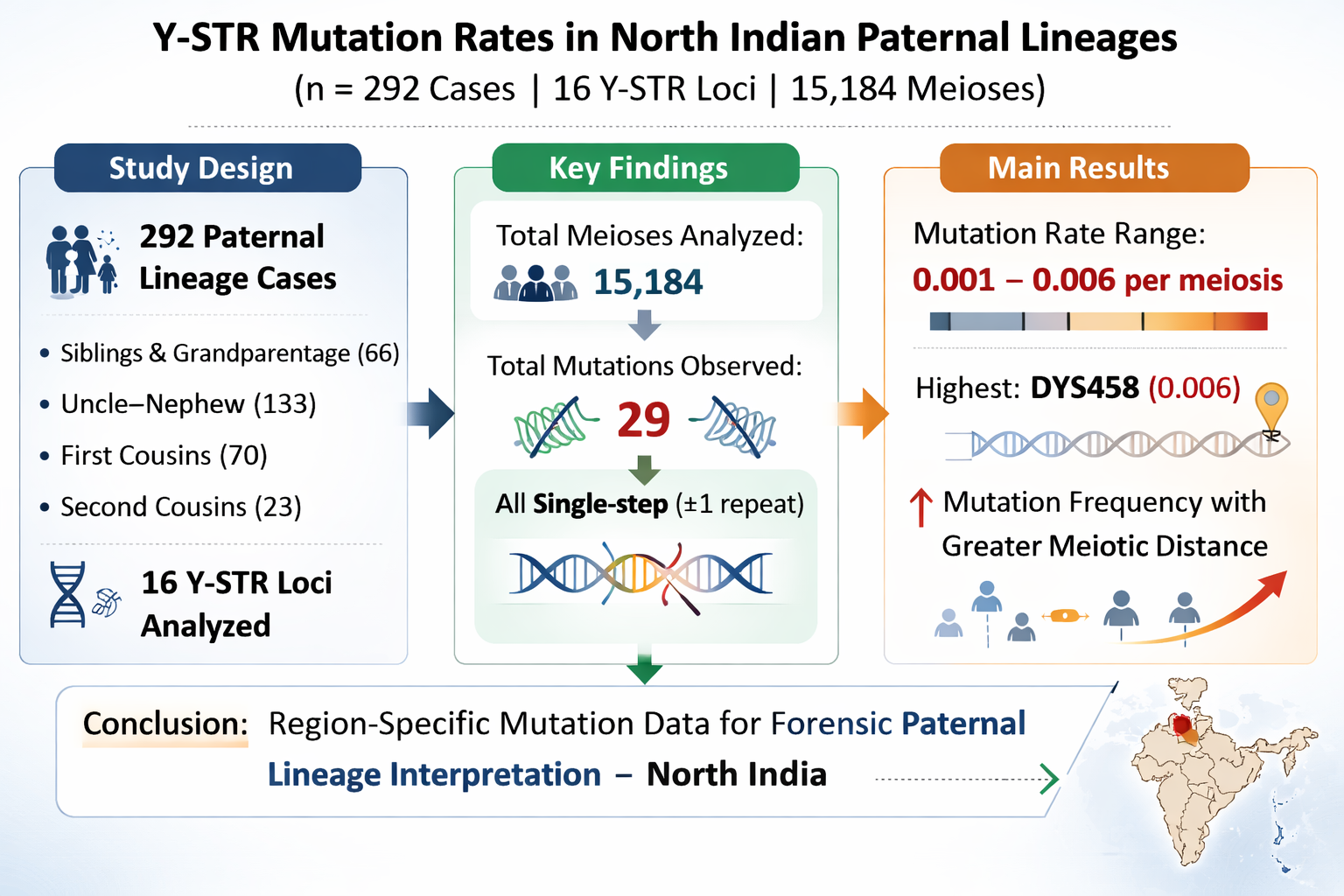
Y-chromosomal short tandem repeats (Y-STRs) are passed from father to son through the male line only. They change very little over generations and are widely used in forensic science and for tracing paternal ancestry. However, mutations at Y-STR loci can complicate relationship analyses, and may result in inaccurate exclusions during father-son or extended paternal lineage testing. . In this preliminary study, we looked for possible Y-STR mutations in 292 cases from the North Indian population. These cases included pairs of siblings, uncles and nephews, first cousins, and second cousins. We found a total of 29 mutations across 11 Y-STR markers out of 16 markers. All mutations were single-step changes consistent with the stepwise mutation model. The highest mutation rates were at DYS458 (0.006) and DYS385 (0.005), while loci such as DYS19, DYS390, and DYS389II had lower rates (0.001). These results align with previous findings on mutation rates at different loci. They also support the observation that Y-STRs with rapid mutations provide better information for distinguishing closely related paternal lineages. Our findings give baseline estimates of mutation rates for the North Indian populace, highlighting the need for population-specific data in forensic work and genealogical research.
Disclaimer: This is not the final version of the article. Changes may occur when the manuscript is published in its final format.