

 ACCESS
Editorial
Volume 1, Article ID: 2025.0006

Amin N. Olaimat
aminolaimat@hu.edu.jo

Department of Clinical Nutrition and Dietetics, Faculty of Applied Medical Sciences, The Hashemite University, P.O. Box 330127, Zarqa 13133, Jordan
Received: 18 Dec 2026 Published: 31 Dec 2025
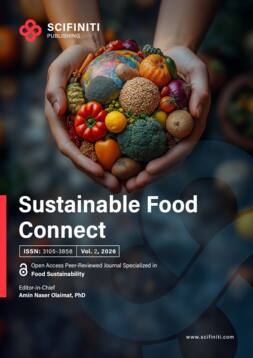
As the Editor-in-Chief, I am delighted to welcome readers, researchers, and practitioners to Sustainable Food Connect, a journal proudly published by Scifiniti. It is an open-access, peer-reviewed journal dedicated to shaping the future of food systems by addressing global food challenges through sustainable and environmentally responsible approaches across the entire value chain, including sustainable production, processing, and consumption practices, the development of commercially viable food products, and the advancement of safe and efficient processing methods. Transformative, science-based solutions are increasingly in demand to address several global issues, such as climate change, resource scarcity, food insecurity, and environmental degradation. The journal Sustainable Food Connect is positioned at the forefront of this mission by offering a platform for cutting-edge research and substantive interdisciplinary dialogue. Sustainable Food Connect promotes an interdisciplinary approach and fosters innovative ideas that integrate agriculture, technology, nutrition, economics, and environmental science. The journal team also hopes to expand on ways to reduce food waste, improve food quality and safety, promote sustainable diets, and strengthen land and livelihood systems, which have been shown to lead primarily to healthier communities. Researchers, academics, policymakers, and industry leaders are all welcome as part of our readership, united by a common goal: advancing scientifically rigorous, socially responsible, and sustainable food practices. The food science discipline is also changing with new technologies, data-based solutions, and increased recognition of sustainability, and our journal has maintained its strict academic principles, transparency, and ethical research practices. We welcome original research, innovative approaches, and practical applications, including studies on new food technologies, creating eco-friendly packaging, enhancing food processing, and analyzing consumer-driven sustainability trends that can lead to global transformation of food systems and help create real-world change. Together, we have the opportunity to shape the future of sustainable food systems and to foster collaborations that extend well beyond traditional academic boundaries. We invite researchers and practitioners to contribute meaningfully to this shared effort towards a more sustainable, equitable, and resilient food future.
Disclaimer/Publisher’s Note: The views expressed in this article are those of the author(s) and do not necessarily reflect the views of the publisher or editors. The publisher and editors assume no responsibility for any injury or damage resulting from the use of information contained herein.
©2025 Copyright by the Authors.
Licensed as an open access article distributed under the terms and conditions of the CC BY 4.0 license