

 ACCESS
Research Article
ACCESS
Research Article
Volume 1, Article ID: 2026.0009

Mohammad Yaghoub Abdollahzadeh Jamalabadi
muhammad_yaghoob@yahoo.com

Department of Marine Engineering, Chabahar Maritime University Chabahar 99717-56499, Iran
Received: 22 Jun 2026 Accepted: 15 Sep 2026 Available Online: 16 Sep 2026
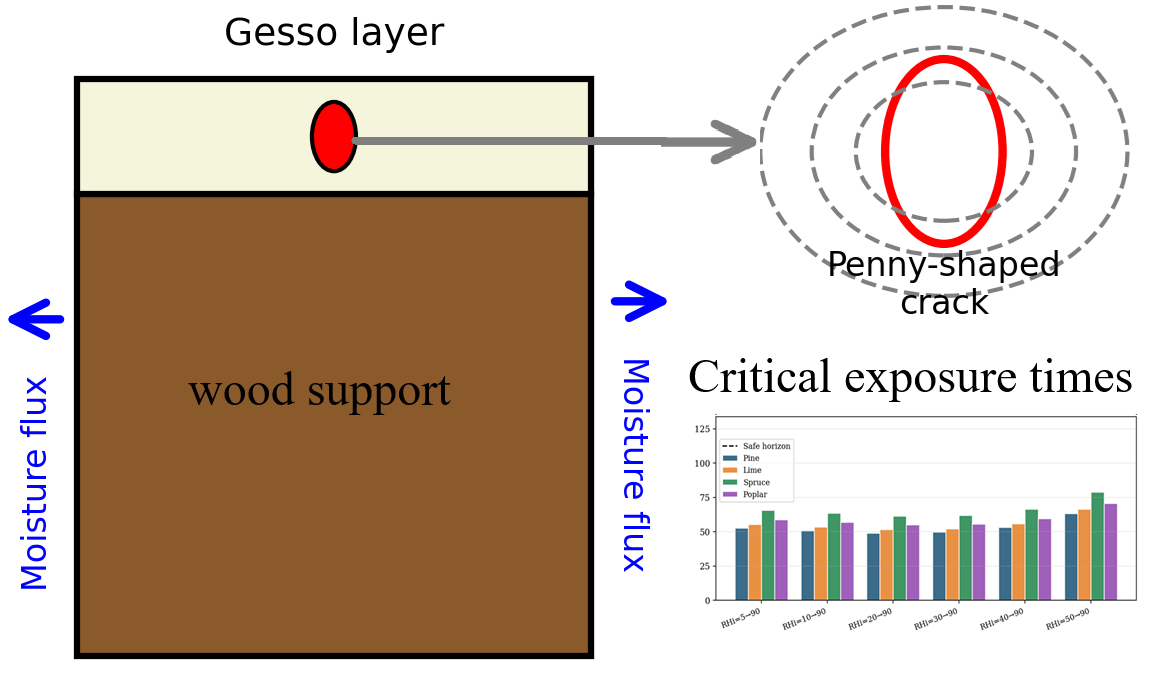
This study presents an analytical framework to predict moisture-induced damage in biosystem composites, using wooden panel paintings as a model system. It brings together a transient diffusion equation, a bilayer hygroscopic stress equation, and a fracture-mechanics evaluation, and from these gets closed-form expressions for the critical exposure time – a quantity that lets one screen durability quickly, without running a simulation each time. For the wood types studied here, hygroscopic expansion coefficients fall between and; the corresponding critical RH thresholds run from 39.1% to 62.9%, and exposure times span 45.4 days (1090 h, the shortest case) up to more than 180 days (the model was checked against data and matched within 3.8% MAPE). A closed-form separation-line criterion is also derived, giving a simple safe/unsafe crack-depth boundary that can be evaluated without re-running the full ASED calculation. Taken together, the results give conservators a way to rank how vulnerable different species are, point toward more eco-friendly material choices, and suggest safe operating conditions that extend service life, cut down on replacement cycles, and help manage conservation resources while keeping energy costs low. Comparison with EN 16893:2018 indicates that its 30–65% RH band is safe for all species studied when objects are kept above 20% RH, but may be insufficient for objects previously stored below 20% RH; we recommend the standard be revised to include species-specific maximum ΔRH limits and an explicit warning for this low-RH scenario.