


 ACCESS
Research Article
ACCESS
Research Article
Volume 1, Article ID: 2026.0003
Guhanathan Selvam
profguhanathan12@gmail.com

Princy Sowmya Ruben
galiate965@gmail.com

Nikila Sambandan
nikilasambandan6363@gmail.com

Harini Selvam
hariniselvam13071999@gmail.com

Kubaib Attar
attar.kubaib@gmail.com

Imran M. Predhanekar
imranpkm@gmail.com

1 Department of Chemistry, Muthurangam Government Arts College (Autonomous), (Affilated to Thiruvalluvar University, Sekadu, Vellore-632 115), Vellore-632002
2 Department of Chemistry, Islamiah College (Autonomous), Vaniyambadi – 653 752, Tamil Nadu, India (Affiliated to Thiruvalluvar University, Serkadu, Vellore-632 115), Tamil Nadu, India
* Author to whom correspondence should be addressed
Received: 13 Mar 2026 Accepted: 26 Jun 2026 Available Online: 26 Jun 2026
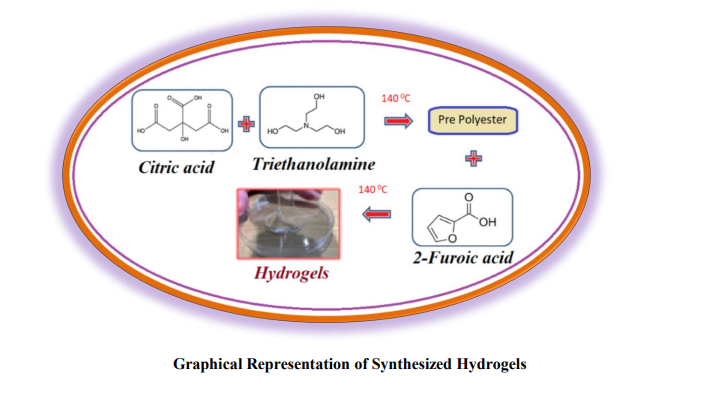
In this work, hydrogels (CA4) were synthesized through an esterification reaction using Citric acid (CA), triethanolamine (TEA), and 2-furoic acid (FA), and subsequently incorporated with nano-ZnO particles to obtain [CA4-ZnO] hydrogels. By evaluating the synthesized [CA4-ZnO] nanocomposite hydrogels using a variety of analytical methods, including UV, FTIR, 1H NMR, 13C NMR, TGA and SEM-EDX. It was confirmed that nano Zinc oxide were incorporated within the CA4 network. Swelling behavior and a pH range of 2.0 to 11.0 were used to closely study the hydrogels properties. As a result, neutral media (pH 7.0) had the highest swelling percentage, compared to acidic and alkaline medium. Swelling equilibrium results significantly improve when nano ZnO concentrations increases. Thermo gravimetric analysis (TGA) showed that the hydrogels of the [CA4-ZnO] nanocomposite were thermally stable up to 300 0C. The Antibacterial studies were carried out with the gram positive bacteria (Staphylococcus aureus, Bacillus subtilis), and Gram negative bacteria (Klebsiella pneumonia, Escherichia coli) shows excellent results in inhibition percentage. The antifungal studies show the lower zone of inhibition. The Cytotoxic studies reveals good percentage of cell viability and antioxidant analysis were also studied which exhibits good zone of inhibition percentage. The optimized hydrogels docking studies revealing that the biological activity has been enhanced with inclusion of nano ZnO in the hydrogels. [CA4-ZnO] nanocomposite hydrogels with the latter protein showed a stronger and more favorable binding to Clumping Factor A. The [CA4-ZnO] nanocomposite hydrogels is capable of overcoming drug resistance and nano zinc oxide based hydrogels had respective anti-bacterial and wound healing properties. Thus, the compounds studied in this work might be useful for tissue engineering, wound healing, and other high-performance uses.
Disclaimer: This is not the final version of the article. Changes may occur when the manuscript is published in its final format.