

 ACCESS
Research Article
ACCESS
Research Article
Volume 1, Article ID: 2026.0007
Julius Gbenga Omosebi
omosebi_jg@fedpolyado.edu.ng

Mercy Kikelomo Omosebi
ainamercykay340@gmail.com

Hawawu Alake Olorunoje
holorunoje@gmail.com

1 Department of Applied Chemistry, The Federal Polytechnic, Ado-Ekiti, Nigeria
2 The National Association of Science and Technology Students (NASTES), Nigeria
3 Department of Science Laboratory Technology, The Federal Polytechnic, Ado-Ekiti, Nigeria
* Author to whom correspondence should be addressed
Received: 27 Mar 2026 Accepted: 30 Jul 2026 Available Online: 31 Jul 2026
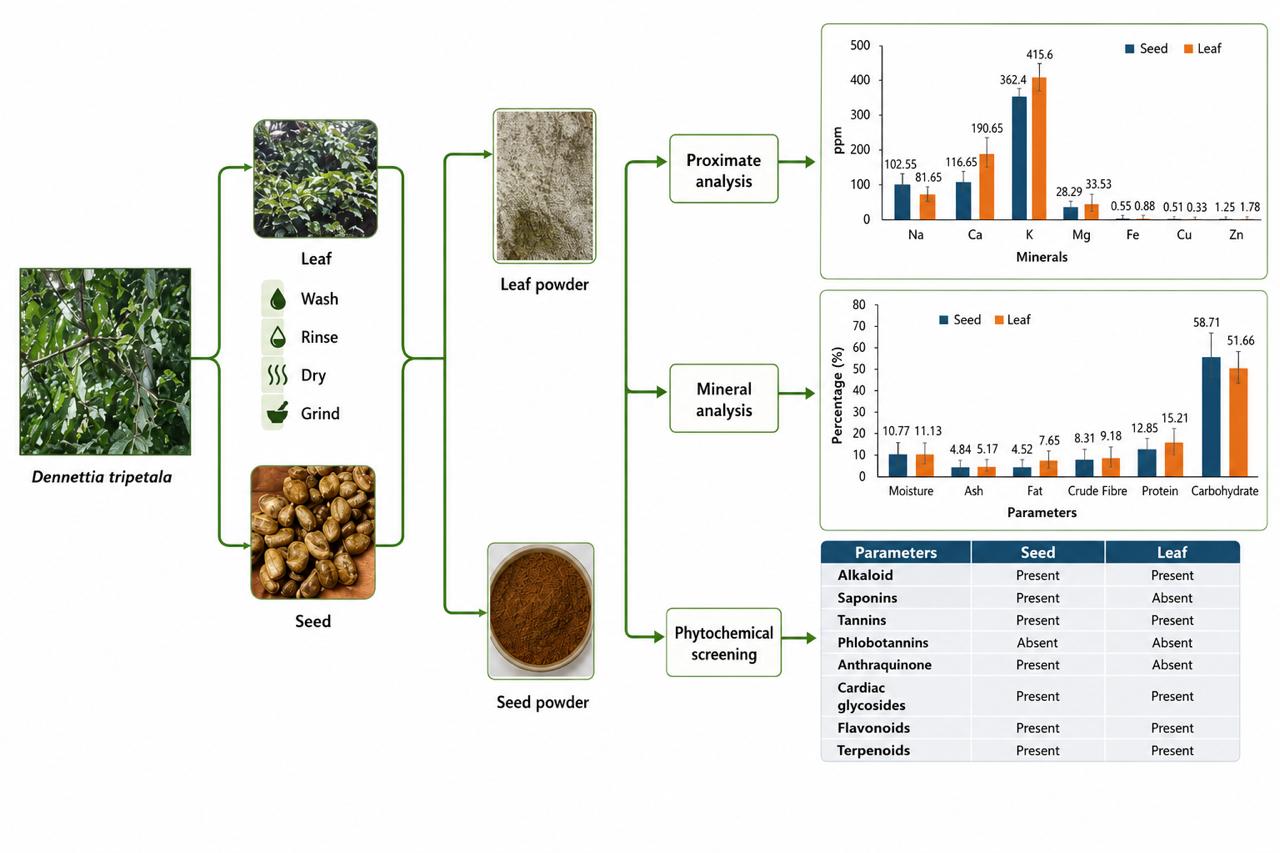
Medicinal herbs and plant foods have been recognized for a long time as a major source of nutrients and bioactive constituents that fight against diseases and promote good health. There is need to explore the nutritional potential and nutraceutical value of plants, hence, this study assesses and compare the nutritional and phytochemical profiles of pepperfruit (Dennettia tripetala) seeds and leaves using standard analytical procedures. The results of the proximate analysis show that the leaves contain moisture 11.13%, ash 5.17%, fat 7.65%, crude fiber 9.18%, protein 15.21% and carbohydrate 51.66% while the seeds show moisture 10.77%, ash 4.84%, fat 4.52%, crude fiber 8.31%, protein 12.85% and carbohydrate 58.71%. Mineral analysis show that the seeds contain potassium (362.40 ppm), Ca (116.65 ppm), sodium (102.55 ppm), magnesium (28.29 ppm), zinc (1.25 ppm), iron (0.55 ppm) and copper (0.51 ppm) while the leaves have potassium (415.60 ppm), Ca (190.65 ppm), sodium (81.65 ppm), magnesium (33.53 ppm), zinc (1.78 ppm), iron (0.88 ppm) and copper (0.33 ppm). The result of phytochemical screening shows that the seeds and leaves contain alkaloids, tannins, flavonoids, terpenoids and cardiac glycosides. However, saponin and anthraquinones were present in the seeds but absent in the leaves while reducing sugar is present only in the leaves. The findings revealed that both the seeds and leaves of Dennettia tripetala contains vital sources of phytochemicals and nutrients. The seeds show a distinct bioactive constituent which mark it therapeutic uses while the leaves show a more equip nutraceutical properties contributing to its nutritional uses. Based on the plants ethnomedicinal uses, this work supports and provide information on the use of Dennetia tripetala parts such as the leaves and seeds in nutritional, pharmacological and health applications.