


 ACCESS
Research Article
ACCESS
Research Article
Volume 2, Article ID: 2026.0026

Usman Aminu
uaminu14@nubapoly.edu.ng

Muhammad Sani Abdulkadir
asmuhd27b@gmail.com

Hussein Muhammed
hmabbasss@gmail.com

Umar Faruk Lawan
umarfaruklawan@kustwudil.edu.ng

1 Department of Mechanical Engineering Technology, School of Engineering Technology, Nuhu Bamalli Polytechnic, Zaria, Nigeria
2 Aliko Dangote University of Science and Technology, Wudil, Kano State, Nigeria
* Author to whom correspondence should be addressed
Received: 03 Dec 2025 Accepted: 07 May 2026 Available Online: 07 May 2026
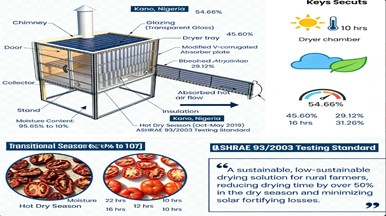
The thermal performance of solar air heaters can be significantly enhanced by changing the shape of the absorber plate, which increases heat transfer surface area and airflow turbulence. This study investigates the seasonal drying performance of a modified V-corrugated solar air heater that uses natural convection for tomato drying in Kano, Nigeria. Experiments were carried out throughout the transitional season (October-November 2019) and the hot dry season (April-May 2021), using ASHRAE 93-2003 testing procedures. The system includes a V-corrugated aluminium absorber panel, an enclosed drying chamber with three trays, and a chimney to improve buoyancy-driven airflow. The results revealed a maximum drying efficiency of 54.66% during the transitional season and shorter drying periods of 10-12 hours during the hot dry season, compared to 16-22 hours in the transitional months. The moisture level fell from 95.65% to 10% across all trials. Higher sun irradiance, decreased relative humidity, and elevated ambient temperatures during the hot dry season considerably improved the drying performance. The redesigned absorber design improved heat transfer and lowered drying time by 70-85% compared to open-sun drying. The technology provides an economical and sustainable post-harvest preservation solution for rural and off-grid areas.
Disclaimer: This is not the final version of the article. Changes may occur when the manuscript is published in its final format.