
 ACCESS
Systematic Scoping Review
ACCESS
Systematic Scoping Review
Volume 2, Article ID: 2026.0027
Timothy Mwewa
mwewatimothy29@gmail.com

Mulala Jimaima
Jimaima20@gmail.com

James Shabiti Mukombwe
james.mukombwe@unza.zm

Yusuf Umer
yusufumer5@gmail.com

Fredrick Kayusi
mg22pu3605021@pu.ac.ke

Petros Chavula
chavulapetros@outlook.com

1 Mukuba University, Itimpi, Kitwe, Copperbelt Province, P.O. Box 20382, Zambia
2 Department of Agricultural Economics and Extension, University of Zambia; Zambia.
3 Department of Agricultural Economics and Extension, School of Agricultural Sciences, University of Zambia, Zambia
4 Department of Natural Resources, College of Agriculture and Environmental Sciences, Haramaya University, P. O. Box 138, Dire Dawa, Ethiopia,
5 Department of Environmental Studies, Geography and Planning, Maasai Mara University, P.O. 861-20500, Narok-Kenya
6 Department of Environmental and Earth Sciences, Pwani University, P.O. 195-80108, Kilifi-Kenya
7 Department of Agricultural Economics and Extension, School of Agricultural Sciences, University of Zambia, P.O. Box 32379, Lusaka, Zambia
8 Africa Centre of Excellence for Climate-Smart Agriculture and Biodiversity Conservation, Haramaya University, Dire Dawa, Ethiopia, Ethiopia
* Author to whom correspondence should be addressed
Received: 10 Aug 2025 Accepted: 30 Jun 2026 Available Online: 01 Jul 2026
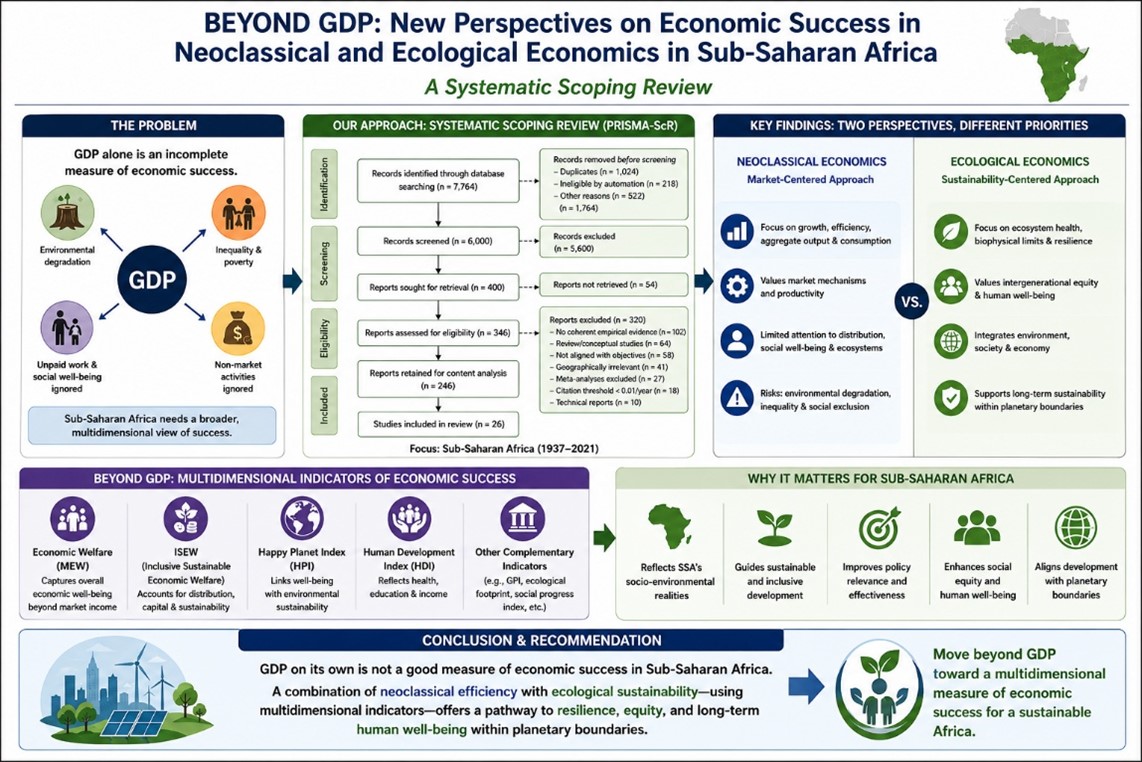
As Sub-Saharan Africa (SSA) faces multiple development challenges, reliance on traditional economic indicators such as Gross Domestic Product (GDP) has been questioned. This study critically examines the limitations of GDP as a measure of financial success. It explores alternative frameworks from neoclassical and ecological economics that may provide more comprehensive insights for sustainable development in SSA. The aim is to compare and assess theoretical and practical views beyond GDP and to propose a multidimensional approach that includes ecological health, social well-being, and economic stability. Methodologically, the study uses a qualitative review and comparative analysis of key literature in both environmental and neoclassical economic schools, concentrating on how each defines success, sustainability, and growth. To study the relevance and applicability to the SSA region, the analysis includes studies only from the SSA to look at the theoretical critiques, empirical trends and case studies. The results show that neoclassical economics highlight more on market efficiency, aggregate output and consumption. Degradation of the environment and socio-economic inequalities are largely ignored. Meanwhile, ecological economics stresses the health of the ecosystem, intergenerational equity, and biophysical limits. These are principles that are important to the SSA’s socio-environment. In conclusion, GDP on its own is not a good measure of economic growth in SSA. A combination of neoclassical and ecological economics is recommended to help economic planning, resilience and policies. In order to allow SSA to be in line with planetary boundaries and human-well-being it is necessary to move beyond GDP as a development metric.
Disclaimer : This is not the final version of the article. Changes may occur when the manuscript is published in its final format.