


 ACCESS
Research Article
ACCESS
Research Article
Volume 3, Article ID: 2026.0036

Gabriel Silva Atencio
gsilvaa468@ulacit.ed.cr

Latin American University of Science and Technology (ULACIT), San José, Costa Rica
Received: 11 Feb 2026 Accepted: 23 Jun 2026 Available Online: 23 Jun 2026
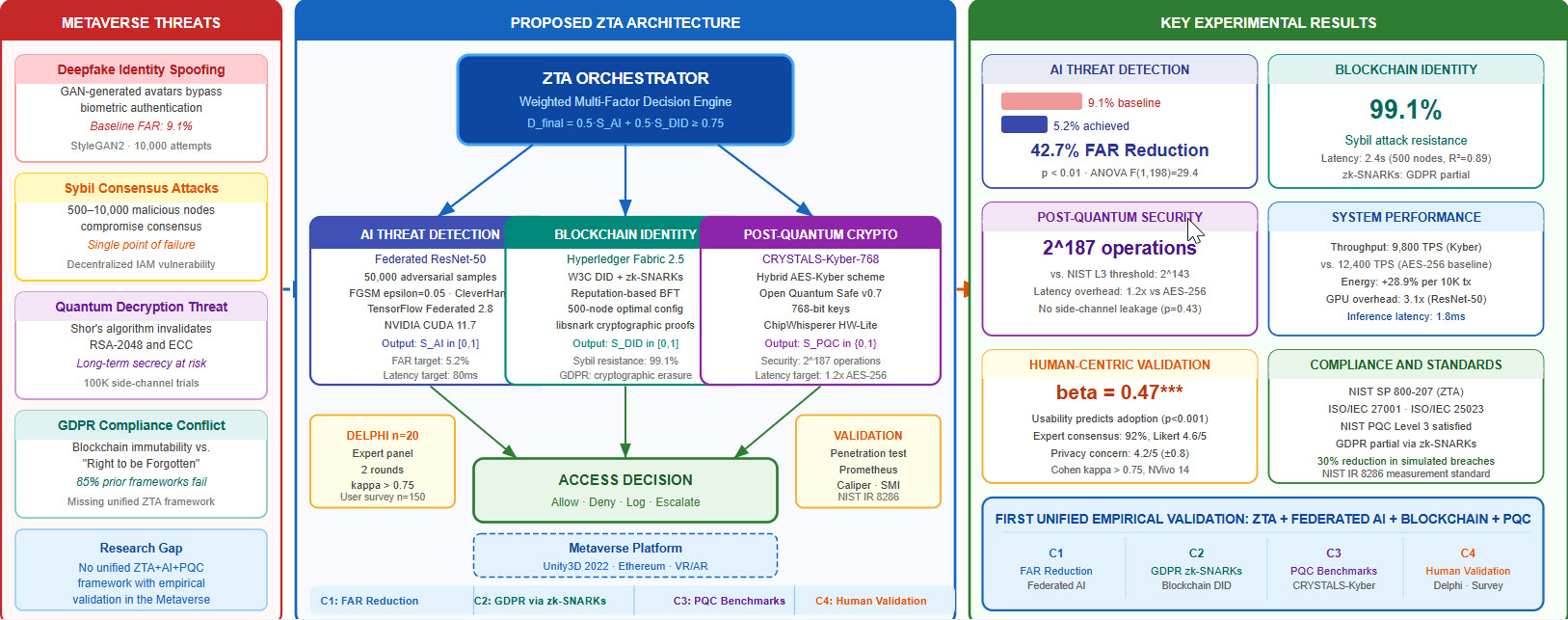
The expansion of the Metaverse presents security risks that conventional perimeter-based protections are unable to mitigate. This research introduces and experimentally substantiates a Zero-Trust Architecture (ZTA) that incorporates a federated ResNet-50 model for anomaly detection, a decentralized identification system based on Hyperledger Fabric using zk-SNARKs, and CRYSTALS-Kyber for quantum-resistant key exchange. The architecture attains a 42.7% decrease in False Acceptance Rate (5.2% compared to a 9.1% baseline, p < 0.01), 99.1% resilience to Sybil attacks, and partial compliance with GDPR using cryptographic erasure proofs. Quantum security is based on the Module-LWE issue, requiring 2187 operations, which surpasses NIST Level 3 standards, and incurs a latency overhead of 1.2 times and an energy consumption increase of 28.9% compared to AES-256. AI inference needs 3.1 times more GPU resources. Four innovative contributions are introduced: Integrated ZTA empirical validation, FAR reduction benchmark, zk-SNARKs for GDPR compliance, and human-centric validation indicating that usability predicts adoption (β = 0.47, p < 0.001). The architecture offers a scalable, experimentally substantiated basis for protecting decentralized virtual environments.
Disclaimer: This is not the final version of the article. Changes may occur when the manuscript is published in its final format.