


 ACCESS
Research Article
ACCESS
Research Article
Volume 3, Article ID: 2026.0038

Miguel Angel Vargas Cruz
miguelangel@grupoalianzaempresarial.com

Grupo Alianza Empresarial, Mexico City, Mexico
Received: 30 Mar 2026 Available Online: 31 Jul 2026
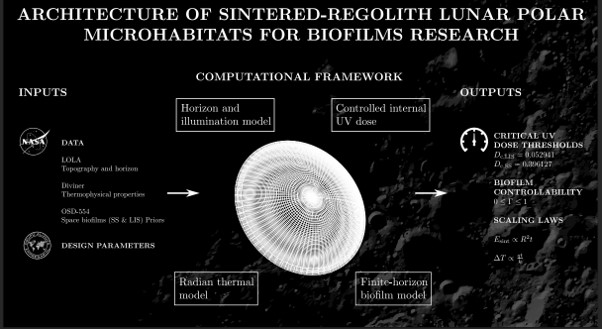
This paper presents a parametric design framework for sintered-regolith microhabitats at the lunar poles and couples it to a reduced model of biofilm attachment, growth, and radiative damage on internal liner materials. The workflow integrates polar illumination geometry derived from Lunar Orbiter Laser Altimeter digital elevation models, regolith thermophysical constraints from Diviner radiometry and sintering studies, and microbiological priors derived from International Space Station datasets, including OSD-554. Spherical-cap shells are parameterized by base radius, rise, and thickness; horizon masks provide fractional illumination; a one-dimensional multilayer spherical-conduction model defines thermal screening variables; and normalized sintering-energy and biofilm-control metrics support multiobjective comparison. The biological model is explicitly treated as a finite-horizon screening model rather than an experimentally calibrated predictor. For the parameter sets used here, the analytical transition from positive to negative net biofilm growth occurs at normalized internal UV doses of approximately 0.396127 for a stainless-steel-like liner and 0.052941 for a liquid-infused-surface-like liner. One-at-a-time perturbations of the biological parameters quantify the uncertainty of these thresholds, while normalized shell-energy scaling shows the expected quadratic dependence on base radius and linear dependence on thickness. The results support relative ranking of materials, sites, and geometries, but not mission-level prediction. Complete source code and execution instructions are provided externally to preserve manuscript readability and reproducibility.
Disclaimer: This is not the final version of the article. Changes may occur when the manuscript is published in its final format.