


 ACCESS
Perspective
ACCESS
Perspective
Volume 2, Article ID: 2026.0018

Ivan Bivolarski
ivanbozhidarov@gmail.com
Chronotherapy and Cancer Research Unit, Oncology Centre, Burgas, Bulgaria
Received: 28 Jun 2026 Available Online: 26 Sep 2026
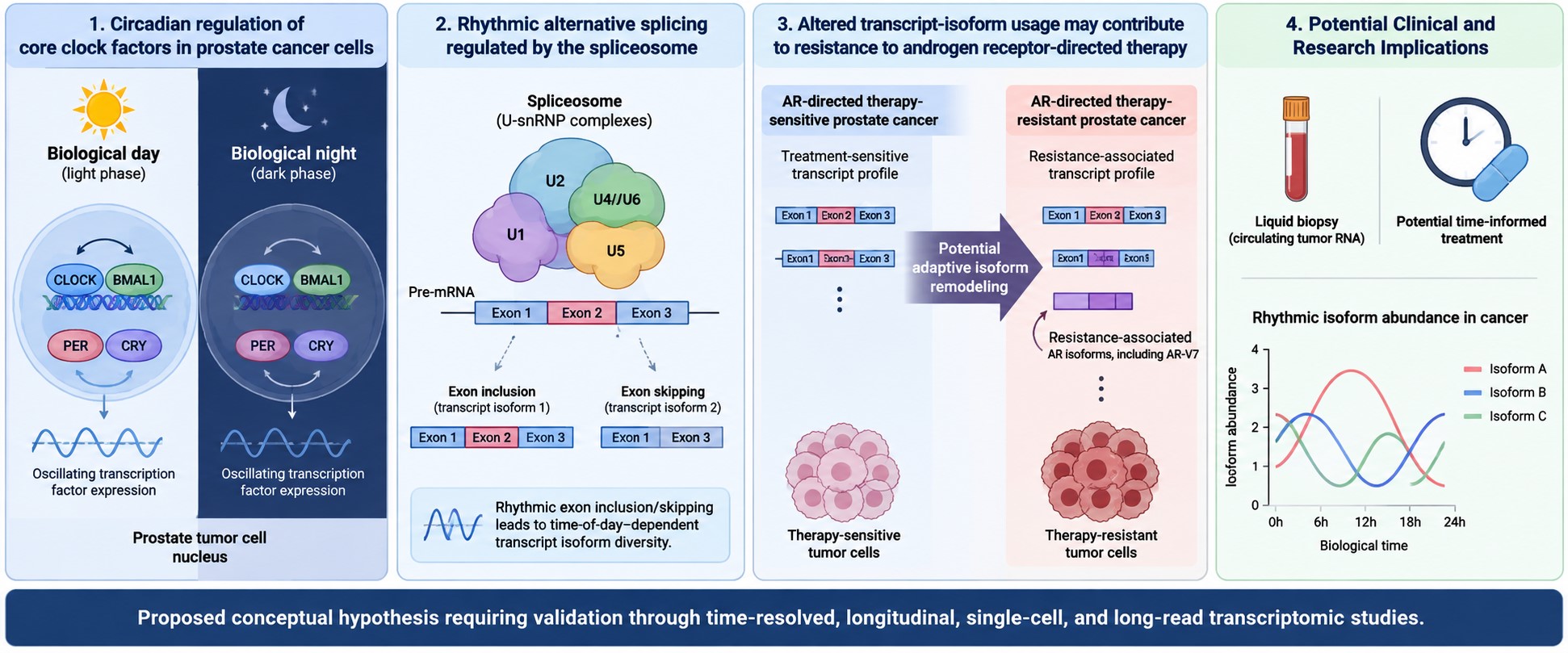
Molecular heterogeneity and therapeutic resistance drive treatment failure in advanced prostate cancer. While alternative splicing and transcript isoform remodeling—epitomized by the resistance-associated androgen receptor variant AR-V7—are critical to this plasticity, the upstream dynamic mechanisms controlling transcript-level diversification remain poorly understood. In this perspective, we propose a novel conceptual framework: the circadian–spliceosome axis. We hypothesize that core circadian networks (including BMAL1, CLOCK, PER, and CRY) act as higher-order temporal organizers that actively modulate RNA-processing machinery, enabling tumor cells to dynamically explore non-genetic, adaptive transcriptomic states under therapeutic pressure. Validating this temporal dimension requires integrating long-read sequencing, single-cell transcriptomics, and longitudinal sampling. Formalizing the circadian–spliceosome axis will expand current models of non-genetic tumor adaptation and open new avenues for chronobiology-informed precision oncology to disrupt resistance phenotypes before they become immutable.
Disclaimer: This is not the final version of the article. Changes may occur when the manuscript is published in its final format.