

 ACCESS
Research Article
ACCESS
Research Article
Volume 3, Article ID: 2026.0017

Soumi Das
iammandovi@gmail.com

Independent Researcher, East Burdwan, West Bengal, 713103, India
Received: 09 Dec 2025 Accepted: 13 Apr 2026 Available Online: 13 Apr 2026
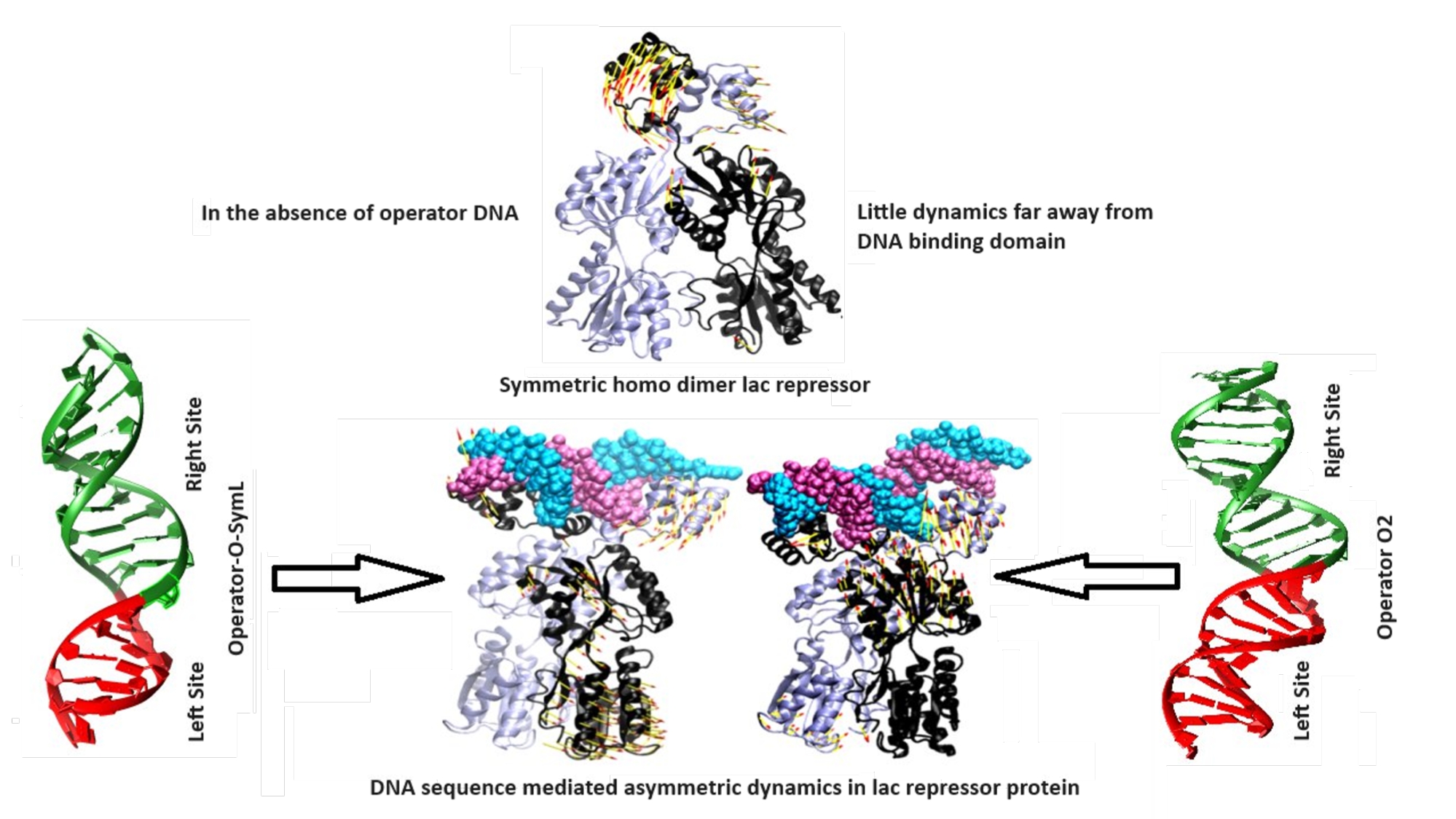
DNA recognition by transcription factors is governed not only by binding affinity but also by sequence-encoded modulation of protein dynamics. Quantitative analysis of residue-specific conformational thermodynamics using side-chain torsion angle histograms derived from molecular dynamics simulations and principal component analysis demonstrates that symmetric Lactose repressor (LacI) protein exhibits operator-specific conformational redistribution upon binding to natural lac operator O2 and synthetic lac operator O-SymL sequences. Operator O2 binding is associated with enhanced conformational entropy in the N- and C- terminal regions, while operator O-SymL binding promotes localized conformational stabilization. Protein dynamics are differentially modulated by polar and hydrophobic amino acid residues with sequence-dependent asymmetry mediated by DNA. Binding to either operator stabilizes residues at the DNA-binding interface, whereas distal core sub-domains retain sequence-dependent conformational landscape remodelling, resulting in unequal monomeric dynamics and functional non-equivalence of structurally identical subunits, a hallmark of sequence-dependent allosteric propagation through the LacI protein scaffold. These findings establish a thermodynamic model illustrating how different DNA sequences modulate the conformational ensemble of the transcription factor thereby tuning transcription regulation beyond the static binding affinity. Such sequence-dependent asymmetric recognition of operator sites provides a mechanistic basis for stabilization of gene regulatory networks through different energetic and dynamic coupling, with broad implications for synthetic circuit design, and the development of allosteric modulators targeting protein-nucleic acid complexes and protein-ligand complexes, potentially increasing the success rate of drug discovery for “undruggable” targets.
Disclaimer: This is not the final version of the article. Changes may occur when the manuscript is published in its final format.