
 ACCESS
Research Article
ACCESS
Research Article
Volume 3, Article ID: 2026.0018
William Yustian
yustianwilliamresearch@yahoo.com

Marvel Reuben Suwitono
rsuwitono@unai.edu

Titin Sulastri
titin.sulastri@unai.edu

1 Department of Pharmacy, Universitas Advent Indonesia, Bandung 40559, Indonesia
2 Department of Biology, Universitas Advent Indonesia, Bandung 40559, Indonesia
* Author to whom correspondence should be addressed
Received: 26 Dec 2025 Accepted: 08 May 2026 Available Online: 09 May 2026
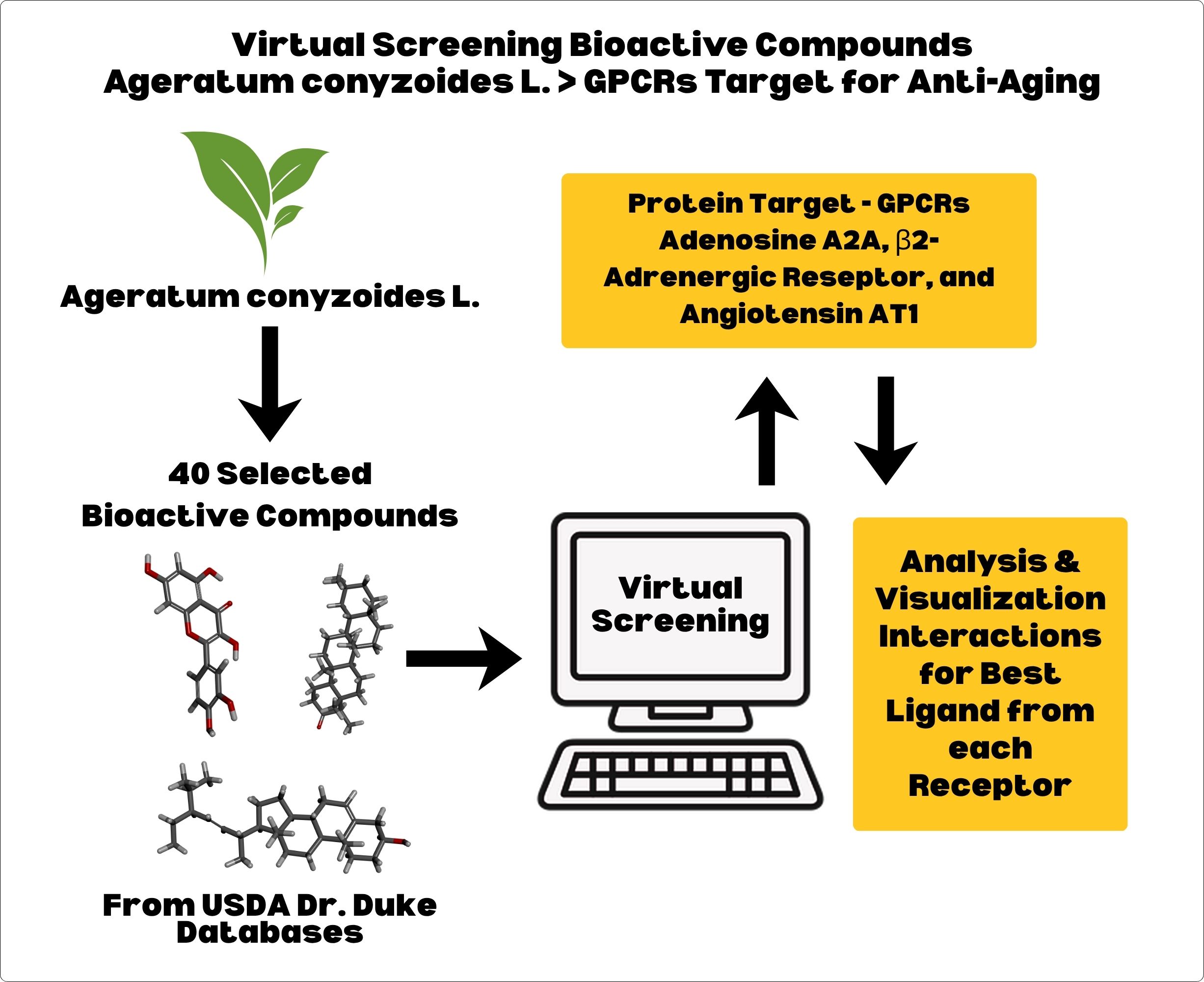
Aging is a complex biological process impacted by genetic, environmental, and lifestyle variables. Natural bioactive chemicals are becoming recognized as possible anti-aging agents, and Ageratum conyzoides is a medicinal herb rich in flavonoids, terpenoids, and sterols. In this study, bioactive compounds from Ageratum conyzoides that target GPCRs associated with aging mechanisms were investigated using computational methods. Using molecular docking, forty phytochemicals were evaluated against the beta-2 adrenergic, angiotensin AT1 receptor, and adenosine A2A receptors. Strong binding affinities were shown by several substances, including quercetin-3,7-diglucoside (-10.0 kcal/mol), friedelin (-9.0 kcal/mol), and stigmasterol (-10.3 kcal/mol). These results imply that prospective ligands for GPCR regulation in aging-related pathways are present in Ageratum conyzoides. To verify biological significance, additional validation using molecular dynamics and experimental testing is needed.
Disclaimer: This is not the final version of the article. Changes may occur when the manuscript is published in its final format.