

 ACCESS
Perspective
ACCESS
Perspective
Volume 2, Article ID: 2026.0010
FAJER AL-AITTAN
f.alaittan@meu.edu.jo

Batool Khataybeh
khataibehbatool@gmail.com

1 Middle East University, Amman, Jordan
2 Department of Nutrition and Food Technology, Faculty of Agriculture, Jordan University of Science and Technology, Irbid 22110, Jordan
* Author to whom correspondence should be addressed
Received: 17 Nov 2025 Accepted: 08 May 2026 Available Online: 09 May 2026
This article is part of the Special Issue Exploration and Application of Natural Antimicrobial Agents and Bio-Preservatives in Food Products for Enhanced Safety and Shelf Life
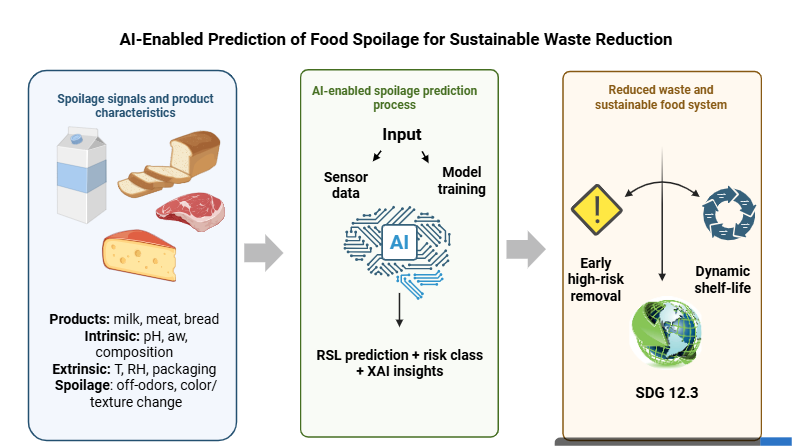
A major barrier for developing a sustainable food system is food spoilage as it leads to the loss of valuable resources, economic loss, and contributes to avoidable emissions. Traditional methods of detecting food spoilage are predominantly retrospective which confirming the food deterioration after it has already occurred. However, the purpose of this editorial is to explain a prescriptive framework to use AI-enabled monitoring of food spoilage through the application of microbiology and machine learning in order to identify trends of deterioration, establish remaining shelf life (RSL), and enable local accountability and accessibility to influence food loss and climate-mitigation efforts. Therefore, rather than replacing traditional microbiological methods, this prescriptive framework is meant to serve as an intelligent decision-support tool for producers, enabling them to produce food with a higher quality and less waste.
Disclaimer: This is not the final version of the article. Changes may occur when the manuscript is published in its final format.