

APA Style
Javier Burgos-Salcedo . (2026). Characterizing Immunodeficiencies Using Entropy Phase Transitions as Signatures of the Status of the Immune System. Cell Therapy & Engineering Connect, 2 (Article ID: 0008). https://doi.org/10.69709/CTEC.2025.107655MLA Style
Javier Burgos-Salcedo . "Characterizing Immunodeficiencies Using Entropy Phase Transitions as Signatures of the Status of the Immune System". Cell Therapy & Engineering Connect, vol. 2, 2026, Article ID: 0008, https://doi.org/10.69709/CTEC.2025.107655.Chicago Style
Javier Burgos-Salcedo . 2026. "Characterizing Immunodeficiencies Using Entropy Phase Transitions as Signatures of the Status of the Immune System." Cell Therapy & Engineering Connect 2 (2026): 0008. https://doi.org/10.69709/CTEC.2025.107655.
ACCESS
Research Article
Volume 2, Article ID: 2026.0008

Javier Burgos-Salcedo
jdariob@sanmateo.edu.co
1 Facultad de Ingeniería, Fundación Universitaria San Mateo, 111411 Bogotá, Colombia
2 Research Department, Corporación para la Investigación y la Innovación-CIINAS, 251201 Bogotá, Colombia
Received: 27 Jul 2025 Accepted: 28 Dec 2025 Available Online: 29 Dec 2025 Published: 16 Jan 2026
Determining the fitness status of the immune system is one of the central challenges of modern biomedical sciences, given its close association with aging and immunosenescence. Currently, no universally accepted metric allows for determining whether an individual’s immune system is competent, nor the extent to which it is competent across different pathologies. In the present study, a model of complex adaptive networks is developed, in which nodes represent the eleven principal immune cell types, focused on the phase transitions of entropy to distinguish the optimal functioning of the immune network in contrast to what occurs in cases of immunodeficiency states, both primary and secondary. The results of the dynamic simulation indicate distinct profiles between the immunocompetent and immunodeficient states of the immune system. They further provide evidence regarding the condition of the complex immune network and its internal connectivity, suggesting the existence of aging-related patterns in immune response effector networks. This entropy-based approach offers a quantitative, holistic assessment of immune status with potential applications in AI-driven diagnostic systems, disease monitoring, and personalized immunomodulatory therapies.
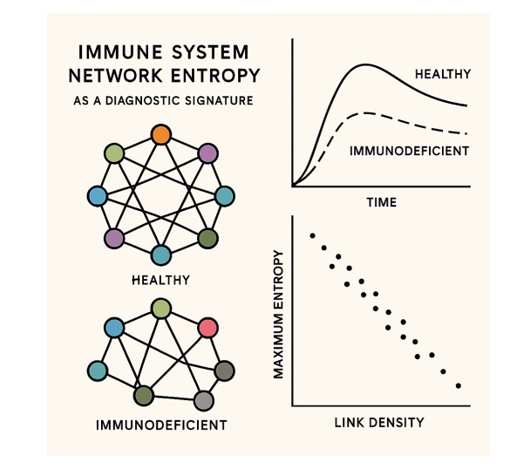
What characterizes an optimal immune response? The most common answer is that it effectively controls infections, prevents the development of cancer, and avoids diseases associated with immune hyperreactivity, such as allergies or autoimmune disorders. Conversely, suboptimal immune function may result in disease due to the weakness or absence of adequate immune response capacity [1]. However, this response characterizes immunocompetence by its results, even without understanding how it fully works. On the other hand, the development and application of efficient vaccines allow us to understand that a protective immune response can be induced by biotechnological means [2], which, although it is a considerable advance in terms of human well-being and health, still leads us to consider the action of the immune system from a totally empirical perspective [3]. Moreover, because the monitoring of vaccine action focuses on measuring the cells and molecules that mediate the immune response [4,5], this strategy, although highly impactful, has contributed only limited insight into the global mechanisms underlying the establishment of immune fitness. Theoretical approaches that represent the immune system as a social network [6], a complex adaptive system [7], or an information transmission network [8] have enabled, through the use of mathematical models of finite graphs [9,10], the application of fundamental concepts from information theory to the study of biological networks [11]. In particular, the idea of entropy has emerged as a potential indicator of human health status [12], suggesting the presence of immune disorders [13], the progression of a disease [14], or even the prediction of future disease [15]. The determination of the total mass, number and distribution of the eleven central cell types that make up the human immune system [16] generates essential information to carry out new quantitative models of the dynamics of immune networks as complex adaptive networks, as is the case of this work in which the basic immune network is represented as a connected graph of eleven nodes whose evolution is modeled using ordinary differential equations and system dynamics approaches [17]. Finally, entropy has a solid conceptual foundation in characterizing the state of biological networks. Its applications in ecology [18,19] have shown that entropy phase transitions can reveal critical changes in natural ecosystems [19]. General methods also exist for detecting phase transitions in complex evolutionary networks [20,21]. Building on these insights, we propose an approach to characterize and measure the transition dynamics of the entropy phase associated with an optimal immune system. This approach can also capture transitions linked to primary and secondary immunodeficiency states. These considerations highlight the usefulness of such theoretical frameworks in biomedicine [22,23] and the application of information theory to the study of complex networks [24]. Systematic simulation of primary immunodeficiencies, which are genetic defects affecting specific immune components, and secondary immunodeficiencies, which are acquired conditions that compromise immune function, demonstrates that entropy phase transitions can serve as distinctive signatures for different immunological states. This approach establishes a quantitative framework that integrates artificial intelligence systems with automated immune repertoire analysis and enhances the assessment and management of immunological health in clinical settings.
2.1. Complex Adaptive Network Model Based on the premise that the immune system is a complex network, a computational model was developed incorporating the eleven major human immune cell types [16]: T lymphocytes, B lymphocytes, natural killer cells, basophils, eosinophils, neutrophils, mast cells, macrophages, monocytes, plasma cells, and dendritic cells. The model was structured according to Treur’s formalism for network analysis [17], with each cell type represented as a node in the network (See Supplementary Data Table S1 for details). The healthy immune system was modeled as an optimal immune fitness state characterized by the dynamic interactions of eleven major immune cell populations organized in a fully connected network under normal physiological conditions. The key assumptions of the model are as follows: The immune network is fully connected in its optimal state, with each cell population potentially interacting with all the others. Each cell population grows logistically once stimulated by an antigen. Growth parameters are based on physiological carrying capacities derived from empirical data on human immune cell proportions. Mortality rates vary between cell populations based on known lifespans. It is important to note that the current model does not explicitly distinguish between naive and antigen-induced (activated) immune cells. Entropy values may vary depending on the state of activation. This distinction represents an important direction for future refinement of the model. Currently, theoretical tools exist for measuring the entropy of complex networks [24]. In addition, some models allow their numerical representation and dynamic simulation using role matrices and differential equations [17]. Since the immune system is a complex network [6] and, for the first time, eleven major types of immune cell populations have been rigorously quantified [16], a complex adaptive network model was developed following Treur’s formalism (see Supplementary Data Figure S1 for details). The model assumes a connected network in which each cell population grows logistically once stimulated by any antigen (see Supplementary Data Table S2 for details). The function parameters, carrying capacity (K) and mortality rate (MR), were obtained from [16] and [25], respectively. Interaction strength (Wint) was derived from [26]. Dynamic simulation of the immune network was performed using the following combination function (CF): 2.2. Entropy Calculation Network entropy (S) was calculated using Shannon’s information entropy formula, 2.3. Network Density Analysis Link density (edge density) was measured as the ratio of existing links (m) to the total number of possible links. For a network of N nodes, the network link density is The (maximal) link density D of a completely connected network is 1. 2.4. Simulating Immunodeficiencies Primary and secondary immunodeficiencies were modeled by systematically modifying the network structure, eliminating nodes (Xi), and reducing their connections as described in Supplementary Data Table S3. These modifications follow the well-known clinical processes underlying these diseases [27-30].
The results of this work include the determination of the entropy phase transition for the state of immunocompetence, and in primary and secondary immunodeficiencies. 3.1. Immune Fitness The study begins by simulating the optimal immune network, modeling the interactions among eleven key immune cell populations, including T lymphocytes, B lymphocytes, and natural killer cells. The dynamic simulation was performed on an optimal immune network in which the eleven main immune cell populations exhibit logistic growth, with K and MR parameters set to values typical of normal immune responses in healthy individuals. The resulting pattern is shown in Figure 1A. The entropy phase change associated with the optimal immune response state is presented in Figure 1B and can be characterized as a three-phase pattern as described below: Stage 1: Network Activation (0 ≤ t ≤ t1) Rapid increase in entropy Resource allocation and path development Network startup or traffic surge response Stage 2: Coordination (t1 ≤ t ≤ t2) Entropy decreases as optimal flows established Route convergence and load balancing Efficient resource utilization patterns emerge Stage 3: Stabilization (t ≥ t2) Stable entropy representing steady-state operation Established traffic patterns and resource allocation Network maintains responsiveness to changes This entropy signature encapsulates the dynamic interplay of activation, regulation, coordination, and stabilization, as well as memory consolidation, in a healthy immune system. 3.2. Immunodeficiencies The behavior of phase transitions of entropy in primary and secondary immunodeficiencies and the connectivity condition is presented, respectively, in Figure 2 and Figure 3. The results indicate that entropy analysis is sensitive to detecting immune dysfunctions, linking changes in entropy dynamics with changes in immune network connectivity. 3.3. Aging Property In Figure 4 a power law relationship between connection density (D) and maximum entropy (Smax) is presented, with an exponent of 0.4349, resembling what is known as “aging property,” suggesting that immunodeficient networks lose their scale-free properties, becoming more homogeneous and less capable of forming preferential connections.
The results indicate that entropy phase transitions can differentiate between immunocompetence and immunodeficiency status of the immune network. The entropy patterns observed in optimal immune networks likely correspond to key immunological events: initial activation and expansion, coordination of specific effector responses, and maintenance of memory, aligning with current understanding of immune response kinetics [31]. The aging property provides insight into the structural basis of immune network dysfunction [32,33], explaining why immunodeficiencies often impact multiple immune functions beyond the primary defect. The network loses its ability to compensate through alternative pathways [34,35]. By contrast, the human immune system exhibits scale-free properties in its optimal state [36-40], showing highly connected “hub” nodes and many sparsely connected ones, a topology that confers robustness and efficiency [41]. The finding that immunodeficient networks lose these scale-free properties and become “more homogeneous” suggests a fundamental shift away from this optimal, robust architecture. Homogenization implies that the distinction between highly connected hubs and less connected nodes diminishes [42]. This approach offers several advantages over traditional immunological assessments. It provides holistic measures that integrates multiple immune parameters, captures dynamic properties of the immune response rather than static measurements, and establishes quantitative relationships between network structure and function. Considering the limitations of our study, first, the model assumes logistic growth dynamics for all cell populations, oversimplifying the complex immune kinetics [43]. Second, the model does not account for spatial factors in immune cell interactions [44], nor does it differentiate connection weights between cell types based on signaling strength or type. On the other hand, clinical validation is paramount from a translational perspective; without empirical data from human patients, the model remains a theoretical framework, emphasizing the crucial next step of bridging computational predictions with real-world clinical observations, which is essential for establishing diagnostic and prognostic utility and advancing computational biology into clinical practice. Although the present study focuses on immunodeficiencies, entropy-based signatures have the potential to distinguish between different types of infections. Moreover, interindividual variability is a critical factor in immune system modeling. In future research, enabling the model to be more robust in capturing individualized immune dynamics, wherein advanced computing and AI tools such as deep learning, probabilistic, hybrid models, and the use of supercomputing resources to perform advanced simulations of biological systems can now be applied to demystify the complexity of the human immune system [45,46]. For instance, deep learning approaches are required to estimate parameter values for immune age, which are strongly correlated with multimorbidity, inflammatory markers, immune senescence, frailty, and cardiovascular aging. Lastly, the ability to decode and harness the power of the human immune system is one of the great frontiers of biomedicine. The immune system represents a complex network of genes, proteins, cells, and tissues, a billion or more times larger than the entire human genome. It differs among individuals and changes over time because a wide range of factors, including age, genetics, and environmental influences, affect it.
AI
Artificial Intelligence
AIDS
Acquired Immune Deficiency Syndrome
BAS
Basophils
B-Cells
B-Lymphocytes
CGD
Chronic Granulomatous Disease
CF
Combination Function
DC
Dendritic Cells
DGS
DiGeorge Syndrome
D
Link Density
EOS
Eosinophils
HIV
Human Immunodeficiency Virus
K
Carrying Capacity
MA
Macrophages
MAST
Mastocytes
MO
Monocytes
MR
Mortality Rate
NEU
Neutrophils
NK
Natural Killer Cells
PC
Plasmatic Cells
S
Shannon’s Entropy
Smax
Maximum Entropy
SCID
Severe Combined Immunodeficiency
T-Cells
T-Lymphocytes
Wint
Interaction Strength
X1–X11
Model Variables for Immune Cell Populations (see Supplementary Table S1)
XLA
X-linked Agammaglobulinemia
The author is solely responsible for conceptualization, methodology, software, validation, formal analysis, investigation, resources, data curation, visualization, writing—original draft preparation, and writing—review and editing. The author has read and approved the published version of the manuscript.
Data supporting the results of this study are available upon request from the corresponding author.
Ethical committee approval was not required for this work because it involves a theoretical and computational immune network model developed using parameters derived from previously published literature, without the use of human or animal subjects, identifiable data, or clinical samples.
The author declares no conflicts of interest.
The study did not receive any external funding and was conducted using only institutional resources.
The author acknowledges Corporación CIINAS and Fundación Universitaria San Mateo for providing their research facilities and resources.
Claude AI was employed solely to carry out stylistic corrections in the text. The graphical abstract was generated using Copilot.
Download Supplementary Materials Figure S1 and Tables S1-S3 here.
[1] Vester, J.C.; Kraneveld, A.D.; Garssen, J. The Assessment of Immune Fitness. J. Clin. Med. 2023, 12, 22. [CrossRef]
[2] Laupèze, B.; Del Giudice, G.; Doherty, M.T.; Van der Most, R. Vaccination as a Preventative Measure Contributing to Immune Fitness. npj Vaccines 2021, 6, 93. [CrossRef]
[3] Stroncek, D.F.; Butterfield, L.H.; Cannarile, M.A.; Dhodapkar, M.V.; Greten, T.F.; Grivel, J.C.; Kaufman, D.R.; Kong, H.H.; Korangy, F.; Lee, P.P.; et al. Systematic Evaluation of Immune Regulation and Modulation. J. Immunother. Cancer 2017, 5, 21. [CrossRef]
[4] Kohrt, H.E.; Nouri, N.; Nowels, K.; Johnson, D.; Holmes, S.; Lee, P.P. Profile of Immune Cells in Axillary Lymph Nodes Predicts Disease-Free Survival in Breast Cancer. PLoS Med. 2005, 2, e284. [CrossRef] [PubMed]
[5] Tvedt, T.H.; Rye, K.P.; Reikvam, H.; Brenner, A.K.; Bruserud, O. The Importance of Sample Collection When Using Single Cytokine Levels and Systemic Cytokine Profiles as Biomarkers—A Comparative Study of Serum versus Plasma Samples. J. Immunol. Methods 2015, 418, 19–28. [CrossRef]
[6] Rieckmann, J.C.; Geiger, R.; Hornburg, D.; Wolf, T.; Kveler, K.; Jarrossay, D.; Sallusto, F.; Shen-Orr, S.S.; Lanzavecchia, A.; Mann, M.; et al. Social Network Architecture of Human Immune Cells Unveiled by Quantitative Proteomics. Nat. Immunol. 2017, 18, 583–593. [CrossRef]
[7] Burgos-Salcedo, J. A Memory Evolutive System-Model of Immunocompetence with Applications to SARS-CoV-2. Sch. Acad. J. Biosci. 2022, 10, 77–84. [CrossRef]
[8] Burgos-Salcedo, J. Immune Network Operations in COVID-19. Explor. Immunol. 2022, 2, 572–580. [CrossRef]
[9] Yue, X.; Wang, Z.; Huang, J.; Parthasarathy, S.; Moosavinasab, S.; Huang, Y.; Lin, S.M.; Zhang, W.; Zhang, P.; Sun, H. Graph Embedding on Biomedical Networks: Methods, Applications and Evaluations. Bioinformatics 2020, 36, 1241–1251. [CrossRef]
[10] Bergthaler, A.; Menche, J. The Immune System as a Social Network. Nat. Immunol. 2017, 18, 481–482. [CrossRef]
[11] Hong, R.; Tong, Y.; Liu, H.; Chen, P.; Liu, R. Edge-Based Relative Entropy as a Sensitive Indicator of Critical Transitions in Biological Systems. J. Transl. Med. 2024, 22, 333. [CrossRef]
[12] Wang, L.; Whittemore, K.; Johnston, S.A.; Stafford, P. Entropy is a Simple Measure for the Antibody Profile and is an Indicator of Health Status: A Proof of Concept. Sci. Rep. 2017, 7, 18060. [CrossRef]
[13] Melis, M.; Littera, R.; Cocco, E.; Frau, J.; Lai, S.; Congeddu, E.; Ragatzu, P.; Serra, M.; Loi, V.; Maddi, R.; et al. Entropy of Human Leukocyte Antigen and Killer-Cell Immunoglobulin-Like Receptor Systems in Immune-Mediated Disorders: A Pilot Study on Multiple Sclerosis. PLoS ONE 2019, 14, e0226615. [CrossRef] [PubMed]
[14] Zhong, J.; Tang, H.; Huang, Z.; Chai, H.; Ling, F.; Chen, P.; Liu, R. Uncovering the Pre-Deterioration State during Disease Progression Based on Sample-Specific Causality Network Entropy (SCNE). Research 2024, 7, 0368. [CrossRef]
[15] Yan, J.; Li, P.; Li, Y.; Gao, R.; Bi, C.; Chen, L. Disease Prediction by Network Information Gain on a Single Sample Basis. Fundam. Res. 2023, 5, 215–227. [CrossRef]
[16] Sender, R.; Weiss, Y.; Navon, Y.; Milo, I.; Azulay, N.; Keren, L.; Fuchs, S.; Ben-Zvi, D.; Noor, E.; Milo, R. The Total Mass, Number, and Distribution of Immune Cells in the Human Body. Proc. Natl. Acad. Sci. USA 2023, 120, e2308511120. [CrossRef] [PubMed]
[17] Treur, J. Analysis of a Network’s Asymptotic Behavior via Its Structure Involving Its Strongly Connected Components. Netw. Sci. 2020, 8, S82–S109. [CrossRef]
[18] del Jesus, M.; Foti, R.; Rinaldo, A.; Rodriguez-Iturbe, I. Maximum Entropy Production, Carbon Assimilation, and the Spatial Organization of Vegetation in River Basins. Proc. Natl. Acad. Sci. USA 2012, 109, 20837–20841. [CrossRef]
[19] Tirabassi, G.; Masoller, C. Entropy-Based Early Detection of Critical Transitions in Spatial Vegetation Fields. Proc. Natl. Acad. Sci. USA 2023, 120, e2215667120. [CrossRef]
[20] Znaidi, M.R.; Sia, J.; Ronquist, S.; Rajapakse, I.; Jonckheere, E.; Bogdan, P. A Unified Approach of Detecting Phase Transition in Time-Varying Complex Networks. Sci. Rep. 2023, 13, 17948. [CrossRef]
[21] Dorogovtsev, S.; Mendes, J.F. Evolution of Networks. Adv. Phys. 2002, 51, 1079–1187. [CrossRef]
[22] Wu, J.W.; Patterson-Lomba, O.; Novitsky, V.; Pagano, M. A Generalized Entropy Measure of Within-Host Viral Diversity for Identifying Recent HIV-1 Infections. Medicine 2015, 94, e1865. [CrossRef]
[23] Asti, L.; Uguzzoni, G.; Marcatili, P.; Pagnani, A. Maximum-Entropy Models of Sequenced Immune Repertoires Predict Antigen-Antibody Affinity. PLoS Comput. Biol. 2016, 12, e1004870. [CrossRef]
[24] Freitas, C.G.S.; Aquino, A.L.L.; Ramos, H.S.; Frery, A.C.; Rosso, O.A. A Detailed Characterization of Complex Networks Using Information Theory. Sci. Rep. 2019, 9, 16689. [CrossRef]
[25] Yanes, R.E.; Gustafson, C.E.; Weyand, C.M.; Goronzy, J.J. Lymphocyte Generation and Population Homeostasis throughout Life. Semin. Hematol. 2017, 54, 33–38. [CrossRef]
[26] Subramanian, N.; Torabi-Parizi, P.; Gottschalk, R.A.; Germain, R.N.; Dutta, B. Network Representations of Immune System Complexity. Wiley Interdiscip. Rev. Syst. Biol. Med. 2015, 7, 13–38. [CrossRef] [PubMed]
[27] Ballow, M.; Sánchez-Ramón, S.; Walter, J.E. Secondary Immune Deficiency and Primary Immune Deficiency Crossovers: Hematological Malignancies and Autoimmune Diseases. Front. Immunol. 2022, 13, 928062. [CrossRef]
[28] Tangye, S.G.; Al-Herz, W.; Bousfiha, A.; Chatila, T.; Cunningham-Rundles, C.; Etzioni, A.; Franco, J.L.; Holland, S.M.; Klein, C.; Morio, T.; et al. Human Inborn Errors of Immunity: 2019 Update on the Classification from the International Union of Immunological Societies Expert Committee. J. Clin. Immunol. 2020, 40, 24–64. [CrossRef] [PubMed]
[29] Amaya-Uribe, L.; Rojas, M.; Azizi, G.; Anaya, J.M.; Gershwin, M.E. Primary Immunodeficiency and Autoimmunity: A Comprehensive Review. J. Autoimmun. 2019, 99, 52–72. [CrossRef] [PubMed]
[30] Justiz Vaillant, A.A.; Qurie, A. Immunodeficiency. In StatPearls; StatPearls Publishing: Treasure Island, FL, USA, 2025 Available online:; Available online: https://www.ncbi.nlm.nih.gov/books/NBK500027/ (accessed on 2 March 2025).
[31] Roach, T.N.F. Use and Abuse of Entropy in Biology: A Case for Caliber. Entropy 2020, 22, 1335. [CrossRef]
[32] Sherwin, W.B. Entropy, or Information, Unifies Ecology and Evolution and Beyond. Entropy 2018, 20, 727. [CrossRef]
[33] Paredes, O.; Farfán-Ugalde, E.; Gómez-Márquez, C.; Borrayo, E.; Mendizabal, A.P.; Morales, A. The Calculus of Codes—From Entropy, Complexity, and Information to Life. Biosystems 2024, 236, 105099. [CrossRef]
[34] McCusker, C.; Upton, J.; Warrington, R. Primary Immunodeficiency. Allergy Asthma Clin. Immunol. 2018, 14, 61. [CrossRef] [PubMed]
[35] Lehman, H.K. Autoimmunity and Immune Dysregulation in Primary Immune Deficiency Disorders. Curr. Allergy Asthma Rep. 2015, 15, 53. [CrossRef]
[36] Assogba, Y.P.; Adechina, A.P.; Tchiakpe, E.; Nouatin, O.P.; Kèkè, R.K.; Bachabi, M.; Bankole, H.S.; Yessoufou, A. Advanced in Immunological Monitoring of HIV Infection: Profile of Immune Cells and Cytokines in People Living with HIV-1 in Benin. BMC Immunol. 2024, 25, 22. [CrossRef]
[37] Vassilopoulou, E.; Venter, C.; Roth-Walter, F. Malnutrition and Allergies: Tipping the Immune Balance towards Health. J. Clin. Med. 2024, 13, 4713. [CrossRef]
[38] Szasz, A.; Szigeti, G. Exploring Biocomplexity in Cancer: A Comprehensive Review. Open J. Biophys. 2024, 14, 154–238. [CrossRef]
[39] Gubela, N.; von Kleist, M. Efficient and Accurate Simulation of Infectious Diseases on Adaptive Networks. PLoS Complex Syst. 2025, 2, e0000049. [CrossRef]
[40] McMillen, P.; Levin, M. Collective Intelligence: A Unifying Concept for Integrating Biology across Scales and Substrates. Commun. Biol. 2024, 7, 378. [CrossRef] [PubMed]
[41] Müller, L.; Di Benedetto, S.; Müller, V. From Homeostasis to Neuroinflammation: Insights into Cellular and Molecular Interactions and Network Dynamics. Cells 2025, 14, 54. [CrossRef]
[42] Liu, X.; Li, D.; Ma, M.; Szymanski, B.K.; Stanley, H.E.; Gao, J. Network Resilience. Phys. Rep. 2022, 971, 1–108. [CrossRef]
[43] Pham, D.; Tan, X.; Balderson, B.; Xu, J.; Grice, L.F.; Yoon, S.; Willis, E.F.; Tran, M.; Lam, P.Y.; Raghubar, A.; et al. Robust Mapping of Spatiotemporal Trajectories and Cell–Cell Interactions in Healthy and Diseased Tissues. Nat. Commun. 2023, 14, 7739. [CrossRef]
[44] Fu, T.; Dai, L.J.; Wu, S.Y.; Xiao, Y.; Ma, D.; Jiang, Y.Z.; Shao, Z.M. Spatial Architecture of the Immune Microenvironment Orchestrates Tumor Immunity and Therapeutic Response. J. Hematol. Oncol. 2021, 14, 98. [CrossRef]
[45] Singh, B.; Jevnikar, A.M.; Desjardins, E. Artificial Intelligence, Big Data, and Regulation of Immunity: Challenges and Opportunities. Arch. Immunol. Ther. Exp. 2024, 72, 6. [CrossRef] [PubMed]
[46] Niarakis, A.; Laubenbacher, R.; An, G.; Ilan, Y.; Fisher, J.; Flobak, Å.; Glazier, J.A. Immune Digital Twins for Complex Human Pathologies: Applications, Limitations, and Challenges. NPJ Syst. Biol. Appl. 2024, 10, 141. [CrossRef] [PubMed]
Disclaimer/Publisher’s Note: The views expressed in this article are those of the author(s) and do not necessarily reflect the views of the publisher or editors. The publisher and editors assume no responsibility for any injury or damage resulting from the use of information contained herein.
©2026 Copyright by the Authors.
Licensed as an open access article using a CC BY 4.0 license
We use cookies to improve your experience on our site. By continuing to use our site, you accept our use of cookies. Learn more