
APA Style
Nehad Jaser Ahmed. (2026). Descriptive Analysis of Valsartan-Related Adverse Events Reported in the FAERS Database. Clinical Pharmacy Connect, 2 (Article ID: 0009). https://doi.org/10.69709/CPC.2026.180140MLA Style
Nehad Jaser Ahmed. "Descriptive Analysis of Valsartan-Related Adverse Events Reported in the FAERS Database". Clinical Pharmacy Connect, vol. 2, 2026, Article ID: 0009, https://doi.org/10.69709/CPC.2026.180140.Chicago Style
Nehad Jaser Ahmed. 2026. "Descriptive Analysis of Valsartan-Related Adverse Events Reported in the FAERS Database." Clinical Pharmacy Connect 2 (2026): 0009. https://doi.org/10.69709/CPC.2026.180140.
ACCESS
Research Article
Volume 2, Article ID: 2026.0009

Nehad Jaser Ahmed
n.ahmed@psau.edu.sa
Department of Clinical Pharmacy, College of Pharmacy, Prince Sattam Bin Abdulaziz University, Alkharj 11942, Saudi Arabia
Received: 18 Jul 2025 Accepted: 06 Feb 2026 Available Online: 07 Feb 2026 Published: 25 Mar 2026
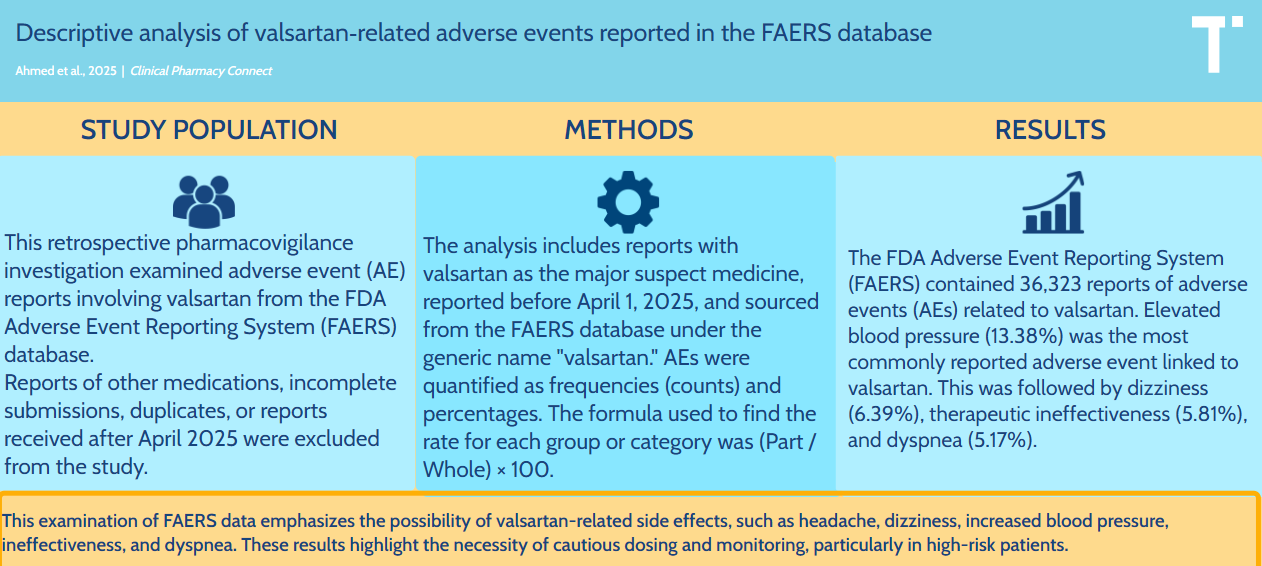
The angiotensin II receptor blocker valsartan, approved by the Food and Drug Administration (FDA), is indicated for the treatment of hypertension in adults and children aged one year and older, reduces hospitalizations due to heart failure, and improves survival following myocardial infarction (MI). Valsartan is widely used across adult populations; safety and effectiveness depend on patient factors and appropriate monitoring. Compared with ACE inhibitors, valsartan is associated with a lower incidence of cough. Reported adverse effects may include headache, nausea, and dizziness. FAERS reports through March 31, 2025, listing valsartan as the primary suspect drug, were retrieved using the term ‘valsartan’ and included in the analysis. Only reports containing complete information, including drug name, adverse event, and patient data, were considered. Adverse events were classified according to the Medical Dictionary for Regulatory Activities (MedDRA) Preferred Terms. The FDA Adverse Event Reporting System (FAERS) recorded 36,323 adverse events (AEs) associated with valsartan. High blood pressure was the most common adverse event associated with valsartan (13.38%). The next in order were dizziness (6.39%), therapeutic ineffectiveness (5.81%), and dyspnea (5.17%). Analysis of FAERS data indicates the potential for adverse effects associated with valsartan, including headache, dizziness, hypertension, lack of efficacy, and dyspnea. These findings emphasize the importance of appropriate dosing and monitoring, particularly in high-risk patients.
Hypertension (HTN) is commonly defined using systolic blood pressure (SBP) and/or diastolic blood pressure (DBP) thresholds (e.g., SBP ≥130 mmHg and/or DBP ≥80 mmHg, depending on guideline). Hypertension is one of the most widespread chronic diseases that can be defined by a constant high level of arterial pressure and is one of the significant causes of heart failure, stroke, myocardial infarction, and renal failure. The updated practice guidelines recommend treating patients with persistent blood pressure of 140/90 mmHg, aiming for a therapeutic target of 130/80 mmHg. However, the definition and management of hypertension have evolved. Although most cases are idiopathic (essential hypertension), excessive salt consumption has long been recognized as a significant risk factor [1]. Antihypertensives include angiotensin II receptor blockers (ARBs), angiotensin-converting enzyme (ACE) inhibitors, calcium channel blockers, and thiazide diuretics. The choice of medication is influenced by age, race, and comorbidities; ACE/ARBs are advised for kidney disease or heart failure. Beta-blockers are not advised as first-line treatment unless specific indications are met. Combination therapy is used if monotherapy doesn’t work (e.g., ACE/ARB with CCB or diuretics). For resistant hypertension, medications like spironolactone, loop diuretics, or vasodilators are used [2]. Angiotensin II receptor blockers (ARBs), a widely used class of antihypertensive medications, act by selectively inhibiting the binding of angiotensin II to the type 1 receptor [3]. This reduces aldosterone release, encourages vasodilation, and lowers blood pressure. Diabetic nephropathy, hypertension, and congestive heart failure are among the chronic renal diseases for which ARBs are prescribed. ARBs often work better for people who experience ACE inhibitor-related side effects, such as angioedema or a persistent cough, even though their therapeutic profiles are similar to those of ACE inhibitors. Although ARBs are usually well tolerated, they can cause dizziness, hypotension, hyperkalemia, and renal impairment [4]. Valsartan, a well-known ARB, has been approved by the FDA to treat hypertension in adults and children aged ≥1 year, reduce heart failure hospitalizations, and improve post–myocardial infarction survival in some heart failure patients [5]. Valsartan is widely used across diverse patient groups; safety and benefit depend on clinical context and appropriate monitoring. Common adverse effects (AEs) linked to valsartan include fatigue, headache, nausea, and dizziness, and they occur at rates comparable to those of a placebo. Notably, valsartan is associated with a lower incidence of cough compared with ACE inhibitors [6]. Adverse events (AEs) occur in at least 10% of patients, representing a significant challenge in clinical practice. These adverse effects can be caused by drugs, treatments, or other interventions, which can be simple to manage side effects or life-threatening issues [7]. Post-marketing surveillance is essential for detecting long-term or rare adverse effects, as pre-approval clinical trials typically enroll only a limited number of participants, often just a few thousand. The FDA Adverse Event Reporting System (FAERS) collects spontaneous reports from manufacturers, healthcare professionals, and consumers to support post-marketing safety surveillance [8-11]. This study aims to investigate and characterize the adverse experiences associated with valsartan, as documented in the FAERS database, given the drug’s high prevalence.
This retrospective pharmacovigilance study examined adverse event (AE) reports involving valsartan from the FDA Adverse Event Reporting System (FAERS) database. FAERS is a key post-marketing surveillance program that collects voluntary reports from manufacturers, healthcare providers, and patients to identify potential medication safety signals [10]. Records listing valsartan as the primary suspect drug were analyzed up to 1 April 2025. The generic name “valsartan” was used to retrieve these reports from the FAERS database. Only reports with complete information (drug name, adverse event, and patient data) were taken into consideration, and adverse events were categorized using MedDRA Preferred Terms. Duplicate reports, incomplete submissions, and submissions received after April 2025 were excluded from the analysis. The data was summarized using descriptive statistics. AEs were measured as percentages and frequencies (counts). (Part/Whole) × 100 was the formula used to determine the rate for each group or category. This formula uses “Whole” to display the total number of reports and “Part” to display the reported numbers in a category. The FDA Adverse Event Reporting System (FAERS) is a publicly accessible database. To access or use this data for research, no special authorization or ethical approval is needed.
FAERS contained 36,323 reports listing valsartan as the primary suspect drug within the study window. After eliminating 14,397 cases with an unspecified age, the patient age distribution was examined, yielding 21,926 evaluable reports, as indicated in Table 1. Of these reports, adults aged 65–85 years accounted for the highest proportion of adverse events (54.3%), followed by adults aged 18–64 years (36.2%). Age distribution of FAERS reports involving valsartan (age reported). To assess gender-specific trends, 3,281 cases with unspecified gender were excluded, leaving 33,042 reports available for analysis. The analysis indicated that female patients (57.8%) encountered adverse events more often than male patients (42.2%) (Figure 1). For reporter-specific analysis, 1,501 cases with unspecified reporter status were excluded, leaving 34,822 reports available for evaluation. The data revealed an almost equal distribution between healthcare professionals (49.2%) and consumers (50.8%), with consumers filing slightly more reports than professionals (Table 2). The specialty of the reporters. Figure 2 summarizes the most frequently reported MedDRA Preferred Terms. The most reported term was hypertension (4,861 reports; 13.38% of all reports), followed by dizziness (2,320; 6.39%) and therapeutic ineffectiveness (2,111; 5.81%). Other common terms included headache, acute kidney injury, fatigue, hypotension, and malaise.Category
Number of Cases
Percentage
0–1 Month
91
0.41
2 Months-2 Years
40
0.18
3–11 Years
21
0.09
12–17 Years
119
0.54
18–64 Years
7939
36.19
65–85 Years
11,909
54.30
More than 85 Years
1807
8.24
Totals
21,926
100.00
Category
Number of Cases
Percentage
Healthcare Professional
17,111
49.2
Consumer
17,711
50.8
Totals
34,822
100.00
This study used FAERS to describe reported adverse events for which valsartan was the primary suspect drug. The age distribution of reported adverse events was noteworthy, with the highest incidence occurring among middle-aged adults (18–64 years) and those aged 65–85 years. This discrepancy aligns with epidemiological evidence indicating that age-related pharmacokinetic changes, polypharmacy, and a higher burden of comorbidities increase the risk of adverse events in older patients [12-14]. In particular, valsartan’s metabolism and excretion may be impacted by age-related changes in hepatic and renal function, which could increase the risk of toxicity. This bias is further compounded by the greater likelihood of older adults receiving valsartan due to the high prevalence of cardiovascular disease and hypertension in this population. Older patients with multiple chronic conditions who use several medications are more likely than younger patients to experience adverse drug events (ADEs). Because valsartan is frequently co-administered with other antihypertensives, diuretics, or heart failure medications, drug interactions and cumulative side effects may elevate the risk of adverse events in this vulnerable population [12-14]. Hypertension was the most frequently reported term; this may reflect underlying disease or lack of effect rather than a drug-caused AEs. Fatigue (8.6%), headache (11.9%), dizziness (18.2% of all reports), acute renal failure (9.3%), and therapeutic ineffectiveness (5.81%) were the most common adverse events that were reported. Such results are congruent with the safety profile of the UK National Health Service (NHS) which indicates that more than 1% of patients treated experience a headache (19%), nausea (15%), vomiting (8%), diarrhea (6%), dizziness (6.39%), and musculoskeletal pain (5%), among other adverse effects [15]. Chen et al.’s cardiovascular safety analysis highlighted more severe cardiac complications, particularly in patients with pre-existing coronary artery disease [16]. Among the cases were notable arrhythmias (4.5%), cardiogenic shock (1.8%), angina exacerbations (2.7%), and new-onset heart failure (3.2% of cases). Despite these adverse event profiles, valsartan demonstrates a favorable safety–efficacy profile, as reported in large clinical trials. The overall incidence rates of adverse events (AEs) in studies involving hypertension (38.5%) are comparable to those in placebo groups (36.2%), while they are marginally higher in populations with heart failure (42.1% vs. 39.8%) [17]. The results from Fogari and Zoppi’s work, indicating similar rates of adverse events (pediatric: 28.4% and diabetic: 37.6% cohorts; older patients: 41.3%; younger patients: 39.1%), support the acceptability of valsartan in specific populations [6]. The most common adverse effects, fatigue (12.1%), headache (14.7%), nausea (9.8%), and dizziness (18.3%), did not differ significantly from placebo (p > 0.05). Valsartan was associated with a significantly lower incidence of cough compared with lisinopril (1.2% vs. 8.7%; p < 0.001), indicating that it may be preferable for individuals prone to cough [6]. Overall, valsartan is generally well tolerated; prescribing should follow labeling precautions and individual risk assessment. Valsartan, a commonly prescribed medication, is an effective therapeutic option for managing heart failure, hypertension, and myocardial infarction. Adverse effects associated with valsartan include dizziness, headache, fatigue, hypertension, acute kidney injury, and, in severe cases, serious cardiac events such as heart failure and arrhythmia, among others. Most of the side effects are similar to those of a placebo and are mild. Careful monitoring is necessary for some patient groups, though, such as those with kidney issues or a higher risk of heart disease. Healthcare providers recommend regular monitoring of blood pressure, kidney function, and electrolytes, particularly in high-risk patients, to help minimize associated risks. Hughes et al. emphasized the importance of using up-to-date baseline data to monitor performance and adjust tactics. To do this, healthcare organizations need to implement comprehensive systems for the systematic collection, processing, and exchange of data. Automated tracking and reporting technology can significantly improve real-time performance tracking [18]. Patients should be instructed to report any severe or persistent symptoms, including edema, dizziness, or irregular heartbeat. Additionally, caution should be used when taking valsartan with other antihypertensive medications to prevent sharp drops in blood pressure. Valsartan is generally safe and effective; its safety and efficacy can be further enhanced through individualized treatment and careful monitoring. 4.1. Strengths and Limitations This study uses the FDA Adverse Event Reporting System (FAERS), one of the largest publicly available pharmacovigilance datasets, to assess the adverse event (AE) profile of valsartan in real-world scenarios. The primary advantage of this approach is its ability to analyze large volumes of diverse patient data across various clinical settings, facilitating the identification of potential safety signals that may not be detected in controlled clinical trials. However, like other spontaneous reporting systems, FAERS has some inherent limitations that should be acknowledged. Underreporting bias is a significant concern because minor or well-established adverse events are less likely to be reported. Furthermore, if duplicates are not properly handled, they may make some negative events seem more frequent. Temporal reporting biases, such as increases in submissions following media coverage or drug safety alerts, may influence data interpretation. It should be noted that although FAERS provides useful AE correlations, there is no concrete evidence linking valsartan to reported responses. Another key limitation is the inability to calculate actual incidence rates due to the absence of denominator data, such as the total number of patients exposed to valsartan. Despite these limitations, the study provides useful details about the safety profile of valsartan, highlighting the importance of continuing pharmacovigilance and educating physicians about its potential risks. The findings highlight the importance of integrating FAERS data with prospective research to accurately determine incidence and establish causality in real-world settings. To better understand the safety profile of valsartan, future research should combine spontaneous reporting methods with reliable data sources, such as electronic medical records, prescription databases, and carefully planned prospective cohort studies. This holistic approach would allow for a more comprehensive assessment of risks in the real world. Special attention should be given to vulnerable patient groups, including children, the elderly, and individuals with neurological disorders, to better characterize their specific risk factors. Furthermore, the application of advanced analytics, such as machine learning algorithms, to real-world data has the potential to transform pharmacovigilance by enabling early detection of safety signals and the implementation of more targeted risk-reduction strategies. These advancements would significantly increase our ability to anticipate and prevent dangerous drug reactions in clinical settings.
ACE
Angiotensin-Converting Enzyme
AE
Adverse Event
ARBs
Angiotensin II Receptor Blockers
DBP
Diastolic Blood Pressure
FAERS
FDA Adverse Event Reporting System
HTN
Hypertension
SBP
Systolic Blood Pressure
Nehad Jaser Ahmed is the sole author of the manuscript and is responsible for writing and review as well as its conceptualization, methodology, investigation, formal analysis, data curation, funding acquisition, and visualization. The author has read and agreed to the published version of the manuscript.
The data analyzed in this study were obtained from the publicly available FDA Adverse Event Reporting System (FAERS) database [11]. The processed data supporting the findings of this study are included in the article. No new data was generated.
Since this study is based on the analysis of publicly available pharmacovigilance data from the FDA Adverse Event Reporting System (FAERS) and does not involve direct human participants, animals, or any new data collection, ethical approval and consent to participate are not required.
The author declares no conflicts of interest.
This study was supported by funding from Prince Sattam bin Abdulaziz University (Project No. PSAU/2024/R/1446).
Declared none.
ChatGPT (GPT-4) and DeepSeek-V3.2 Artificial Intelligence (AI) tools were used only to help with grammar refinement and language editing. The author confirms that no parts of the manuscript were generated using AI tools. AI assistance was used only for paraphrasing and language refinement of text that was originally written by the authors. No AI tool was employed to generate new scientific content, data interpretation, or original text in the manuscript.
[1] Iqbal, A.M.; Jamal, S.F. Essential Hypertension. Available online: https://www.ncbi.nlm.nih.gov/books/NBK539859 (accessed on 15 July 2025).
[2] Khalil, H.; Zeltser, R. Antihypertensive Medications. Available online: https://www.ncbi.nlm.nih.gov/books/NBK554579 (accessed on 15 July 2025).
[3] Fadaly, W.A.; Elshaier, Y.A.; Ali, F.E.; El-Bahrawy, A.H.; Abdellatif, K.R.; Nemr, M.T. Vicinal diaryl pyrazole with tetrazole/urea scaffolds as selective angiotensin converting enzyme-1/cyclooxygenase-2 inhibitors: Design, synthesis, anti-hypertensive, anti-fibrotic, and anti-inflammatory. Drug Dev. Res. 2024, 85, e22217. [CrossRef] [PubMed]
[4] Patel, P.; Launico, M.V. Angiotensin II Receptor Blockers (ARB). Available online: https://www.ncbi.nlm.nih.gov/books/NBK537027 (accessed on 15 July 2025).
[5] Drugs.com. Valsartan. Available online: https://www.drugs.com/valsartan.html (accessed on 15 July 2025).
[6] Fogari, R.; Zoppi, A. A drug safety evaluation of valsartan. Expert. Opin. Drug. Saf. 2011, 10, 295–303. [CrossRef] [PubMed]
[7] Skelly, C.L.; Cassagnol, M.; Munakomi, S. Adverse Events. Available online: https://www.ncbi.nlm.nih.gov/books/NBK558963 (accessed on 15 July 2025).
[8] U.S. Food and Drug Administration. Postmarketing Surveillance Programs.:, Available online: https://www.fda.gov/drugs/surveillance/postmarketing-surveillance-programs (accessed on 15 July 2025).
[9] Gajdács, M. The concept of an ideal antibiotic: Implications for drug design. Molecules 2019, 24, 892. [CrossRef] [PubMed]
[10] Ahmed, N.J.; Fouda, M.I.; Fouda, D.I.; Foudah, A.I. The adverse effect reporting for the most commonly used antibiotics. J. Pharm. Res. Int. 2020, 32, 22–28. [CrossRef]
[11] U.S. Food and Drug Administration. FDA Adverse Event Reporting System (FAERS) Database.:, Available online: https://www.fda.gov/drugs/surveillance/fdas-adverse-event-reporting-system-faers (accessed on 15 July 2025).
[12] Laatikainen, O.; Sneck, S.; Turpeinen, M. Medication-related adverse events in health care-what have we learned? A narrative overview of the current knowledge. Eur. J. Clin. Pharmacol. 2022, 78, 159–170. [CrossRef] [PubMed]
[13] Zazzara, M.B.; Palmer, K.; Vetrano, D.L.; Carfì, A.; Onder, G. Adverse drug reactions in older adults: A narrative review of the literature. Eur. Geriatr. Med. 2021, 12, 463–473. [CrossRef] [PubMed]
[14] Ogura, T.; Shiraishi, C. Comparison of adverse events among angiotensin receptor blockers in hypertension using the united states food and drug administration adverse event reporting system. Cureus 2025, 17, e81912. [CrossRef] [PubMed]
[15] NHS. Side Effects of Valsartan. Available online: https://www.nhs.uk/medicines/valsartan/side-effects-of-valsartan (accessed on 15 July 2025).
[16] Chen, Z.; Li, J.; Zhou, Y.; Qiu, Q.; Yan, D.; Peng, G.; Xu, Y.; Ye, Y.; Shen, Y. Comparison of the pharmacovigilance signals of cardiac and renal adverse events associated with sacubitril/valsartan and valsartan alone based on the FAERS database. Expert. Opin. Drug. Saf. 2024, 24, 445–452. [CrossRef] [PubMed]
[17] Black, H.R.; Bailey, J.; Zappe, D.; Samuel, R. Valsartan: More than a decade of experience. Drugs 2009, 69, 2393–2414. [CrossRef] [PubMed]
[18] Hughes, R.G. Tools and Strategies for Quality Improvement and Patient Safety. In Patient Safety and Quality: An Evidence-Based Handbook for Nurses; Agency for Healthcare Research and Quality (US): Rockville, MD, USA, 2008; Chapter 44. Available online: https://www.ncbi.nlm.nih.gov/books/NBK2682 (accessed on 3 January 2026).
Disclaimer/Publisher’s Note: The views expressed in this article are those of the author(s) and do not necessarily reflect the views of the publisher or editors. The publisher and editors assume no responsibility for any injury or damage resulting from the use of information contained herein.
©2026 Copyright by the Authors.
Licensed as an open-access article distributed under the terms and conditions of the CC BY 4.0 license
We use cookies to improve your experience on our site. By continuing to use our site, you accept our use of cookies. Learn more