

 ACCESS
Systematic Review
ACCESS
Systematic Review
Volume 2, Article ID: 2026.0013

Nehad Jaser Ahmed
n.ahmed@psau.edu.sa

Department of Clinical Pharmacy, College of Pharmacy, Prince Sattam Bin Abdulaziz University, Alkharj, Saudi Arabia
Received: 08 Jan 2026 Available Online: 17 Sep 2026
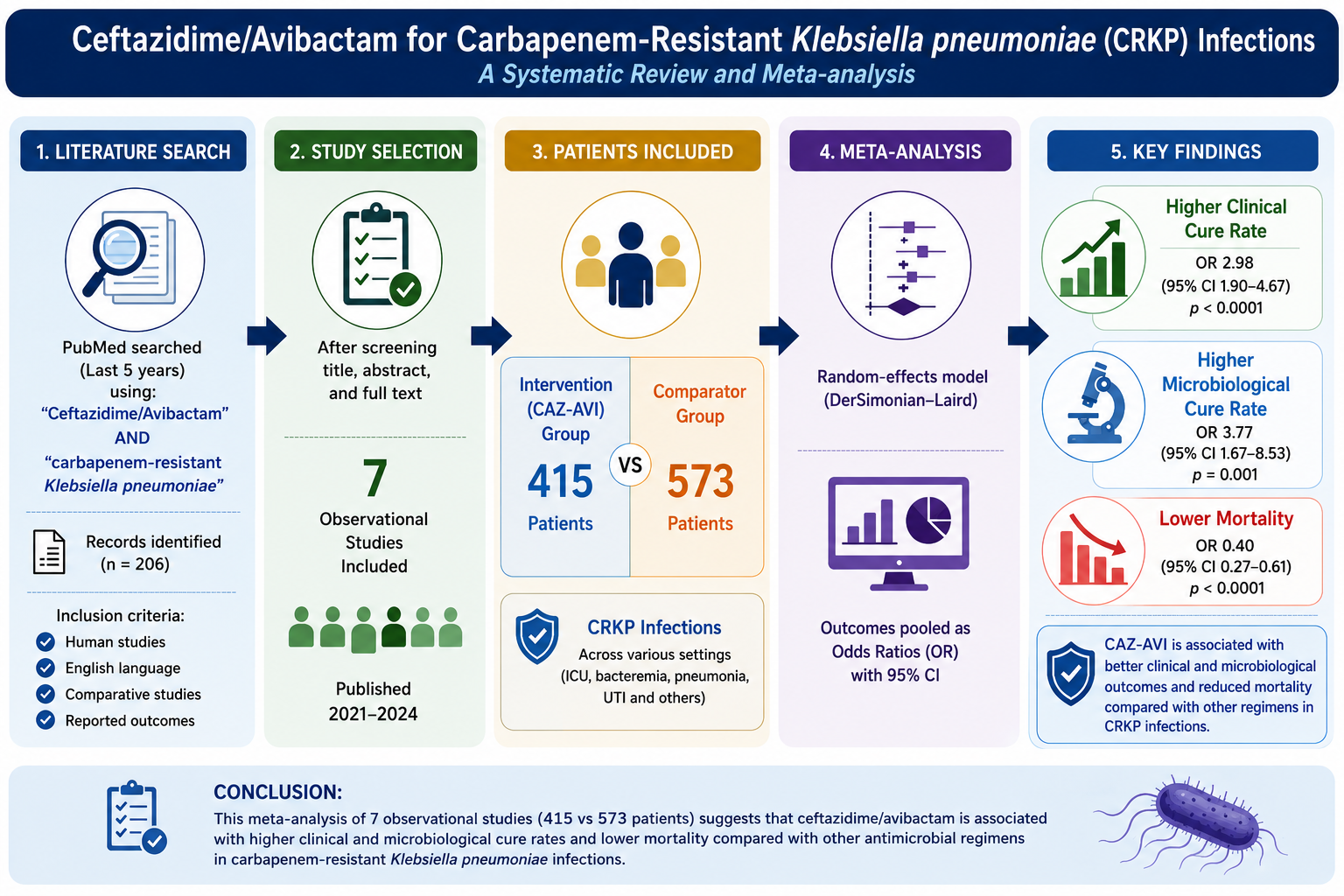
Carbapenem-resistant Klebsiella pneumoniae (CRKP) infections are difficult to treat because of high-level resistance, limited treatment options, and inconsistent treatment duration. Ceftazidime-avibactam (CAZ-AVI) has emerged as a potential option for carbapenem-resistant Enterobacterales infections, but comparative evidence specific to CRKP remains limited. This meta-analysis compared clinical cure, microbiological cure, and mortality associated with CAZ-AVI versus other antimicrobial regimens for CRKP infections. PubMed was searched for English-language human studies from the past five years using the terms "Ceftazidime/Avibactam" and "carbapenem-resistant Klebsiella pneumoniae." Of 206 eligible human records screened, seven observational comparative studies comprising 988 patients were included: 415 received CAZ-AVI-containing regimens, and 573 received comparator regimens. Given study heterogeneity, pooled odds ratios (OR) with 95% confidence intervals (CI) were calculated using a random-effects (DerSimonian-Laird) model, with heterogeneity quantified via the I² statistic. CAZ-AVI was associated with higher clinical cure (64.9% vs 42.2%; OR 2.98, 95% CI 1.90–4.67, p<0.0001; I²=21%), higher microbiological cure (70.4% vs 41.2%; OR 3.77, 95% CI 1.67–8.53, p=0.001; I²=69%, attenuating to OR 5.18, 95% CI 2.61–10.27, I²=41% after excluding one outlying study in sensitivity analysis), and lower mortality (26.8% vs 43.9%; OR 0.40, 95% CI 0.27–0.61, p<0.0001; I²=19%). As all included studies were non-randomized with heterogeneous comparators, these findings support—but do not establish—a benefit of CAZ-AVI for CRKP infections; randomized studies are needed to confirm these results and guide antimicrobial stewardship.
Disclaimer: This is not the final version of the article. Changes may occur when the manuscript is published in its final format.