


 ACCESS
Research Article
ACCESS
Research Article
Volume 3, Article ID: 2026.0043

Siavash Alamouti
siavash.alamouti@mimik.com


Fay Arjomandi
fay.arjomandi@mimik.com

Michel Burger
michel.burger@mimik.com

Jeremy Hsu
jeremy.hsu@mimik.com

Bashar Altakrouri
bashar.altakrouri@aramco.com

1 mimik Technology Inc., Oakland, CA 94619, United States
2 mimik Technology Inc. Vancouver, BC V6A 1B2, Canada
3 Saudi Aramco, Dhahran 31311, Saudi Arabia
* Author to whom correspondence should be addressed
Received: 11 Apr 2026 Available Online: 30 Sep 2026
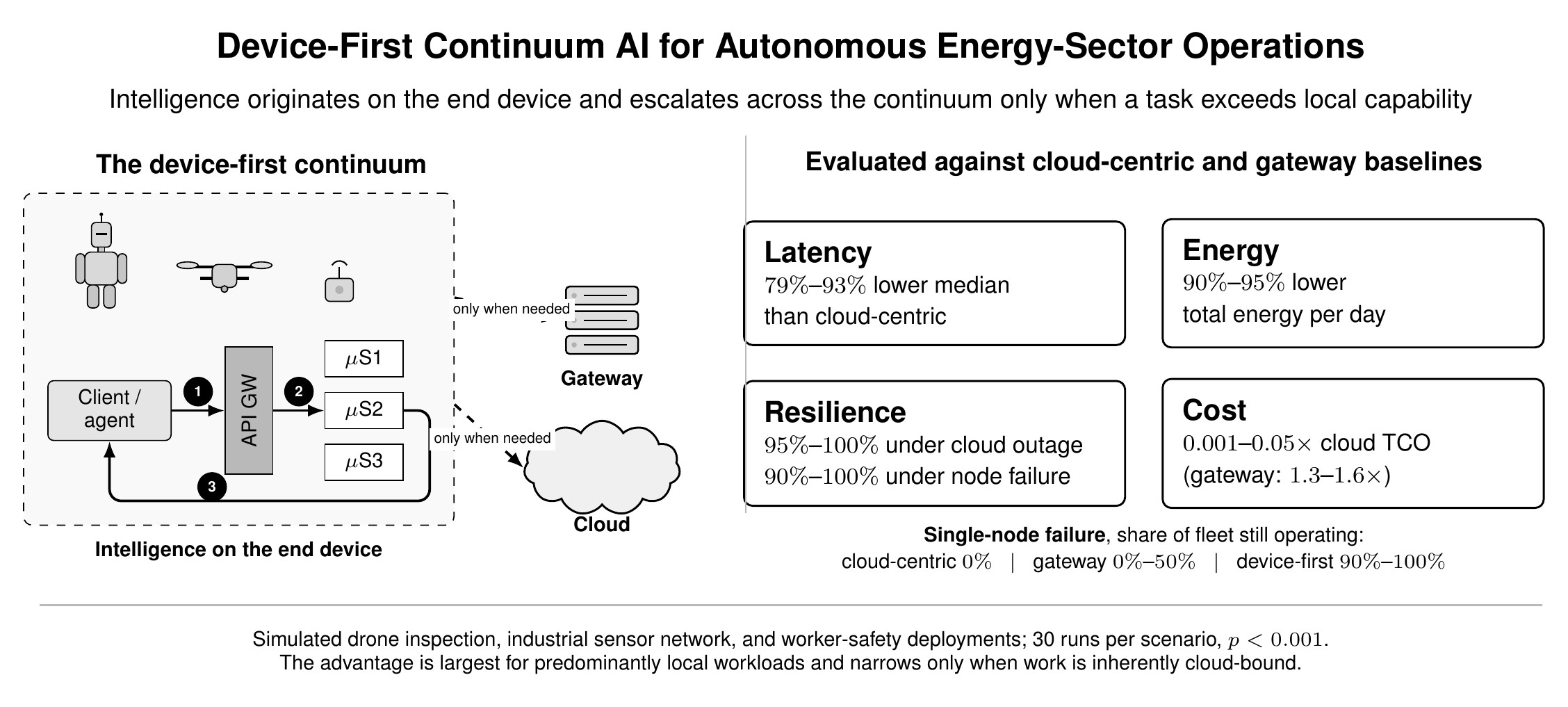
Industrial automation in the energy sector requires AI that remains operational regardless of network conditions, a requirement that cloud-centric architectures cannot meet in remote oil fields, offshore platforms, and other disconnected environments. This paper evaluates Device-First Continuum AI (DFC-AI), an architecture in which intelligent agents originate on the end device and escalate across the continuum to a gateway or the cloud only when a task exceeds local capability. This study contributes a benchmark-grounded comparison of three architectures—cloud-centric, gateway-based, and device-first—on latency, resilience, and cost, along with a model that explains the results and the conditions under which the device-first advantage holds. Across simulations of drone inspection, sensor-network, and worker-safety deployments, DFC-AI delivers large reductions in both latency and energy, maintains near-full capability when the cloud is unreachable and when an individual node fails, and runs at a small fraction of the cost of either alternative. Cloud-centric systems fail completely on disconnection, while gateway-based systems, although they survive a cloud outage, concentrate risk at a single aggregation node whose loss disables every device it serves and can cost more than the cloud they were meant to replace. The advantage is largest for the predominantly local workloads typical of the energy sector and narrows only when work is inherently cloud-bound. The practical implication is that processing intelligence where data originates, rather than transmitting it to a distant tier, is what makes industrial AI available, affordable, and resilient at scale.
Disclaimer: This is not the final version of the article. Changes may occur when the manuscript is published in its final format.