
APA Style
Avinash Kumar Singh, Roshni Sharma, Vidya Spriha Kujur, Mrinal Poddar, Ashish Kumar, Sanoj Kumar, Tarun Kumar Dhiman, Rahul Kumar. (2025). Integration of Nanotechnology and Nanomaterials in Biomaterials Research. Biomaterials Connect, 2 (Article ID: 0019). https://doi.org/10.69709/BIOMATC.2025.188313MLA Style
Avinash Kumar Singh, Roshni Sharma, Vidya Spriha Kujur, Mrinal Poddar, Ashish Kumar, Sanoj Kumar, Tarun Kumar Dhiman, Rahul Kumar. "Integration of Nanotechnology and Nanomaterials in Biomaterials Research". Biomaterials Connect, vol. 2, 2025, Article ID: 0019, https://doi.org/10.69709/BIOMATC.2025.188313.Chicago Style
Avinash Kumar Singh, Roshni Sharma, Vidya Spriha Kujur, Mrinal Poddar, Ashish Kumar, Sanoj Kumar, Tarun Kumar Dhiman, Rahul Kumar. 2025. "Integration of Nanotechnology and Nanomaterials in Biomaterials Research." Biomaterials Connect 2 (2025): 0019. https://doi.org/10.69709/BIOMATC.2025.188313.
ACCESS
Review Article
Volume 2, Article ID: 2025.0019

Avinash Kumar Singh
avinashkumarsingh92@gmail.com
Roshni Sharma
roshnisharma2608@gmail.com
Vidya Spriha Kujur
vidyasphk94@gmail.com
Mrinal Poddar
mrinalpoddar02@gmail.com
Ashish Kumar
ashish.nano2011@gmail.com
Sanoj Kumar
sanoj156@gmail.com
Tarun Kumar Dhiman
tkdhiman91@gmail.com
Rahul Kumar
vns.rahul92@gmail.com
1 Foundation of Research and Technology-Hellas (FORTH), 70013 Heraklion, Crete, Greece
2 Department of Chemistry, Aligarh Muslim University, Aligarh 202002, India
3 Center for Nanotechnology, Central University of Jharkhand, Ranchi 835205, India
4 Department of Chemical and Materials Engineering, Chang Gung University, Taoyuan 333, Taiwan
5 Centre for Studies in Science Policy, Jawaharlal Nehru University, New Delhi 110067, India
6 University School of Basic and Applied Sciences, Guru Gobind Singh Indraprastha University, New Delhi 110078, India
* Author to whom correspondence should be addressed
Received: 12 Mar 2025 Accepted: 22 Aug 2025 Available Online: 23 Aug 2025 Published: 23 Oct 2025
Nanotechnology has emerged as a transformative force in biomaterials research, significantly enhancing their functionality and versatility across medical applications, including tissue engineering, drug delivery, regenerative medicine, and medical implants. The integration of nanomaterials into biomaterials has improved biocompatibility, mechanical strength, drug release control, and bioactivity. The present review provides a comprehensive overview of the historical perspective, classification, and applications of nanomaterials in biomaterials research. It discusses how inorganic, organic, and hybrid nanomaterials are advancing biomedical applications, including their effects on scaffolds, nanoparticles for targeted drug delivery, and surface modifications for implants. The paper also addresses current challenges in the use of nanomaterials, including biocompatibility, toxicity, scalability, and regulatory considerations. Finally, future research directions are proposed to enhance the safety, functionality, and integration of nanotechnology in biomaterials, paving the way for next-generation biomedical applications. This review highlights the profound influence of nanotechnology on biomaterials and its potential to revolutionize healthcare. It explores the transformative impact of nanomaterials on biological applications and focuses on specific applications such as tissue engineering, drug delivery systems, diagnostic instruments, and regenerative medicine.
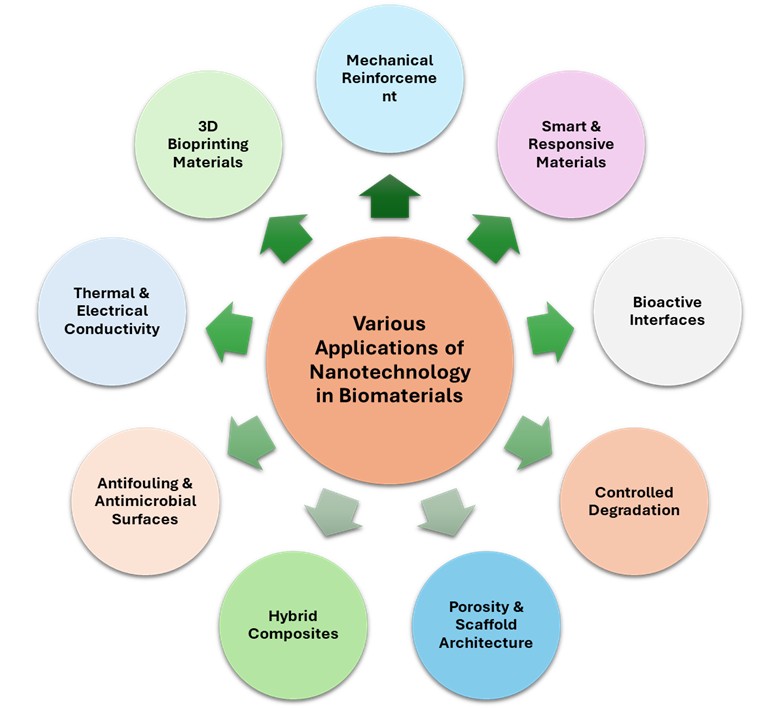
1.1. Overview of Biomaterials Research From the late 19th century, the use of metals and their composites in biomaterials has increased significantly. Biomaterials, often synthetic but sometimes natural, have been extensively used to replace or repair various biological functions of human tissue. Since they are constantly exposed to body fluids, they play a vital role in supporting daily human activities. A global effort is underway to develop novel biomaterials that can further enhance these activities. Extensive research has led to the development of numerous biomaterials aimed at understanding the interactions between the human body and these materials [1]. These biomaterials exhibit exceptional properties applicable in a wide range of fields, from complex diagnostics to clinical treatments. When designing biomaterials, it is essential to consider factors such as biocompatibility, as well as chemical, mechanical, and physical properties. In addition, their bioactivity and bioinertness should be evaluated [2]. Careful evaluation of these parameters enables the creation of more effective and biocompatible systems for medical use. For example, many bone substitutes act only as mechanical supports and do not facilitate processes such as hematopoiesis. They exhibit only basic functional properties within normal physiological systems. In contrast, pacemakers and neuromuscular stimulators perform specialized electrical functions. Specialized implants, such as oxygenators and dialyzers, can also perform essential chemical tasks like oxygenation and dialysis [3]. Further enhancement of biomaterials could enable the development of advanced implants with multiple functions. One such biomaterial is smart polymers, which impart novel and innovative properties to inert polymers when interacting with peptides, proteins, cells, or DNA. A notable example is the use of biodegradable polymers in sutures and bone plates. These polymers are developed from natural or synthetic polyesters and polyamides to temporarily scaffold or support tissues as they naturally regenerate [4]. Some biomolecules, such as liposomes, plasmid vectors, and enzymes, may be precipitated and dissolved in a switchable manner using stimuli-responsive polymers. The biodegradability of such polymers has led to the development of various advanced drug delivery systems. Reconstituted collagen polymers are widely used in skin substitutes, heart valves, and arterial wall replacements, representing a major breakthrough in the field. Biological tissues are generally categorized as hard (e.g., bone, cartilage, teeth, nails) or soft (e.g., skin, ligaments, fibrous tissues, synovial membranes), irrespective of mineral content. Biomedical implants are engineered to support, repair, or restore the function of damaged or diseased tissues in both categories. These biomaterials are either natural or synthetic, designed to function properly in a biological setting. This growing demand for synthetic tissue has arisen from the limited availability of donor organs, driving research efforts toward developing methods to mimic or replicate biological tissues and organs [4]. 1.2. Role of Nanotechnology The integration of nanotechnology into the implant field has dramatically increased in recent years. Researchers are increasingly investigating nanomaterials with biomimetic properties to enhance the performance of conventional implants [5]. Nanomaterials offer increased surface area, tailored stiffness, and modified surface roughness and physicochemical properties, which collectively improve cell adhesion, proliferation, bone protein synthesis, and mineral deposition. Since the advent of nanotechnology, various nanophase materials (grain size less than 100 nm), including metals, polymers, ceramics, and composites, have emerged with unique surface properties; many of these materials exhibit enhanced capacity to promote osseointegration and new bone formation. For example, Serra et al. [6] produced a nanostructured Ti6Al4V alloy using severe plastic deformation techniques. The nanostructured Ti6Al4V alloy exhibited better mechanical properties over conventional titanium, including (i) an ultimate tensile strength of 1240 MPa over 700 MPa, (ii) a yield stress of 1200 MPa over 530 MPa, and (iii) an elongation of 12% over 25% of pure titanium. A significant application is in diagnostics, where nanoparticles (NPs), such as gold NPs, functionalized with antibodies, can detect proteins associated with specific diseases. Iron oxide is regarded as a superparamagnetic NP, and other NPs have gained interest due to their magnetic characteristics. The regulated orientation and organization of these NPs in a strong magnetic field make them suitable for use as materials for drug delivery systems for cancer therapy. Due to these properties, nanoparticles (NPs) are ideal as drug carriers, thermal mediators in hyperthermia treatments, and contrast agents for computed tomography or magnetic resonance imaging (MRI). Therefore, the exposure of living organisms to natural, incidental, and engineered nanoparticles is rapidly increasing [7]. Metal oxide nanoparticles are particularly attractive as antibacterial agents due to their exceptionally large surface areas and unique crystalline morphologies, which feature numerous edges, corners, and other potentially reactive sites. The impact of iron-oxide nanoparticles on biofilms that developed on the surface of polymer-brush-coated biomaterials was assessed for this property. Carbon nanotube (CNT)-based composites are also studied and used in this field. The incorporation of CNTs into polycaprolactone (PCL), polycarbonate-urethane (PCU), or polystyrene (PS) matrices has been proposed to enhance the mechanical properties (in terms of tensile and compressive moduli) of the composite scaffolds. Carbon nanotubes (CNTs) serve as a safer alternative to traditional toxic fibers such as asbestos [8]. Incorporating single-walled carbon nanotubes (SWCNTs) into PLGA composites reduced polymer crystallinity by ~5%, increased tensile strength by ~12%, and slowed degradation [9]. Traditional nanotoxicology assays have primarily focused on evaluating cytotoxicity and genotoxicity of nanoparticle uptake in cancer cell cultures (U251, IMR-90) [10]. Using cell lines such as HeLa, U937 [11], A549 [12], many articles have studied cytotoxicity and genotoxicity of Ag-nps. Similarly, ZnO and TiO2 nps have been studied with Hep2 [13], and TiO2 nps with PC-3M [14] to show more reproducible and homogeneous results, facilitating targeted studies of nanoparticle-cell interactions.
In recent decades, nanomaterials have significantly enhanced the properties and functions of biomaterials in biomedical research and healthcare applications [15]. Biomaterials are designed to interact with biological systems such as bioimaging [16], medical implants [17], biosensing [18], wound healing [19], tissue engineering, and drug delivery [20]. The integration of nanotechnology enables precise control at the molecular level, leading to significant improvements in the performance and functionality of these materials for medical applications. 2.1. Historical Perspectives on Nanotechnology in Biomaterials Nanomaterials possess a high surface-to-volume ratio, which enhances their chemical reactivity and enables precise interactions with biological systems at the molecular level, resulting in properties that can be effectively harnessed for biomedical applications. Advancements in nanotechnology have continuously driven the development of potentially biocompatible biomaterials ever since the concept of biocompatibility became integral to medical science [21,22]. Initially, nanoparticles, nanofibers, and nanostructured surfaces were introduced as biomaterials for the development of medical devices, tissue engineering, and drug delivery applications [23]. During the 1950s and 1960s, liposomes and polymeric carriers were developed as the first generation of biomaterials for targeted drug delivery, offering precision and efficiency [24]. They encapsulated drugs at the nanoscale and delivered them precisely to targeted tissues. This approach prevented drug degradation and allowed controlled release over time. This discovery helped overcome major issues such as poor bioavailability and non-specific targeting in conventional drug delivery. During the 1990s, biocompatible hydroxyapatite nanoparticles were extensively studied, playing a crucial role in the design of scaffolds for new bone formation and the regeneration of damaged bone tissue. Due to its high surface area and biocompatibility, hydroxyapatite also acts as a carrier for drugs and bioactive molecules. The development of these biomaterials laid the foundation for functionalizing nanoparticles with biological molecules to enhance biocompatibility and minimize immune responses associated with other biomaterials [25,26]. Similarly, nanofibers were produced via electrospinning and used to create scaffolds for tissue engineering that closely mimicked the extracellular matrix (ECM) of natural tissues. These nanofibrous scaffolds provided better cell attachment, proliferation, and differentiation compared to traditional biomaterials [27,28]. These advancements have enabled the development of nanocoatings and surface modifications that enhance medical implant performance by improving tissue integration and providing antimicrobial properties. Collectively, these innovations in biomaterials have significantly advanced medical science, enhancing treatment effectiveness and enabling patient-specific customization. 2.2. Key Milestones and Major Advancements in the Past Few Years In recent years, the field of nanotechnology-enhanced biomaterials has witnessed several key milestones and major advancements. Researchers have made significant progress in developing smart biomaterials that respond to environmental stimuli such as pH, temperature, or specific enzymes. These materials can be utilized in biological research and have applications in several fields, including tissue engineering [29], cell therapy [30], and gene transfection [31]. A breakthrough in nanomaterials for biomaterials research was the development of a nano drug delivery system [32]. These nanoparticles can be programmed to release their therapeutic payloads in response to specific physiological conditions, such as the acidic environment of a tumor. Moreover, these materials can improve the poor water solubility of drugs, bioavailability, and reduce drug metabolism. This innovation has been particularly impactful in cancer treatment, where precise targeting is crucial to minimize damage to healthy tissues. In tissue engineering, the evolution of nanomaterials has led to the creation of nanocomposite scaffolds that incorporate multiple nanomaterials to achieve superior mechanical, biological, and chemical properties. For example, graphene and carbon nanotubes have been integrated into polymeric scaffolds to enhance their electrical conductivity, making them suitable for tissue engineering applications that require electrical stimulation, such as bone and cartilage tissue engineering [33]. Recent advancements in nanotechnology-enhanced biomaterials have also focused on improving the biocompatibility and functionality of implantable devices. Nanoscale surface modifications, such as nanostructured coatings with anti-inflammatory or antibacterial properties, have contributed to reduced implant rejection and infection rates [34]. Nanoparticles are now being integrated with 3D printing technology to fabricate biomaterials. This enables the precise fabrication of complex, patient-specific structures at the nanoscale, opening new avenues for regenerative therapies and personalized medicine. It is now simpler to construct tissues and organs for transplantation thanks to the development of scaffolds that can better support tissue growth, made possible by the combination of 3D printing and nanomaterials [35]. 2.3. Comparison of Traditional vs. Nanobiomaterials Performance and adaptability have significantly improved over traditional biomaterials because of the incorporation of nanotechnology into biomaterials research. Traditional biomaterials, such as metals, ceramics, and polymers, have been widely used in implants and medical devices due to their mechanical strength and durability [22,36,37]. However, challenges remain regarding biocompatibility, integration with biological tissues, drug delivery, and tissue regeneration. 2.3.1. Biocompatibility and Tissue Integration Conventional biomaterials often present biocompatibility challenges, potentially leading to immune reactions, implant rejection, or inadequate tissue integration [38]. On the other hand, biomaterials augmented by nanotechnology can be designed with surface alterations at the nanoscale that replicate the composition and functionality of natural tissues [39]. Furthermore, implants with nanostructured surfaces can promote cell proliferation and adhesion, improve tissue integration, and reduce rejection rates. 2.3.2. Drug Delivery Efficiency Traditional drug delivery methods usually depend on systemic administration, in which medications are dispersed throughout the body, which frequently results in side effects and non-specific targeting [40]. Nanotechnology-enhanced biomaterials offer more efficient drug delivery by targeting specific cells or tissues and controlling the release of the drug. This approach minimizes side effects and improves therapeutic outcomes, particularly in cancer treatment [32]. 2.3.3. Mechanical Properties and Functionality Traditional biomaterials are often selected for their mechanical strength; however, they may fall short in meeting the flexibility and functional requirements necessary for biomedical applications [37]. In contrast, nanomaterials can be tailored to achieve a balance between strength and flexibility, as seen in nanocomposite materials. For instance, the incorporation of carbon nanotubes into polymer matrices can enhance the mechanical properties of scaffolds while providing electrical conductivity, which is essential for applications like nerve or muscle tissue engineering [15]. 2.3.4. Antimicrobial Properties Another advantage of nanotechnology-enhanced biomaterials is their ability to incorporate antimicrobial properties [34]. Traditional biomaterials are prone to bacterial colonization, which can lead to infections, particularly in implants. Nanomaterials, such as silver nanoparticles, have been incorporated into biomaterials to confer antimicrobial properties, thereby reducing the risk of infections and enhancing the safety of medical devices [41,42].
In biomaterials research, nanotechnology has introduced significant innovations that are highly relevant for medical applications. This section examines various types of nanomaterials used in biomaterials, with an emphasis on their properties and applications. Materials with at least one dimension in the range of 1–100 nm are termed nanomaterials. These materials possess unique physical, chemical, and biological properties that make them highly suitable for biomedical applications. Nanomaterials are generally categorized as inorganic, organic, hybrid, or nanocomposites [43]. Nanoscale biomaterials hold immense potential to advance medical research and improve therapeutic outcomes. Nanomaterials’ characteristics make them perfect for a variety of medicinal and diagnostic applications. Ongoing research and development in this area are driving innovative healthcare solutions. The integration of nanoparticles and biomaterials is revolutionizing the development of advanced treatment approaches [44]. Inorganic and organic nanomaterials possess unique properties that enhance drug delivery, improve biocompatibility, and facilitate the development of innovative medical devices. Future research in this field holds great promise for improving patient outcomes and developing innovative treatments for various diseases. Continued advancements in nanotechnology will serve as the foundation for future medical breakthroughs [45]. 3.1. Inorganic Nanomaterials 3.1.1. Metal Nanoparticles 3.1.2. Metal Oxide Nanoparticles Metal oxide nanoparticles also play a key role as biomaterials in the research. A few of them are discussed below. 3.1.3. Carbon-Based Nanomaterials 3.2. Organic Nanomaterials 3.2.1. Polymer-Based Nanoparticles Polymeric nanogels and dendrimers are prominent polymer-based nanoparticles used in biomaterials research. Additionally, micelles and liposomes are significant organic nanomaterials. 3.2.2. Liposomes and Micelles 3.3. Nanofiber-Based Biomaterials Nanofiber biomaterials, particularly those fabricated using electrospinning, have gained considerable attention due to their ability to replicate the fibrillar architecture of the extracellular matrix (ECM). These fibers provide large surface area, high porosity, and interconnected pore networks, which are vital for cell attachment, nutrient diffusion, and biological signalling [74]. They can be made from a wide range of organic polymers such as gelatin, silk fibroin, polycaprolactone, or synthetic copolymers, and are often enhanced with carbon-based nanomaterials (e.g., graphene oxide, carbon nanotubes) or metallic nanoparticles (e.g., silver, gold) for added functionality. Nanofiber mats can be functionalized with growth factors, antibacterial agents, or drugs for site-specific delivery and can be designed to support specific cell lineages, such as neuronal or musculoskeletal stem cells. These systems are particularly valuable in applications such as skin repair, nerve conduits, and muscle regeneration. Nanofiber-based platforms have also been adapted into wound dressings that respond to environmental cues such as pH or enzymatic activity for on-demand drug release [75]. A study by Arbade et al. highlighted that nanofiber systems loaded with antibacterial agents like silver nanoparticles provided excellent microbial resistance while maintaining biocompatibility, making them ideal for chronic wound treatment and post-operative healing environments [76]. 3.4. Hydrogel Nanomaterials Hydrogels are valued for their excellent biocompatibility, softness, and tissue-like consistency. When combined with nanomaterials to form nano-hydrogels, these hydrogels acquire additional properties, including mechanical reinforcement, stimuli responsiveness, and enhanced drug delivery capabilities. These integrated nano-hydrogels can encapsulate cells, proteins, and nanoparticles, making them versatile materials for applications such as injectable therapies, 3D culture systems, and localized drug delivery [77]. These nano-hydrogels, composed of materials such as gelatin methacrylate (GelMA), alginate, cellulose nanofibrils, or chitosan, have shown promising results in treating burn wounds, osteoarthritis, ocular diseases, and tumor microenvironments. Including materials such as metal–organic frameworks (MOFs), nano-silica, gold nanoparticles, etc., in hydrogels has diversified its applications and made it usable for controlled photothermal treatment, biosensing, and angiogenesis stimulation [78]. Arbade et al. have highlighted the growing interest in multi-component hydrogels that exhibit adaptive stiffness and tunable release profiles, which can be optimized for bone and cartilage regeneration; additionally, these hydrogels enable stem cell encapsulation. These materials can also be engineered to respond to physiological stimuli such as pH, temperature, or enzyme levels, making them promising candidates for personalized medicine [79]. Figure 1 illustrates various types of nanomaterials applicable in biomaterial research.
Nanomaterials are highly versatile, and various modification techniques can be employed to enhance their biocompatibility, physicochemical properties, and functional behavior, thereby improving their performance in biomedical applications. Hybrid nanomaterials and surface-functionalized nanoparticles are two of the most studied approaches for this purpose. 4.1. Hybrid Nanomaterials and Nanocomposites Hybrid nanomaterials and nanocomposites combine organic and inorganic components, harnessing the advantages of both to achieve enhanced performance. One example is the coupling of polymers with carbon nanotubes to form a nanocomposite, yielding a material with enhanced electrical conductivity and mechanical strength. There are various applications for these materials where they can be used. Some of them are tissue engineering, medication delivery, and biosensing [80]. Furthermore, silica–polymer composites possess adjustable porosity and degradability, which have shown promising results in controlled drug delivery systems. These hybrid materials are versatile and support applications across diverse fields, including tissue regeneration, targeted drug delivery, and biosensing technologies. Recent advances in photodynamic and sonophotodynamic therapy have led to the use of TiO2 composites. Yavaş et al. (2025) reported that TiO2 nanoparticles, when combined with copper phthalocyanine (CuPc), exhibit potent, non-invasive anticancer activity, inducing up to 83.8% apoptosis in HepG2 liver cancer cells under sonophotodynamic activation [81]. Similarly, Abd El-Kaream et al. (2025) also synthesized microwave-activated TiO2/rose bengal@chitosan nanoparticles, which increased the production of reactive oxygen species (ROS), which was further used to selectively suppress skin cancer cells in vitro as well as in vivo systems [82]. El-Bassyouni et al. (2025) reviewed that titanium and its alloys have been extensively modified using various techniques, including atomic layer deposition of TiO2 thin films. This approach has been applied in long-term orthopedic and dental applications, as it enhances corrosion resistance, reduces implant degradation, and improves biocompatibility [83]. 4.2. Functionalization and Surface Modification of Nanomaterials Functionalization plays a key role in ensuring the effective utilization of nanoparticles. The surface functionalization/modifications are crucial for improved biocompatibility and enhanced targeting capabilities. Various methods, such as coating nanoparticles with biocompatible polymers, attaching ligands, and altering surface charge, are employed to enhance interactions between nanomaterials and biological systems [84]. Functionalization facilitates the attachment of targeted ligands for selective medication delivery or the incorporation of biodegradable components that can improve the body’s ability to release chemicals [85]. State-of-the-art techniques, such as click chemistry, have facilitated the precise attachment of therapeutic drugs or biomolecules to nanoparticle surfaces. These advancements have enhanced the efficiency of treatment and have minimized effects on the off-target areas. These successful discoveries were later backed by recent broad reviews, such as those by Kulwade et al. (2025), which have put forth the application of Carbon-based nanostructures in tissue engineering, such as skin, bone, cartilage, neural, cardiac, muscle, and hepatic tissues. This review emphasized the versatility of carbon nanomaterials (including nano-diamonds, CNTs, graphene, and fullerenes) and their favorable interactions with biological systems, stem cell-based regenerative strategies, and prospects for clinical translation [86].
5.1. Tissue Engineering Nanoscale material design and development improve material properties and functionalities, revolutionizing biomaterial applications in drug delivery, tissue engineering, and diagnostics. In tissue engineering, extracellular matrix (ECM) components and cell-cell/cell-ECM interactions, including osteoprogenitor cell migration, recruitment, proliferation, differentiation, matrix formation, and bone remodeling, are observed under standard 2D culture conditions. Researchers have manipulated mechanical properties (e.g., scaffold stiffness, strength, and toughness) by creating nanostructures (e.g., incorporating nanoparticles or nanofibers into polymer matrices) to mimic the natural nanocomposite structure of bone [87]. In 2002, Hutmacher et al. first reported the processing of bioresorbable scaffolds for tissue engineering applications using FDM (Fused Deposition Modeling) [88]. The key factors for an ideal scaffold for bone tissue engineering are: (i) macro- (pore size > 100 µm) and microporosity (pore size < 20 µm); (ii) interconnected open porosity for in vivo tissue in-growth; (iii) sufficient mechanical strength and controlled degradation kinetics for proper load transfer to the adjacent host tissue; (iv) initial strength for safe handling during sterilizing, packaging, transportation to surgery, as well as survival through physical forces in vivo; and (v) sterile environment for cell seeding [89]. 5.1.1. Nanostructured Scaffolds With the advent of technology, the design of a scaffold that meets the requirements of a reproducible 3D culture was brought to life. Hydrogels can be designed as soft scaffolds for cell culture. The stiffness, swelling behavior, and molecular mobility of their architecture are influenced by the type of cross-linking and the degree of branching. The most prevalent types are polymeric gels, composed of bioinspired units linked by covalent bonds, and low-molecular-weight gelators (LMWGs), also called supramolecular gels, which self-assemble through weak non-covalent interactions [90]. The swelling capacity of nanostructured hydrogel scaffolds in liquid media aids cell entrapment and facilitates the transport of nutrients and oxygen within the scaffolds. As a result, these scaffolds can also give cells the support they need to remain differentiated and proliferate [91]. Recent studies, such as that by Sudheesh Kumar et al., have shown that chitin can form hydrogen bonds with ceramics and polymers, creating enhanced composites. Using freeze-drying, they created 90-chitin hydrogel/nano-hydroxyapatite (nHAp) nanocomposite scaffolds with interconnected pores and 70–80% porosity [92]. Resorbable ceramic scaffolds can be biphasic (containing hydroxyapatite (HA) and tricalcium phosphate (TCP)) or composed of HA or TCP alone. Due to their larger surface area, nanocrystalline hydroxyapatite (nHAp, Ca10(OH)2(PO4)6) powders have been shown to exhibit superior sintering behavior and enhanced densification, which can improve fracture toughness and other mechanical properties. The mechanical and biocompatibility of bone-grafting materials may be enhanced by specially created nHAp composites [93]. For instance, due to their larger surface area for cell adhesion and reduced crystallinity, HA nanoparticles coated on glasses showed greater MG-63 cell attachment and proliferation than micro-sized HA particles [94]. In a similar vein, HA nanoparticles embedded in 3D PCL (polycaprolactone) scaffolds have demonstrated increased calcium deposition, alkaline phosphatase activity, attachment, and proliferation (i.e., mineralization of MSCs, or mesenchymal stem cells [95]. CNTs and nanofibers, with their electrical and mechanical properties, are promising for bone tissue engineering. High porosity is essential for cell ingrowth and nutrient/waste distribution, and electrical conductivity is crucial for tissue regeneration. For example, an 80%/20% (w/w) PLA/CNT composite showed optimal electrical conductivity for bone formation, despite PLA’s insulating properties [96]. Cellular processes like adhesion, proliferation, migration, and differentiation are sensitive to material surface characteristics. Raffa et al. [97] showed that PC12 cells adhered to nanometer-scale topography. Conversely, Washburn et al. [98] reported that the proliferation of MC3T3-E1 cells is sensitive to the nanoscale roughness of polymeric materials. Additionally, modifications to both the bulk structure and surface of materials can influence the differentiation process. According to some studies, the differentiation of H9c2 cells, their cytocompatibility, proliferation, and adhesion are impacted by the surface roughness of nanofilms with varying MNP concentrations [99]. Adding MNPs to the nanofilms enhances the proliferation and cells’ adhesion without compromising their viability [100]. 5.1.2. 3D Bioprinting of Nanomaterials Ceramics, metals, and polymers are among the materials proposed and employed as substitutes for natural bone and cartilage at damaged sites. Advancements in stem cell technology, 3D scaffold fabrication, and 3D printing for in vitro implant construction are anticipated to address current challenges in bone and cartilage repair. Scaffolds can be fabricated from natural polymers, which are highly biodegradable and exhibit low immunogenicity. A useful 3D macroporous nanofibrous (MNF) scaffold, for instance, was created by Cai et al. for use in bone tissue regeneration [101]. They observed hESC-MSC morphology on the MNF scaffold, not spindle-like shapes, and improved attachment. They also assessed in vivo bone formation over six weeks. 3D bioprinting, an additive manufacturing process, deposits bioinks and biomaterials layer-by-layer [102]. This technology is further separated into elective laser sintering, stereolithography (SLA), powder-based printing (3DP), fused deposition modeling, and robocasting. Nanotechnology has applications in biotechnology and medicine across various tissues. Bioactive glasses and nHA enhance bone regeneration. Nano-HA’s biocompatibility, bioactivity, and osteoconductivity make it valuable for orthopedic implants. A study also showed nHA supports bone repair without inflammation [103]. Cheng et al. found ZA had higher binding to nHA (92%) than micro-HA (43%) [104]. 5.2. Drug Delivery Systems 5.2.1. Role of Nanoparticles in Targeted Drug Delivery Nanotechnology has revolutionized drug delivery systems, offering innovative approaches to target diseases with precision and efficiency. Nanoparticles, as key components in these systems, provide numerous advantages over traditional drug delivery methods. They can be engineered for controlled release, targeting specific cells or tissues, and overcoming biological barriers. In this section, we will explore the role of nanoparticles in targeted drug delivery, mechanisms of targeting, functionalization techniques, and examples of nanomaterials used in drug delivery systems [105]. Drug delivery systems (DDSs) are designed to administer biologically active agents via various routes, including oral, topical, intravenous, and intravaginal administration [106]. DDSs offer several advantages, including reduced systemic toxicity, improved efficacy, lower drug doses to achieve the same effect, shorter administration times, and more consistent drug levels. The primary application of DDSs lies in tissue engineering. Additionally, they are employed in the treatment of disorders such as osteomyelitis, osteoporosis, osteoarthritis, and osteosarcoma. [107]. Nanoparticles have revolutionized drug delivery systems due to their small size, high surface area, and modifiable surfaces, and are ideal carriers for targeted drug delivery. Traditional drug administration often results in drugs being distributed non-specifically throughout the body, leading to side effects and reduced therapeutic efficacy. Nanoparticles help overcome these challenges by enhancing the bioavailability, biodistribution, and accumulation of therapeutics. They enable targeted drug delivery to specific sites, increasing drug concentration where it is most needed while minimizing undesired systemic exposure [107]. 5.2.2. Controlled Release Mechanisms One of the most important aspects of nanotechnology-based drug delivery is the ability to control when and where drugs are released. Nanoparticles can be engineered to release their payload in response to a specific stimulus, ensuring that the drug is released at the right time and in the right place. 5.2.3. Targeting Mechanisms Chemotherapeutic drug delivery is widely used, but the toxicity of these drugs can cause severe side effects. Selective tissue targeting is employed to mitigate these effects. The unique size of nanoparticles enables distinction of cancer pathology and molecular biology, resulting in preferential therapeutic targeting compared to traditional treatments [120]. There are two kinds of targeted drug delivery systems: (a) Active targeted drug delivery (smart drug delivery) is based on ligand-receptor interactions. It is based on a method that delivers a precise amount of a therapeutic or diagnostic agent specifically to diseased areas within the organ [121]. Drug-loaded nanoparticles (NPs) functionalized with ligands recognize specific receptors or antigens on target cells, enabling controlled drug distribution that reduces side effects on healthy tissues, which is not achievable with traditional chemotherapy [122], and (b) passive targeted delivery exploits the enhanced permeability and retention (EPR) effect. Rapid tumor growth leads to improperly formed blood vessels and junctions, making them loose and leaky. Due to their unique size, nanoparticles can pass through these loose junctions, leading to preferential accumulation at the tumor site over time. These phenomena are known as enhanced permeation and retention [123]. The behavior of drugs and their specific affinity for the intratumoral environment must be considered individually when designing passively targeted nanoparticles, and the optimal drug release profiles should be determined on a case-by-case basis [117]. It becomes evident that passive targeting of nanoparticles to diseased cells is more complex than it appears, as therapeutics developed solely through passive pathways may not realize the full potential benefits of nanoparticle-based therapies. Patients who are inherently more responsive to nanoparticles may receive more effective treatment [124]. Although active targeting can significantly enhance drug selectivity, challenges remain in identifying suitable biomarkers for various diseases. In addition, the biological complexity of receptor-mediated internalization can have a decisive impact, particularly if the target ligand binds to receptors expressed on normal tissues or immune cells [125]. Both active and passive targeting mechanisms have their advantages regarding the design of novel drug delivery systems. Passive targeting-essentially through the EPR effect-is a relatively simple and efficient approach, especially in the case of tumor targeting. However, it is often less specific, with changes in drug distribution. On the other hand, active targeting has greater specificity due to the use of ligand-receptor interactions, thus allowing more precise delivery to target tissues. However, it requires a very careful selection of appropriate targeting ligands and consideration of off-target effects. Both mechanisms offer more effective and less toxic treatments, and ongoing research is focused on optimizing these strategies for additional clinical applications [126]. 5.3. Regenerative Medicine The use of nanotechnology in regenerative medicine, which aims to replace or repair damaged tissues and organs, has been extremely beneficial. Nanomaterials can be employed to deliver genetic material for tissue regeneration, enhance stem cell activity, and modify the cellular microenvironment [130]. 5.3.1. Stem Cell Engineering with Nanomaterials Stem cell therapy holds potential for treating a variety of diseases, but controlling stem cell differentiation and ensuring proper tissue regeneration remain challenging. Nanomaterials enable the creation of controlled microenvironments that promote stem cell differentiation. While regulating stem cell development and ensuring tissue regeneration are challenging, stem cell therapy holds promise for treating various diseases. 5.4. Biosensing and Diagnostics 5.4.1. Fundamental and Diverse Applications of Nanomaterial-Enhanced Biosensors Biosensors are innovative engineering instruments with a wide range of technological uses. Additionally, biosensors are used to monitor environmental pollution, detect toxic elements, identify biohazardous bacteria or viruses in organic matter, and measure biomolecules in clinical diagnostics [138,139]. The high specificity of biological recognition processes and the sensitivity of electrochemical transducers, as demonstrated by low detection limits, are combined in electrochemical biosensors, a subclass of chemical sensors [140,141]. A biological recognition element found in these devices selectively reacts with the target analyte to generate an electrical signal correlated with the analyte’s concentration under study [142,143,144]. The general workflow for constructing sensors and biosensors, particularly those utilizing nanomaterials, involves combining the detection sample with bioreceptors conjugated to nanomaterials, resulting in a signal response, as illustrated in Figure 5 [145]. Many studies have investigated using transducers that are physically similar to the target species to create sensitive biosensors [146]. As a result, pathogen detection has been studied using electrodes that range in size from micrometers to nanometers. The creation of nanoscale structures of conducting and semiconducting materials through a variety of bottom-up and top-down nanomanufacturing techniques, including nanowires, has prompted research into nanostructured electrodes for pathogen detection, even though nanoscale planar electrodes are among the most frequently studied for this purpose [146,147]. A wide range of measurements is described by optical transduction (e.g., Raman, surface enhanced Raman, refraction, dispersion spectrometry, fluorescence, phosphorescence, absorption, etc.). A wide range of optical characteristics can be measured using any of these spectroscopic methods. Amplitude, energy, polarization, decay time, and/or phase are some of these characteristics [148]. For example, changes in the local environment surrounding the analyte, its intramolecular atomic vibrations (i.e., the energy of the electromagnetic radiation measured), can frequently be inferred from their energy. Another application of optical nanosensors in biological measurements is the development of calcium ion-sensitive nanosensors, which have been used to monitor calcium ion fluctuations in smooth vascular muscle cells during stimulation [149]. Despite their luminescence potential, dendrimers are rarely used for sensing. For instance, Lebedev et al. created luminescent dendrimers with a porphyrin core (either as a metal complex or as a free base). The fluorescence of a metal-free porphyrin (pKa = 6.3) and the phosphorescence of a metalloporphyrin (pH = 0–100 percent air saturation) demonstrated their suitability for measuring pH and oxygen [150]. However, a high degree of non-specific binding and the fact that many substances can function as quenchers can compromise the use of QDs in optical sensors. 5.4.2. Nanomaterial-Based Biosensors in Specific Diagnostic Applications There is an urgent need for highly sensitive techniques to measure cancer diagnosis markers that are present at extremely low levels in the preliminary stages of the disease. Current diagnostic procedures (e.g., G. ELISA) are insufficiently sensitive and identify proteins at concentrations indicative of more advanced disease stages [151,152]. Various detection techniques, including oligonucleotide microarrays, nanoparticle probes, microfluidic protein chips and arrays, and nanobio chips, have been reported, even though they involve numerous biomarkers [153]. The development of biosensors has historically focused primarily on electrochemical devices. Only a small percentage of biosensors and aptasensors among cancer detection tools are capable of quantitative analysis. An aptasensor developed by Wang’s research group enables the quantification of platelet-derived growth factor BB (PDGF-BB), a specific protein associated with cancer that is often measured only qualitatively [154]. This portable, sensitive nano-based aptasensor offered quick detection for early cancer diagnosis. A very low LOD of roughly 0–11 fM was produced by the large amount of loading aptamers on magnetic nanoparticles, the CX reaction that released zinc ions, and the fragments of disported DNA. Similarly, Zhao et al. developed a novel aptasensor by immobilizing graphene/dual-labeled aptamers onto a glassy carbon-modified electrode [155]. The linear range was from 3.16 × 10⁻¹⁶ M to 3.16 × 10⁻¹² Mdot. Carcinoembryonic antigen (CEA), a glycoprotein with an aberrant amount, is a significant tumor marker that is closely related to cancer detection. A nano-based electrochemical CEA biosensor was constructed using one-pot synthesis in a study conducted by Jang and colleagues [156]. In this work, multidimensional polymer nanotubes with conductive qualities were prepared using 3-carboxylate polypyrrole. A quick reaction (less than 1 s) with ultrasensitive detection was seen by binding between CEA aptamers and the amid groups of multidimensional polymer nanotubes immobilized on the electrode surface. For a summary of recent advancements and specific examples of nanomaterials and their applications in biomedical research, refer to Table 1. A Few recent works on nanomaterials used in biomedical research.
Material
Fabrication Technique
Properties
Outcomes
Ref
Nanocomposite of poly (ecaprolactone) (PCL) and silica
Solvent casting
Composite nanoparticle scaffold
When compared to pure PCL, silica improved the mechanical characteristics of mesenchymal stem cells or marrow stromal cells (MSCs) grown on PCL composites without sacrificing their biocompatibility.
[157]
PLGA/nHA
Solvent casting/particulate leaching
Composite scaffolds with nHA crystal
When compared to PLGA controls, osteoblasts grown on PLGA/nHA composites produced more bone.
[158]
Chitosan/nHA
To induce HA growth, freeze-dry followed by a change in pH
Composite scaffold contacting nHA crystal
MG-63 adhesion, spreading, and proliferation on chitosan/nHA composites were higher after 21 days compared to chitosan controls.
[159]
PLGA/MWCNT
Electrospinning
Composite fiber
Compared to the PLGA control, there was an increase in BMSC attachment after 24 h and proliferation after 5 days of culture on composite scaffolds.
[160]
PPF/PF-DA/CNT composite
Particulate leaching/thermal crosslinking
CNT homogeneously distributed into porous material
At 4 and 12 weeks, nanocomposite scaffolds showed positive soft and hard tissue responses. A three-fold increase in bone tissue ingrowth at 12 weeks appeared in flaws that included nanocomposite scaffolds, in contrast to scaffolds made of control polymers. Furthermore, the 12-week samples revealed decreased density of inflammatory cells and elevated connective organization of tissues.
[161]
Polyamide HA composite
Particle leaching and phase separation
Allogenic BMSCs coupled with porous scaffolds containing nanoscale HA crystals
In the early post-implantation phase, the composite with BMSCs demonstrated improved osteogenesis, osteoconductivity, and high biocompatibility.
At the late stage following implantation, the effects of the composite with or without BMSCs on osteogenesis were comparable.[162]
Ti alloy
Anodization process
Nanotube/ nanorods
High osseointegration and corrosion resistance
[163]
Co-Cr-Mo alloys tantalum
Microemulsion technique and heat treatments
Nanostructure and nanoparticle
Excellent biocompatibility and anticorrosive behavior, as well as high resistance to wear and corrosion.
[164]
CNF/polycaprolactone/mineralized HA
Electrochemical deposition
Nanofibrous scaffolds
High cell viability, good adhesion strength, elastic modulus, and suitability for load-bearing applications
[165]
CNT/alumina ceramic composites
Stirring
Ceramics and nanotubes
It improves the mechanical characteristics, and in bone implantation testing, the composite showed good bone tissue compatibility and connected directly to new bone
[166]
Graphene/HA composites
Spark plasma sintering
Nanosheets reinforced composites
Improvements in apatite mineralization, osteoblast adhesion, and fracture toughness of about 80% as compared to pure HA
[167]
Aluminum oxide-coated Ti alloy
Oxide magnetron sputtered coating
In vivo and in vitro systems
High corrosion resistance and the hydrophilic nature of the coated surface contribute to good biocompatibility.
[168]
Although nanomaterials have significantly advanced biomaterials research, particularly in drug delivery and regenerative medicine, their use presents several challenges and limitations. These challenges span multiple areas, including biocompatibility, manufacturing, regulatory frameworks, and environmental considerations. Understanding and addressing these issues is critical to fully realizing the potential of nanomaterials in biomedical applications [169]. 6.1. Issues Related to Biocompatibility and Toxicity One of the most significant challenges in using nanomaterials with biomaterials is ensuring their biocompatibility and minimizing toxicity. Due to their interactions with biological systems at cellular and molecular levels, the small size and high surface reactivity of nanomaterials can sometimes lead to unintended biological effects [169]. Biocompatibility of nanomaterials refers to their ability to perform their intended function within the body without eliciting undesirable responses, such as immune reactions, inflammation, or other adverse effects. Polymeric nanomaterials are used in nanomedicine due to their biocompatibility and biodegradability. These nanoparticles are considered excellent candidates for controlled drug delivery due to their ability to achieve targeted drug release, protect the encapsulated payload, and prolong circulation time [169,170]. The toxicity of nanomaterials can adversely disrupt the normal physiology of human and animal organs and tissues. The interaction between nanomaterials and biological matter is complex due to a lack of understanding of the intracellular mechanisms and pathways. Furthermore, accumulating knowledge of nanoparticle-cell interactions indicates that cells uptake nanoparticles via active or passive mechanisms. All metallic nanomaterials (NMs) can induce an inflammatory response, depending on their composition, size, and shape [170]. 6.2. Challenges in Manufacturing and Scalability 6.2.1. Precision and Consistency Achieving desired therapeutic effects with nanomaterials requires precise control over their size, shape, surface properties, and composition. Precise targeting of infected or cancerous cells is another challenge, as the biodistribution of nanoparticles within the body may not always align with therapeutic objectives, leading to off-target effects. Small variations in these parameters can lead to significant performance differences, hindering consistent large-scale production [171]. Scalability and cost-effectiveness of nanobiomaterial production are critical challenges that must be addressed to ensure widespread accessibility. 6.2.2. Scalability Many nanoparticle synthesis methods, such as chemical vapor deposition or electrospinning for nanofibers, are difficult to scale up for industrial production. Batch-to-batch variability, high production costs, and low yields are common issues when attempting to produce nanomaterials in larger quantities for clinical or commercial use. This presents a barrier to the widespread adoption of nanomaterial-based biomaterials, particularly in cost-sensitive markets like healthcare. 6.2.3. Regulatory Hurdles and Safety Concerns The introduction of nanomaterials into the medical field also faces substantial regulatory challenges. Regulatory agencies, such as the U.S. Food and Drug Administration (FDA) and the European Medicines Agency (EMA), have stringent guidelines for the approval of new medical products, and nanomaterials present unique regulatory hurdles due to their novel properties. 6.2.4. Unclear Regulatory Pathways Traditional frameworks are inadequate to address nanomaterial complexities. For instance, the behavior of nanomaterials in biological systems differs significantly from that of bulk materials, and there is currently no standardized testing methodology for assessing the safety and efficacy of nanoparticles. This can slow down the approval process for nanomaterial-based products, as companies and regulators must navigate uncharted territory to establish the safety of these materials. 6.2.5. Safety Concerns Long-term safety is a major concern for nanomaterials. Regulatory agencies require comprehensive data on their potential toxicity, biodistribution, and degradation prior to approval for medical applications. The long-term effects of nanomaterials in the body remain largely unknown, especially for non-biodegradable materials or those that accumulate over time. Ensuring nanomaterials do not interfere with the immune system, cause unintended tissue damage, or accumulate in non-target organs further complicates regulatory approval [172]. 6.3. Environmental Impact and Long-Term Stability Nanomaterials, particularly those used in medical devices and drug delivery systems, also raise concerns about their environmental impact and long-term stability, both within the body and in the external environment. 6.3.1. Environmental Impact The manufacturing, use, and disposal of nanomaterials can have unintended environmental consequences. Nanoparticles can enter the environment through wastewater, manufacturing runoff, or medical waste, potentially leading to environmental contamination. The environmental behavior of nanomaterials, including their interactions with ecosystems, degradation, and bioaccumulation, remains incompletely understood. For example, metallic nanoparticles, such as silver or titanium dioxide, widely used for their antimicrobial properties, may pose risks to aquatic life or disrupt microbial ecosystems if released into water supplies [173]. 6.3.2. Long-Term Stability In biomedical applications, the long-term stability of nanomaterials is essential for their safety and efficacy. Some nanomaterials, such as biodegradable polymers, are designed to break down over time, while others, like metallic nanoparticles, are intended to remain stable. However, non-biodegradable nanomaterials can accumulate in tissues or organs over time, leading to potential long-term toxicity. The degradation products of some nanomaterials, such as metal ions released from metallic nanoparticles, can have toxic effects [173,174].
7.1. Breakthroughs in Nanomaterials for 3D Bioprinting Recent advances in nanomaterials, especially in bioink development, have greatly enhanced 3D bioprinting technologies. To improve the mechanical properties, biocompatibility, and functionality of bioinks, nanomaterials such as graphene, nanosilicates, and carbon nanotubes have been incorporated. For example, nanocellulose-based inks have emerged as viable substitutes due to their structural similarity to extracellular matrices, which support cell survival and proliferation [175,176]. Furthermore, it has been demonstrated that adding nanoparticles improves the hydrogels’ printability and structural stability, enabling the production of intricate tissue architectures [177]. The integration of 3D bioprinting and nanotechnology has enabled the development of smart bioinks that respond to environmental cues and have also been applied in 4D bioprinting [178]. The integration of nanotechnology has advanced bioprinting by enhancing the mechanical and biological properties of printed scaffolds and enabling the creation of dynamic tissue architectures capable of post-printing transformations [179]. The diverse range of biofunctional nanoparticles, including ceramic, metallic, polymeric, and carbon-based types, along with their integration into biopolymers and cells for various 3D bioprinting methods (such as inkjet, laser-assisted, extrusion-based, and stereolithography) to create nanocomposite structures, is comprehensively illustrated in Figure 6 [180]. Furthermore, it is noticeable that nanomaterials have introduced transformative changes in tissue engineering when incorporated into 3D bioprinting and have opened up to advanced approaches for the development of regenerative medicine. 7.2. Smart and Stimuli-Responsive Nanomaterials Nanomaterials are increasingly developed as smart, stimuli-responsive systems, capable of responding to external stimuli such as light, pH, and temperature. Advances in this field include polymeric micelles for stimuli-responsive drug delivery, which can release therapeutic agents in a controlled manner and have significantly improved drug delivery and cancer therapy [181]. These nanocarriers can be designed to respond to specific biological triggers, enhancing their effectiveness and minimizing adverse effects [182]. Figure 7 further elaborates on this, demonstrating how various stimuli (exogenous like temperature, light, and ultrasound, and endogenous like enzymes, ROS, and glucose) are leveraged with different types of nanoparticles (polymeric, lipid-based, mesoporous silica, dendrimers, and gold nanoparticles) for therapeutic drug delivery in diverse ailments such as periodontitis, inflammatory bowel diseases, rheumatoid arthritis, atherosclerosis, and diabetes mellitus [183]. Self-assembled peptide nanoparticles have demonstrated significant potential in biological applications, serving as versatile platforms for targeted imaging and therapy [181]. The potential of graphene-based nanomaterials to improve treatment outcomes through controlled drug release in response to various stimuli has also been reported [184]. The development of molecularly imprinted nanomaterials has expanded the potential of drug delivery systems and bioanalysis by enabling the selective recognition of specific biomolecules using smart systems [185,186]. All of these developments have contributed to the creation of smart nanomaterials, enabling novel approaches in therapeutic interventions, drug delivery systems, and diagnostic technologies. 7.3. Nanomaterial-Based Immunomodulation Today, immunomodulation strategies have greatly benefited from the use of nanomaterials. These materials enhance the effectiveness of immunotherapy for diseases such as autoimmune disorders and cancer. Recent research highlights the applications of nanosystems for immunomodulatory purposes, which have potential for targeted immune response for specific immune cells and modification in the tumor microenvironment [187]. Advances in the delivery of immunotherapeutic agents have enhanced these systems, addressing challenges such as insufficient immune stimulation and off-target effects [188]. Nanomaterials designed to target lymphoid organs are engineered to efficiently enhance immune responses and enable targeted therapy for the treatment of inflammation and cancer [189]. Advancements in treatment outcomes require extensively studied and improved nanomaterials that can modulate immune responses while simultaneously evading immune detection [190]. The incorporation of nanomaterials into current immunotherapeutic strategies has improved the efficacy of checkpoint inhibitors and cancer vaccines [191]. Thus, the use of nanomaterials offers new opportunities for targeted therapies and may enable breakthrough advancements in precision medicine when integrated into immunomodulation strategies. 7.4. Emerging Nanocomposite Designs Recent research and developments in nanocomposites have demonstrated transformative applications in fields such as medicine, electronics, and energy storage. Recent developments include ceramic-polymer nanocomposites that combine the flexibility of polymer matrices with the high permittivity of ceramic fillers, making them suitable for energy storage applications [192]. The improved dielectric qualities of these composites are essential for the creation of sophisticated capacitors and electrical devices. Thermally drawn elastomer nanocomposites, developed for soft mechanical sensors, have shown significant potential in robotics and health monitoring [193]. The primary focus of current research is the ability to tune the electrical and mechanical properties of nanocomposites through modified production methods. Lanthanide-doped nanoparticles have been incorporated into nanocomposites, enabling the design of diverse materials and opening innovative approaches for cancer treatment and bioimaging [194]. The architectural development of nanocomposites has opened a way to create versatile materials having a wide range of multisector usage. 7.5. Integration of Nanomaterials with Digital and Computational Technologies Integrating digital and computational technologies, mainly machine learning and artificial intelligence (AI), into nanomaterials development has shown significant advancement. Ongoing research has shown that algorithms of AI are capable of optimizing designs for nanocomposites and have been identifying materials with desired properties very quickly [195]. This has been highly significant in reducing the time and cost associated with conventional material discovery approaches. One computational approach for materials optimization is a Bayesian optimization-based, data-driven design framework, developed to simultaneously determine the composition and microstructure of nanocomposites, thereby enhancing performance across a wide range of applications [196]. There has been growth in the production of nanomaterials and also in their characterization by using machine learning, which highlights the relation between material characterization and processing parameters. Microfluidic technology, known for its precise control over the properties of synthesized materials, is further enhanced through machine learning algorithms and in-line characterization tools [197]. Today, the design and application of nanomaterials across various domains have become more innovative and efficient through the integration of nanotechnology with digital and computational technologies. Several challenges remain in integrating AI into nanomaterials research, including the scarcity of consistent, high-quality datasets for training AI models. In some cases, there is also a complete lack of datasets in the case of many nanomaterial investigations, leading to misclassification or inaccurate material prediction [198]. 7.6. Challenges in Integrating Advanced Technologies Such as AI into Nanomaterials Research There are several challenges in the integration of AI in the research and development of nanomaterials that need a proper solution for successful results. One of the challenges is the transparent interpretation of AI models and the potential for model bias. AI models can be influenced by training data bias and may not fully capture the diversity of nanomaterials, potentially affecting prediction accuracy. Moreover, AI algorithms are complex and generally show difficulty in interpretation, and complicate the result validation [199]. Another challenge arises when integrating AI with existing research workflows, as incorporating AI into conventional nanomaterial development methods can be difficult, limiting the effective application of this technology [200]. The incorporation of AI in nanotechnology raises several regulatory and ethical concerns. Specifically, it is related to potential impact on environmental safety, sustainability, and self-learning abilities. Ensuring responsible development in this field is important to address [198]. Moreover, the computational demands for advancing AI can be substantial and require readily available resources for research [201]. Although AI and machine learning hold significant potential in nanomaterials research, addressing challenges through collaboration, the development of standardized datasets, and computational advancements is essential to fully harness this technology.
8.1. Designing Next-Generation Multifunctional Nanomaterials The advancements today in the field of nanomaterials with multifunctionalities are focused greatly on combining several different properties to challenge the complex problems in the biomedicine sector, environmental science application, energy sector etc. there have been cutting edge development in Carbon-metal nanohybrids (CMNHs), which exhibit improved electrical and optical properties which are termed very critical for energy harvesting and environmental remediation technologies [202]. Polymer-based nanoparticles are at the forefront of development for photothermal therapy and have also demonstrated effectiveness in stimuli-responsive designs, enhancing their therapeutic potential [203]. Moreover, hollow nanostructures have gained popularity in drug delivery due to their high drug-loading capacity and versatility, making them well-suited for biomedical applications [204]. Future research should explore 2D nanomaterials for cellular-level applications, leveraging their unique properties to develop innovative cellular constructs [205]. Furthermore, integration of artificial intelligence (AI) into designing nanomaterials would bring about a significant increase in the development of new materials, which also enhance their properties and can be used for application in clean energy [206]. Scalability and reproducibility remain fundamental challenges for these materials, making their resolution critical for the commercialization of advanced nanomaterials. 8.2. Enhancing Safety Profiles and Reducing Toxicity As the applications of nanomaterials continue to expand, safety has become an increasingly important concern. Recent research emphasizes the need for safer-by-design methodologies that integrate safety assessments into the design process to mitigate potential risks [207]. While functionalized silver and gold nanoparticles have shown promise in biomedical applications, further research is necessary to fully elucidate their toxicity mechanisms and enhance biocompatibility [208]. Novel approaches, such as machine learning, are being used to enhance risk assessment and safety profiling of nanomaterials and to improve predictions of their interactions with biological systems [209]. Furthermore, advancements in solid-state batteries utilizing nanomaterials highlight the importance of improving safety through enhanced mechanical and thermal stability [210]. Future studies should focus on developing comprehensive frameworks for assessing nanomaterial safety to ensure their responsible use in consumer products and medical applications. 8.2.1. Application of Bioinspired and Biomimetic Nanomaterials Bioinspired nanomaterials, which leverage natural processes for innovative applications, are emerging as a transformative concept in nanotechnology. Recent advancements in biomolecular self-assembly have facilitated the creation of hierarchical nanomaterials with specific functionalities for energy and environmental applications [211]. Enhancing biocompatibility and multifunctionality, the incorporation of bioinspired nanomaterials into micro/nanodevices has demonstrated considerable promise in biomedical domains [212]. Research on protein-guided biomimetic nanomaterials, with a focus on drug delivery and disease therapy, is expanding. In addition, the development of cephalopod-inspired nanomaterials for thermal and optical control demonstrates the adaptability of bioinspired material designs, which are versatile for applications in both medical technology and sensing [213]. Research should focus on exploring bio-inspired, multifunctional nanomaterials capable of addressing global challenges in environmental sustainability and healthcare [214,215].
Nanotechnology has become a cornerstone of recent advances in materials science in recent times. It has revolutionized research on biomaterials, with unprecedented progress in material properties, their applications, biological interactions, and therapeutic applications. The incorporation of nanomaterials has enhanced properties across various domains, including biosensors, medical implants, tissue engineering scaffolds, and drug delivery systems. Despite numerous breakthroughs, several challenges persist for nanomaterials, including toxicity, long-term biocompatibility, large-scale manufacturing, and regulatory concerns. These issues require the establishment of standardized test protocols to increase safety profiles, optimize manufacturing strategies, and ensure the efficiency and reliability of nanomaterial-based biomaterials. Some work in this regard has already started in the European Union, but it is still in the initial stages before an industry-wide regulation can become a norm. In the coming years, research in nanotechnology and biomaterials will focus on developing intelligent, multifunctional nanomaterials with precise monitoring of biological interactions. Advanced and emerging technologies in computer science, such as machine learning and artificial intelligence, can play a pivotal role in the development of novel biomaterials. They can support the design of biomaterials tailored for specific medical applications. Similarly, biomimetic nanomaterials can also help in regenerative medicine. The adoption of green synthesis strategies for nanomaterials and biodegradable nanocomposites synthesis will further reduce the environmental impact and improve the long-term stability of these materials. Similarly, enhancing the biocompatibility and antibacterial properties of medical implants can reduce complications and improve long-term success. Nano-enabled point-of-care testing and wearable biosensors can enable early disease detection and real-time health monitoring. This will promote preventive health care practices. With each innovation, nanotechnology is going to drive advances in medicine and shape the future of biomaterials.
| AgNPs | Silver Nanoparticles |
| AI | Artificial Intelligence |
| AuNPs | Gold Nanoparticles |
| BaP | Benzo[a]pyrene |
| BMP | Bone Morphogenetic Protein |
| BPT | Benzopyrene Tetrol |
| Ca10(OH)2(PO4)6 | Hydroxyapatite Chemical Formula |
| CEA | Carcinoembryonic Antigen |
| CMNHs | Carbon-Metal Nanohybrids |
| CNPs | Carbon Nanoparticles |
| CNF | Carbon Nanofiber |
| CNTs | Carbon Nanotubes |
| CRISPR | Clustered Regularly Interspaced Short Palindromic Repeats |
| DDSs | Drug Delivery Systems |
| DNA | Deoxyribonucleic Acid |
| ECM | Extracellular Matrix |
| EGFR | Epidermal Growth Factor Receptor |
| ELISA | Enzyme-Linked Immunosorbent Assay |
| EMA | European Medicines Agency |
| EPR | Enhanced Permeability and Retention |
| FDA | Food and Drug Administration |
| FDM | Fused Deposition Modeling |
| Fe3O4 | Iron Oxide Nanoparticles |
| fM | Femtomolar |
| HAp | Hydroxyapatite |
| HER2 | Human Epidermal Growth Factor Receptor 2 |
| hESC-MSC | Human Embryonic Stem Cell-Derived Mesenchymal Stem Cell |
| HIV | Human Immunodeficiency Virus |
| LMWG | Low-Molecular-Weight Gelators |
| LOD | Limit of Detection |
| MC3T3-E1 | Mouse Pre-Osteoblast Cell Line |
| MNP | Magnetic Nanoparticles |
| MNF | Macroporous Nanofibrous |
| MPa | Megapascal |
| MRI | Magnetic Resonance Imaging |
| MSCs | Mesenchymal Stem Cells |
| nHAp | Nano-Hydroxyapatite |
| nm | Nanometer |
| NMs | Nanomaterials |
| NPs | Nanoparticles |
| PCL | Polycaprolactone |
| PCU | Polycarbonate-Urethane |
| PDGF-BB | Platelet-Derived Growth Factor BB |
| PLA | Polylactic Acid |
| PLGA | Polylactic-co-Glycolic Acid |
| PLLA | Poly-L-Lactic Acid |
| PS | Polystyrene |
| QDs | Quantum Dots |
| RNA | Ribonucleic Acid |
| ROS | Reactive Oxygen Species |
| SARS-CoV-2 | Severe Acute Respiratory Syndrome Coronavirus 2 |
| siRNA | Small Interfering Ribonucleic Acid |
| SLA | Stereolithography |
| SWCNT | Single-Walled Carbon Nanotube |
| TCP | Tricalcium Phosphate |
| Ti6Al4V | Titanium-Aluminum-Vanadium Alloy |
| TiNPs | Titanium Nanoparticles |
| TiO2 | Titanium Dioxide |
| VEGF | Vascular Endothelial Growth Factor |
| ZA | Zoledronic Acid |
| ZnO | Zinc Oxide |
Conceptualization: T.K.S., R.K.; Validation, formal analysis: S.K., M.P.; Investigation, resources, data curation, writing—original draft preparation: A.K.S., R.S., V.S.K., A.K., writing—review and editing: T.K.D., R.K., S.K., visualization, supervision, project administration: T.K.D., M.P., V.S.K.
The authors declare no conflicts of interest regarding this manuscript.
The study did not receive any external funding and was conducted using only institutional resources.
ChatGPT (version 4) and Co-pilot AI tools were used to assist with rephrasing, editing, and conceptual understanding in parts of this manuscript.
[1] Gelmi, A.; Schutt, C.E. Stimuli-Responsive Biomaterials: Scaffolds for Stem Cell Control. Adv. Heal. Mater. 2020, 10(1), 2001125. [CrossRef]
[2] Lévesque, J.; Hermawan, H.; Dubé, D.; Mantovani, D. Design of a Pseudo-Physiological Test Bench Specific to the Development of Biodegradable Metallic Biomaterials. Acta Biomaterialia 2008, 4(2), 284–295. [CrossRef]
[3] Shimizu, T.; Yamato, M.; Isoi, Y.; Akutsu, T.; Setomaru, T.; Abe, K.; Kikuchi, A.; Umezu, M.; Okano, T. Fabrication of Pulsatile Cardiac Tissue Grafts Using a Novel 3-Dimensional Cell Sheet Manipulation Technique and Temperature-Responsive Cell Culture Surfaces. Circ. Res. 2002, 90(3), e40–e48. [CrossRef]
[4] Chattopadhyay, A.; Kumar, S.S.; Varol, T.; Perumal, A. Additive Manufacturing of Soft Materials and Soft Gel for Bio-Organs. In Challenges and Innovations in 3D Printed Bio-Organs and Their Materials; Khan, A., Ed.; Springer Nature: Berlin/Heidelberg, Germany, 2025; pp. 443–473. [CrossRef]
[5] Anu, K.; Begum, S.M.; Rajesh, G.; Devi, K.R. Wet Biochemical Synthesis of Copper Oxide Nanoparticles Coated on Titanium Dental Implants. Int. J. Adv. Res. Sci. Eng. Technol. 2016, 3, 1191–1194. Available online: https://www.ijarset.com/upload/2016/january/8_IJARSET_maleeka.pdf (accessed on 11 March 2025).
[6] Serra, G.; Morais, L.; Elias, C.N.; Semenova, I.P.; Valiev, R.; Salimgareeva, G.; Pithon, M.; Lacerda, R. Nanostructured Severe Plastic Deformation Processed Titanium for Orthodontic Mini-Implants. Mater. Sci. Eng. C 2013, 33(7), 4197–4202. [CrossRef]
[7] Yin, F.; Yang, S.; Hu, S.; Kuang, S.; Han, Q. Enhanced Human Osteoblast Cell Functions by "Net-like" Nanostructured Cell-Substrate Interface in Orthopedic Applications. Mater. Lett. 2017, 189, 275–278. [CrossRef]
[8] Mackle, J.N.; Blond, D.; Mooney, E.; McDonnell, C.; Blau, W.J.; Shaw, G.; Barry, F.; Murphy, M.; Barron, V. In Vitro Characterization of an Electroactive Carbon-Nanotube-Based Nanofiber Scaffold for Tissue Engineering. Macromol. Biosci. 2011, 11(9), 1272–1282. [CrossRef] [PubMed]
[9] Cheng, Q.; Rutledge, K.; Jabbarzadeh, E. Carbon Nanotube–Poly(lactide–co–glycolide) Composite Scaffolds for Bone Tissue Engineering Applications. Ann. Biomed. Eng. 2013, 41, 904–916. [CrossRef]
[10] AshaRani, P.V.; Mun, G.L.K.; Hande, M.P.; Valiyaveettil, S. Cytotoxicity and Genotoxicity of Silver Nanoparticles in Human Cells. ACS Nano 2008, 3(2), 279–290. [CrossRef] [PubMed]
[11] Kaba, S.; Egorova, E. In Vitro Studies of the Toxic Effects of Silver Nanoparticles on HeLa and U937 Cells. Nanotechnol. Sci. Appl. 2015, 8, 19–29. [CrossRef]
[12] Foldbjerg, R.; Dang, D.A.; Autrup, H. Cytotoxicity and Genotoxicity of Silver Nanoparticles in the Human Lung Cancer Cell Line, A549. Arch. Toxicol. 2011, 85, 743–750. [CrossRef]
[13] Osman, I.F.; Baumgartner, A.; Cemeli, E.; Fletcher, J.N.; Anderson, D. Genotoxicity and Cytotoxicity of Zinc Oxide and Titanium Dioxide in HEp-2 Cells. Nanomedicine 2010, 5(8), 1193–1203. [CrossRef]
[14] Thurn, K.T.; Arora, H.; Paunesku, T.; Wu, A.; Brown, E.M.B.; Doty, C.; Kremer, J.; Woloschak, G. Endocytosis of Titanium Dioxide Nanoparticles in Prostate Cancer PC-3M Cells. Nanomedicine: Nanotechnol. Biol. Med. 2011, 7, 123–130. [CrossRef]
[15] Kumarage, V.; Siriwardane, I.W.; Sandaruwan, C.; Kandanapitiye, M.S.; Kottegoda, N.; Jayewardenepura, G. Nanotechnology Applications in Biomaterials: A Review. J. Res. Technol. Eng. 2022, 3, 32–54. Available online: https://www.jrte.org/wp-content/uploads/2022/07/Nanotechnology-Applications-in-Biomaterials-A-review.pdf (accessed on 11 March 2025).
[16] Chew, S.A.; Danti, S. Biomaterial-Based Implantable Devices for Cancer Therapy. Adv. Healthc. Mater. 2016, 6(2), 1600766. [CrossRef]
[17] Lloyd, A.W.; Faragher, R.G.A.; Denyer, S.P. Ocular Biomaterials and Implants. Biomaterials 2001, 22(8), 769–785. [CrossRef] [PubMed]
[18] D’souza, S.F. Immobilization and Stabilization of Biomaterials for Biosensor Applications. Appl. Biochem. Biotechnol. 2001, 96, 225–238. [CrossRef] [PubMed]
[19] Tian, J.; Wong, K.K.Y.; Ho, C.; Lok, C.; Yu, W.; Che, C.; Chiu, J.; Tam, P.K.H. Topical Delivery of Silver Nanoparticles Promotes Wound Healing. ChemMedChem 2006, 2(1), 129–136. [CrossRef]
[20] Joseph, X.; Akhil, V.; Arathi, A.; Mohanan, P. Nanobiomaterials in Support of Drug Delivery Related Issues. Mater. Sci. Eng. B 2022, 279, 115680. [CrossRef]
[21] Chen, M.Q. Recent Advances and Perspective of Nanotechnology-Based Implants for Orthopedic Applications. Front. Bioeng. Biotechnol. 2022, 10, 878257. [CrossRef] [PubMed]
[22] Gautam, S.; Bhatnagar, D.; Bansal, D.; Batra, H.; Goyal, N. Recent Advancements in Nanomaterials for Biomedical Implants. Biomed. Eng. Adv. 2022, 3, 100029. [CrossRef]
[23] Saji, V.S.; Choe, H.C.; Yeung, K.W.K. Nanotechnology in Biomedical Applications: A Review. Int. J. Nano Biomater. 2010, 3(2), 119–139. [CrossRef]
[24] Bozzuto, G.; Molinari, A. Liposomes as Nanomedical Devices. Int. J. Nanomed. 2015, 10, 975–999. [CrossRef] [PubMed]
[25] Mondal, S.; Park, S.; Choi, J.; Vu, T.T.H.; Doan, V.H.M.; Vo, T.T.; Lee, B.; Oh, J. Hydroxyapatite: A Journey from Biomaterials to Advanced Functional Materials. Adv. Colloid Interface Sci. 2023, 321, 103013. [CrossRef]
[26] Bauso, L.V.; La Fauci, V.; Longo, C.; Calabrese, G. Bone Tissue Engineering and Nanotechnology: A Promising Combination for Bone Regeneration. Biology 2024, 13(4), 237. [CrossRef] [PubMed]
[27] Jun, I.; Han, H.S.; Edwards, J.R.; Jeon, H. Electrospun Fibrous Scaffolds for Tissue Engineering: Viewpoints on Architecture and Fabrication. Int. J. Mol. Sci. 2018, 19(3), 745. [CrossRef]
[28] Xie, X.; Chen, Y.; Wang, X.; Xu, X.; Shen, Y.; Khan, A.U.R.; Aldalbahi, A.; Fetz, A.E.; Bowlin, G.L.; El-Newehy, M.; et al. Electrospinning Nanofiber Scaffolds for Soft and Hard Tissue Regeneration. J. Mater. Sci. Technol. 2020, 59, 243–261. [CrossRef]
[29] Han, S.; Cruz, S.H.; Park, S.; Shin, S.R. Nano-Biomaterials and Advanced Fabrication Techniques for Engineering Skeletal Muscle Tissue Constructs in Regenerative Medicine. Nano Converg. 2023, 10(1), 1–19. [CrossRef]
[30] Sun, Y.; Lu, Y.; Yin, L.; Liu, Z. The Roles of Nanoparticles in Stem Cell-Based Therapy for Cardiovascular Disease. Front. Bioeng. Biotechnol. 2020, 8, 947. [CrossRef]
[31] Keles, E.; Song, Y.; Du, D.; Dong, W.J.; Lin, Y. Recent Progress in Nanomaterials for Gene Delivery Applications. Biomater. Sci. 2016, 4(9), 1291–1309. [CrossRef] [PubMed]
[32] Cheng, X.; Xie, Q.; Sun, Y. Advances in Nanomaterial-Based Targeted Drug Delivery Systems. Front. Bioeng. Biotechnol. 2023, 11, 1177151. [CrossRef]
[33] Amiryaghoubi, N.; Fathi, M.; Barzegari, A.; Barar, J.; Omidian, H.; Omidi, Y. Recent Advances in Polymeric Scaffolds Containing Carbon Nanotube and Graphene Oxide for Cartilage and Bone Regeneration. Mater. Today Commun. 2021, 26, 102097. [CrossRef]
[34] Sahoo, J.; Sarkhel, S.; Mukherjee, N.; Jaiswal, A. Nanomaterial-Based Antimicrobial Coating for Biomedical Implants: New Age Solution for Biofilm-Associated Infections. ACS Omega 2022, 7(50), 45962–45980. [CrossRef] [PubMed]
[35] Zhang, L.; Forgham, H.; Shen, A.; Wang, J.; Zhu, J.; Huang, X.; Tang, S.Y.; Xu, C.; Davis, T.P.; Qiao, R. Nanomaterial Integrated 3D Printing for Biomedical Applications. J. Mater. Chem. B 2022, 10(37), 7473–7490. [CrossRef]
[36] Rheima, A.M.; Abdul-Rasool, A.A.; Al-Sharify, Z.T.; Zaidan, H.K.; Athair, D.M.; Mohammed, S.H.; Kianfar, E. Nano Bioceramics: Properties, Applications, Hydroxyapatite, Nanohydroxyapatite and Drug Delivery. Case Stud. Chem. Environ. Eng. 2024, 10, 100869. [CrossRef]
[37] Spataru, M.C.; Baltatu, M.S.; Sandu, A.V.; Vizureanu, P. General Trends on Biomaterials Applications: Advantages and Limitations; 2024. [CrossRef]
[38] Wang, H. Biomaterials in Medical Applications. Polymers 2023, 15(4), 847. [CrossRef] [PubMed]
[39] Zhang, L.; Webster, T.J. Nanotechnology and Nanomaterials: Promises for Improved Tissue Regeneration. Nano Today 2009, 4(1), 66–80. [CrossRef]
[40] Kumar, A.; Zhou, L.; Zhi, K.; Raji, B.; Pernell, S.; Tadrous, E.; Kodidela, S.; Nookala, A.; Kochat, H.; Kumar, S. Challenges in Biomaterial-Based Drug Delivery Approach for the Treatment of Neurodegenerative Diseases: Opportunities for Extracellular Vesicles. Int. J. Mol. Sci. 2020, 22(1), 138. [CrossRef]
[41] Vazquez-Muñoz, R.; Bogdanchikova, N.; Huerta-Saquero, A. Beyond the Nanomaterials Approach: Influence of Culture Conditions on the Stability and Antimicrobial Activity of Silver Nanoparticles. ACS Omega 2020, 5(44), 28441–28451. [CrossRef] [PubMed]
[42] Yılmaz, G.E.; Göktürk, I.; Ovezova, M.; Yılmaz, F.; Kılıç, S.; Denizli, A. Antimicrobial Nanomaterials: A Review. Hygiene 2023, 3(3), 269–290. [CrossRef]
[43] Kujur, V.S.; Poddar, M.; Dhiman, T.K.; Singh, A.K.; Kumar, R. Fundamentals of Functional Materials: Applications for Clean Environment. In Metal Oxide–Based Carbon Nanocomposites for Environmental Remediation and Safety; CRC Press: 2023; pp. 141–169. [CrossRef]
[44] Kujur, V.S.; Sharma, R.; Kumar, R.; Dhiman, T.K. Dielectric, Magnetic and Biological Material Applications. In Materials for Electronic, Magnetic, and Spintronic Technologies: Characterization and Applications from Energy Storage to Disease Detection; Springer Nature: Cham, Switzerland, 2024; pp. 133–151. [CrossRef]
[45] Dhiman, T.K.; Ahlawat, A.; Solanki, P.R. 2021. Available online: https://spast.org/techrep/article/view/1747 (accessed on 11 March 2025).
[46] Baig, N.; Kammakakam, I.; Falath, W. Nanomaterials: A Review of Synthesis Methods, Properties, Recent Progress, and Challenges. Mater. Adv. 2021, 2(6), 1821–1871. [CrossRef]
[47] Félix, L.L.; Coaquira, J.A.H.; Martínez, M.A.R.; Goya, G.F.; Mantilla, J.; Sousa, M.H.; Santos Valladares, L.; Barnes, C.H.W.; Morais, P.C. Structural and Magnetic Properties of Core-Shell Au/Fe3O4 Nanoparticles. Sci. Rep. 2017, 7(1), 41732. [CrossRef]
[48] Xiang, Y.; Peng, X.; Kong, X.; Tang, Z.; Quan, H. Biocompatible AuPd@PVP Core-Shell Nanoparticles for Enhancement of Radiosensitivity and Photothermal Cancer Therapy. Colloids Surf. A Physicochem. Eng. Asp. 2020, 594, 124652. [CrossRef]
[49] Kwon, K.C.; Ryu, J.H.; Lee, J.; Lee, E.J.; Kwon, I.C.; Kim, K.; Lee, J. Proteinticle/Gold Core/Shell Nanoparticles for Targeted Cancer Therapy without Nanotoxicity. Adv. Mater. 2014, 26(37), 6436–6441. [CrossRef]
[50] Lv, Q.; Min, H.; Duan, D.B.; Fang, W.; Pan, G.M.; Shen, A.G.; Hu, J.M. Total Aqueous Synthesis of Au@Cu2−xS Core–Shell Nanoparticles for In Vitro and In Vivo SERS/PA Imaging-Guided Photothermal Cancer Therapy. Adv. Healthc. Mater. 2019, 8(2), 1801257. [CrossRef]
[51] Solanki, S.; Lakshmi, G.B.V.S.; Dhiman, T.; Gupta, S.; Solanki, P.R.; Kapoor, R.; Varma, A. Co-Application of Silver Nanoparticles and Symbiotic Fungus Piriformospora Indica Improves Secondary Metabolite Production in Black Rice. J. Fungi 2023, 9(2), 260. [CrossRef]
[52] Abdel-Karim, R. Nanotechnology-Enabled Biosensors: A Review of Fundamentals, Materials, Applications, Challenges, and Future Scope. Biomed. Mater. Devices 2024, 2(2), 759–777. [CrossRef]
[53] Hussein, H.A.; Abdullah, M.A. Novel Drug Delivery Systems Based on Silver Nanoparticles, Hyaluronic Acid, Lipid Nanoparticles and Liposomes for Cancer Treatment. Appl. Nanosci. 2021, 12(11), 3071–3096. [CrossRef]
[54] Mandal, A.K. Silver Nanoparticles as Drug Delivery Vehicle Against Infections. Glob. J. Nanomed. 2017, 3(2), 1–4. [CrossRef]
[55] Singh, H.; Ahlawat, A.; Dhiman, T.K.; Solanki, P.R. Photocatalytic Degradation of Gentamicin Using TiO2 Nanoparticle Driven by UV Light Irradiation. Mater. Lett. 2023, 346, 134504. [CrossRef]
[56] Mishra, P.K.; Mishra, H.; Ekielski, A.; Talegaonkar, S.; Vaidya, B. Zinc Oxide Nanoparticles: A Promising Nanomaterial for Biomedical Applications. Drug Discov. Today 2017, 22(12), 1825–1834. [CrossRef]
[57] Garimella, L.B.V.S.; Dhiman, T.K.; Kumar, R.; Singh, A.K.; Solanki, P.R. One-Step Synthesized ZnO NP-Based Optical Sensors for Detection of Aldicarb via a Photoinduced Electron Transfer Route. ACS Omega 2020, 5(6), 2552–2560. [CrossRef]
[58] Alshammari, B.H.; Lashin, M.M.A.; Mahmood, M.A.; Al-Mubaddel, F.S.; Ilyas, N.; Rahman, N.; Sohail, M.; Khan, A.; Abdullaev, S.S.; Khan, R. Organic and Inorganic Nanomaterials: Fabrication, Properties and Applications. RSC Adv. 2023, 13(20), 13735–13785. [CrossRef] [PubMed]
[59] Ghane, N.; Khalili, S.; Khorasani, S.N.; Das, O.; Ramakrishna, S.; Neisiany, R.E. Antiepileptic Drug-Loaded and Multifunctional Iron Oxide@Silica@Gelatin Nanoparticles for Acid-Triggered Drug Delivery. Sci. Rep. 2024, 14(1), 11400. [CrossRef]
[60] Sarkar, T.; Dhiman, T.K.; Sajwan, R.K.; Sri, S.; Solanki, P.R. Studies on Carbon-Quantum-Dot-Embedded Iron Oxide Nanoparticles and Their Electrochemical Response. Nanotechnology 2020, 31(35), 355502. [CrossRef]
[61] Kiran, A.S.; Kumar, T.S.S.; Sanghavi, R.; Doble, M.; Ramakrishna, S. Antibacterial and Bioactive Surface Modifications of Titanium Implants by PCL/TiO2 Nanocomposite Coatings. Nanomaterials 2018, 8(10), 860. [CrossRef]
[62] Balaș, M.; Nistorescu, S.; Badea, M.A.; Dinischiotu, A.; Boni, M.; Dinache, A.; Smarandache, A.; Udrea, A.M.; Prepelita, P.; Staicu, A. Photodynamic Activity of TMPyP4/TiO2 Complex under Blue Light in Human Melanoma Cells: Potential for Cancer-Selective Therapy. Pharmaceutics 2023, 15(4), 1194. [CrossRef]
[63] Ghareeb, A.; Fouda, A.; Kishk, R.M.; El Kazzaz, W.M. Unlocking the Potential of Titanium Dioxide Nanoparticles: An Insight into Green Synthesis, Optimizations, Characterizations, and Multifunctional Applications. Microb. Cell Fact. 2024, 23(1), 1–40. [CrossRef]
[64] Wei, D.; Sun, H.; Zhang, M.; Zhao, Y.; Yuan, H. Mapping the Technological Trajectory of Inorganic Nanomaterials in the Cancer Field. J. Nanopart. Res. 2024, 26(4), 1–23. [CrossRef]
[65] Ramalingam, B.; Das, S.K. Biofabricated Graphene-Magnetite Nanobioaerogel with Antibiofilm Property: Response Surface Methodology Based Optimization for Effective Removal of Heavy Metal Ions and Killing of Bacterial Pathogens. Chem. Eng. J. 2023, 475, 145976. [CrossRef]
[66] Sattari, S.; Adeli, M.; Beyranvand, S.; Nemati, M. Functionalized Graphene Platforms for Anticancer Drug Delivery. Int. J. Nanomed. 2021, 16, 5955–5980. [CrossRef]
[67] Murjani, B.O.; Kadu, P.S.; Bansod, M.; Vaidya, S.S.; Yadav, M.D. Carbon Nanotubes in Biomedical Applications: Current Status, Promises, and Challenges. Carbon Lett. 2022, 32(5), 1207–1226. [CrossRef]
[68] Huang, B. Carbon Nanotubes and Their Polymeric Composites: The Applications in Tissue Engineering. Biomanuf. Rev. 2020, 5(1), 1–26. [CrossRef]
[69] Singh, A.K.; Sri, S.; Garimella, L.B.V.S.; Dhiman, T.K.; Sen, S.; Solanki, P.R. Graphene Quantum Dot-Based Optical Sensing Platform for Aflatoxin B1 Detection via the Resonance Energy Transfer Phenomenon. ACS Appl. Bio Mater. 2022, 5(3), 1179–1186. [CrossRef]
[70] Mahmood, A.; Ijaz, H.; Sarfraz, R.M.; Zafar, N.; Zaman, M.; Azam, M. Polymeric Hydrogels and Nanogels: Classification, Development and Pharmaceutical Applications. In Hydrogels and Nanogels-Applications in Medicine; IntechOpen: 2023. [CrossRef]
[71] Maity, A.; Sarkar, S.; Ghosh, S.; Sarkar, S.; Ghosh, B. Recent Advances in Dendrimer-Based Drug and Gene Delivery System. Int. J. Pharmacol. Pharm. Sci. 2024, 6(1), 01–04. [CrossRef]
[72] Patel, V.; Dave, P.Y. Liposomal Technology in Drug Formulations: Enhancing Therapeutic Efficacy and Safety. In Emerging Frontiers in the Drug Formulation Design; Shukla, R.; Saraf, S.A., Eds.; IntechOpen: London, UK, 2025; pp. 1–28. [CrossRef]
[73] Vambhurkar, G.; Jain, N.; Srinivasarao, D.A.; Famta, P.; Singh, S.B.; Srivastava, S. Drug Solubilization and Drug Release from Polymeric Micelles. In Polymeric Micelles: Principles, Perspectives and Practices; Springer Nature: Berlin/Heidelberg, Germany, 2023; pp. 87–109. [CrossRef]
[74] Poddar, M.; Lakshmi, G.B.V.S.; Sharma, M.; Chaudhary, N.; Nigam, S.; Joshi, M.; Solanki, P.R. Environmental Friendly Polyacrylonitrile Nanofiber Mats Encapsulated and Coated with Green Algae Mediated Titanium Oxide Nanoparticles for Efficient Oil Spill Adsorption. Mar. Pollut. Bull. 2022, 182, 113971. [CrossRef] [PubMed]
[75] Srivastava, P.; Lakshmi, G.B.V.S.; Sri, S.; Chauhan, D.; Chakraborty, A.; Singh, S.; Solanki, P.R. Potential of Electrospun Cellulose Acetate Nanofiber Mat Integrated with Silver Nanoparticles from Azadirachta Indica as Antimicrobial Agent. J. Polym. Res. 2020, 27(11), 1–11. [CrossRef]
[76] Arbade, G.K.; Dongardive, V.; Rath, S.K.; Tripathi, V.; Patro, T.U. Effect of Poly(ethylene glycol) on Drug Delivery, Antibacterial, Biocompatible, Physico-Chemical and Thermo-Mechanical Properties of PCL-Chloramphenicol Electrospun Nanofiber Scaffolds. Int. J. Polym. Mater. Polym. Biomater. 2020, 71, 208–219. [CrossRef]
[77] Sarkar, T.; Dhiman, T.K.; Solanki, P.R. 5 Hydrogel for Sensing. Intell. Hydrogels Diagn. Ther. 2020, 63, 63–84. [CrossRef]
[78] Kurtuluş, O.A.; Ondaral, S.; Emin, N.; Kadak, A.E. Bioaerogels Produced from Tempo Oxidized Nano Cellulose with Chitosan, Gelatin, and Alginate: General Performances for Wound Dressing Application. Cellulose 2024, 32(1), 295–311. [CrossRef]
[79] Arbade, G.K.; Srivastava, J.P.; Tripathi, V.; Lenka, N.; Patro, T.U. Enhancement of Hydrophilicity, Biocompatibility and Biodegradability of Poly(ε-caprolactone) Electrospun Nanofiber Scaffolds Using Poly(ethylene glycol) and Poly(L-lactide-co-ε-caprolactone-co-glycolide) as Additives for Soft Tissue Engineering. J. Biomater. Sci. Polym. Ed. 2020, 31(13), 1648–1670. [CrossRef] [PubMed]
[80] Lakshmi, G.B.V.S.; Singh, R.K.; Punia, Y.; Dhiman, T.K.; Singh, A.K.; Solanki, P.R. Interaction Studies of PVP and CTAB Capped CuO Nanorods with Aldicarb and Chlorpyrifos. ECS J. Solid State Sci. Technol. 2024, 13(3), 037006. [CrossRef]
[81] Yavaş, A.; Kesmez, M.; Duman, F.D.; Aksel, M. Synergistic Cytotoxicity of Nano-Titanium Dioxide and Phthalocyanine on HepG2 Cells via Sonophotodynamic Therapy. Biol. Trace Elem. Res. 2025, 1–13. [CrossRef]
[82] Abd El-Kaream, S.A.; Hassan, N.A.M.; Saleh, H.; Albahloul, M.A.S.; Khedr, A.M.; El-Kholey, S.M. Microwave Assisted Drug Delivery of Titanium Dioxide/Rose Bengal Conjugated Chitosan Nanoparticles for Micro-Photodynamic Skin Cancer Treatment In Vitro and In Vivo. BMC Cancer 2025, 25(1), 896. [CrossRef]
[83] El-Bassyouni, G.T.; Mouneir, S.M.; El-Shamy, A.M. Advances in Surface Modifications of Titanium and Its Alloys: Implications for Biomedical and Pharmaceutical Applications. Multiscale Multidiscip. Model. Exp. Des. 2025, 8(5), 1–47. [CrossRef]
[84] Kujur, V.S.; Wadhwa, G.; Singh, K.; Aslam, S.; Kumar, R. Advanced of Chalcogenides Based as Hazardous Gas Sensing. In Advanced Functional Materials for Optical and Hazardous Sensing: Synthesis and Applications; Springer Nature: Singapore, 2023; pp. 47–67. [CrossRef]
[85] Kumar, R.; Dhiman, T.K.; Gbvs, L.B.V.S.; Solanki, P.R.; Singh, K. Highly Sensitive Optical Approach Towards Cu(II) Ions Detection in Water Sample Using Thioglycolic Acid Capped Vanadium Disulfide-Based Dichalcogenide Quantum Dots. J. Environ. Chem. Eng. 2024, 12(2), 112011. [CrossRef]
[86] Kulwade, S.; Arbade, G.K.; Patil, P.S. Exploring Carbon Nanomaterials in Tissue Engineering: Biomaterials for Regeneration and Stem Cell Integration. Polym. Technol. Mater. 2025, 64(9), 1364–1388. [CrossRef]
[87] El-Said, K.S.; Ali, E.M.; Kanehira, K.; Taniguchi, A. Molecular Mechanism of DNA Damage Induced by Titanium Dioxide Nanoparticles in Toll-Like Receptor 3 or 4 Expressing Human Hepatocarcinoma Cell Lines. J. Nanobiotechnology 2014, 12, 1–10. [CrossRef]
[88] Zein, I.; Hutmacher, D.W.; Tan, K.C.; Teoh, S.H. Fused Deposition Modeling of Novel Scaffold Architectures for Tissue Engineering Applications. Biomaterials 2002, 23(4), 1169–1185. [CrossRef] [PubMed]
[89] Bose, S.; Roy, M.; Bandyopadhyay, A. Recent Advances in Bone Tissue Engineering Scaffolds. Trends Biotechnol. 2012, 30(10), 546–554. [CrossRef] [PubMed]
[90] Dvir, T.; Timko, B.P.; Kohane, D.S.; Langer, R. Nanotechnological Strategies for Engineering Complex Tissues. In Nano-Enabled Medical Applications; Taylor & Francis Group: Abingdon, UK, 2020; pp. 351–382. [CrossRef]
[91] Ehrlich, H.; Ilan, M.; Maldonado, M.; Muricy, G.R.D.S.; Bavestrello, G.; Kljajić, Z.; Carballo, J.L.; Schiaparelli, S.; Ereskovsky, A.; Schupp, P.J.; et al. Three-Dimensional Chitin-Based Scaffolds from Verongida Sponges (Demospongiae: Porifera). Part I. Isolation and Identification of Chitin. Int. J. Biol. Macromol. 2010, 47(2), 132–140. [CrossRef]
[92] Kumar, P.T.S.; Sowmya, S.; Lakshmanan, V.; Tamura, H.; Nair, S.V.; Jayakumar, R. Β-Chitin Hydrogel/Nano Hydroxyapatite Composite Scaffolds for Tissue Engineering Applications. Carbohydr. Polym. 2011, 85(3), 584–591. [CrossRef]
[93] Habraken, W.J.E.M.; Wolke, J.G.C.; Jansen, J.A. Ceramic Composites as Matrices and Scaffolds for Drug Delivery in Tissue Engineering. Adv. Drug Deliv. Rev. 2007, 59(4–5), 234–248. [CrossRef]
[94] Shi, Z.; Huang, X.; Cai, Y.; Tang, R.; Yang, D. Size Effect of Hydroxyapatite Nanoparticles on Proliferation and Apoptosis of Osteoblast-Like Cells. Acta Biomater. 2009, 5(1), 338–345. [CrossRef]
[95] Heo, S.J.; Kim, S.E.; Wei, J.; Kim, D.H.; Hyun, Y.T.; Yun, H.S.; Shin, W.J. In Vitro and Animal Study of Novel Nano-Hydroxyapatite/Poly(ɛ-caprolactone) Composite Scaffolds Fabricated by Layer Manufacturing Process. Tissue Eng. Part A 2009, 15(5), 977–989. [CrossRef]
[96] Supronowicz, P.; Ajayan, P.M.; Ullmann, K.R.; Arulanandam, B.P.; Metzger, D.W.; Bizios, R. Novel Current-Conducting Composite Substrates for Exposing Osteoblasts to Alternating Current Stimulation. J. Biomed. Mater. Res. 2001, 59(3), 499–506. [CrossRef]
[97] Raffa, V.; Pensabene, V.; Menciassi, A.; Dario, P. Design Criteria of Neuron/Electrode Interface. The Focused Ion Beam Technology as an Analytical Method to Investigate the Effect of Electrode Surface Morphology on Neurocompatibility. Biomed. Microdevices 2007, 9, 371–383. [CrossRef]
[98] Washburn, N.R.; Yamada, K.M.; Simon, C.G.; Kennedy, S.B.; Amis, E.J. High-Throughput Investigation of Osteoblast Response to Polymer Crystallinity: Influence of Nanometer-Scale Roughness on Proliferation. Biomaterials 2004, 25(7–8), 1215–1224. [CrossRef]
[99] Stevens, M.M.; George, J.H. Exploring and Engineering the Cell Surface Interface. Science 2005, 310(5751), 1135–1138. [CrossRef]
[100] Ventrelli, L.; Fujie, T.; Del Turco, S.; Basta, G.; Mazzolai, B.; Mattoli, V. Influence of Nanoparticle-Embedded Polymeric Surfaces on Cellular Adhesion, Proliferation, and Differentiation. J. Biomed. Mater. Res. A 2013, 102(8), 2652–2661. [CrossRef]
[101] Cai, Y.; Zhang, G.; Wang, L.; Jiang, Y.; Ouyang, H.; Zou, X. Novel Biodegradable Three-Dimensional Macroporous Scaffold Using Aligned Electrospun Nanofibrous Yarns for Bone Tissue Engineering. J. Biomed. Mater. Res. A 2012, 100(5), 1187–1194. [CrossRef]
[102] An, J.; Teoh, J.E.M.; Suntornnond, R.; Chua, C.K. Design and 3D Printing of Scaffolds and Tissues. Engineering 2015, 1(2), 261–268. [CrossRef]
[103] Raucci, M.G.; Demitri, C.; Soriente, A.; Fasolino, I.; Sannino, A.; Ambrosio, L. Gelatin/Nano-Hydroxyapatite Hydrogel Scaffold Prepared by Sol-Gel Technology as Filler to Repair Bone Defects. J. Biomed. Mater. Res. A 2018, 106(7), 2007–2019. [CrossRef]
[104] Cheng, T.L.; Murphy, C.M.; Ravarian, R.; Dehghani, F.; Little, D.G.; Schindeler, A. Bisphosphonate-Adsorbed Ceramic Nanoparticles Increase Bone Formation in an Injectable Carrier for Bone Tissue Engineering. J. Tissue Eng. 2015, 6, 2041731415609448. [CrossRef]
[105] Patra, J.K.; Das, G.; Fraceto, L.F.; Campos, E.V.R.; Rodriguez-Torres, M.D.P.; Acosta-Torres, L.S.; Diaz-Torres, L.A.; Grillo, R.; Swamy, M.K.; Sharma, S.; et al. Nano Based Drug Delivery Systems: Recent Developments and Future Prospects. J. Nanobiotechnol 2018, 16, 1–33. [CrossRef]
[106] Mehtani, D.; Seth, A.; Sharma, P.; Maheshwari, N.; Kapoor, D.; Shrivastava, S.K.; Tekade, R.K. Biomaterials for Sustained and Controlled Delivery of Small Drug Molecules. In Biomaterials and Bionanotechnology; Elsevier: 2019; pp. 89–152. [CrossRef]
[107] Tărăbuță, P.A.; Motelica, L.; Ficai, D.; Oprea, O.; Ficai, A.; Andronescu, E. Drug Delivery Systems for Tissue Engineering. In Biomaterials and Tissue Engineering; Springer Nature: Cham, Switzerland, 2023; pp. 205–238. [CrossRef]
[108] AlSawaftah, N.; Awad, N.S.; Pitt, W.G.; Husseini, G.A. pH-Responsive Nanocarriers in Cancer Therapy. Polymers 2022, 14(5), 936. [CrossRef]
[109] Lôbo, G.C.N.B.; Paiva, K.L.R.; Silva, A.L.G.; Simões, M.M.; Radicchi, M.A.; Báo, S.N. Nanocarriers Used in Drug Delivery to Enhance Immune System in Cancer Therapy. Pharmaceutics 2021, 13, 1167. [CrossRef]
[110] Cong, X.; Zhang, Z.; Li, H.; Yang, Y.G.; Zhang, Y.; Sun, T. Nanocarriers for Targeted Drug Delivery in the Vascular System: Focus on Endothelium. J. Nanobiotechnol. 2024, 22(1), 1–29. [CrossRef]
[111] Dilliard, S.A.; Siegwart, D.J. Passive, Active and Endogenous Organ-Targeted Lipid and Polymer Nanoparticles for Delivery of Genetic Drugs. Nat. Rev. Mater. 2023, 8(4), 282–300. [CrossRef]
[112] Swain, S.M.; Shastry, M.; Hamilton, E. Targeting HER2-Positive Breast Cancer: Advances and Future Directions. Nat. Rev. Drug Discov. 2022, 22(2), 101–126. [CrossRef]
[113] Moles, E.; Chang, D.W.; Mansfeld, F.M.; Duly, A.; Kimpton, K.; Logan, A.; Howard, C.B.; Thurecht, K.J.; Kavallaris, M. EGFR Targeting of Liposomal Doxorubicin Improves Recognition and Suppression of Non-Small Cell Lung Cancer. Int. J. Nanomed. 2024, 19, 3623–3639. [CrossRef]
[114] Singh, H.; Dan, A.; Kumawat, M.K.; Pawar, V.; Chauhan, D.S.; Kaushik, A.; Bhatia, D.; Srivastava, R.; Dhanka, M. Pathophysiology to Advanced Intra-Articular Drug Delivery Strategies: Unravelling Rheumatoid Arthritis. Biomaterials 2023, 303, 122390. [CrossRef]
[115] Hou, Y.; Sun, Z.; Rao, W.; Liu, J. Nanoparticle-Mediated Cryosurgery for Tumor Therapy. Nanomedicine 2018, 14(2), 493–506. [CrossRef]
[116] Danhier, F.; Feron, O.; Préat, V. To Exploit the Tumor Microenvironment: Passive and Active Tumor Targeting of Nanocarriers for Anti-Cancer Drug Delivery. J. Control. Release 2010, 148(2), 135–146. [CrossRef]
[117] Bertrand, N.; Wu, J.; Xu, X.; Kamaly, N.; Farokhzad, O.C. Cancer Nanotechnology: The Impact of Passive and Active Targeting in the Era of Modern Cancer Biology. Adv. Drug Deliv. Rev. 2014, 66, 2–25. [CrossRef]
[118] Karimi, M.; Zangabad, P.S.; Ghasemi, A.; Amiri, M.; Bahrami, M.; Malekzad, H.; Asl, H.G.; Mahdieh, Z.; Bozorgomid, M.; Ghasemi, A.; et al. Temperature-Responsive Smart Nanocarriers for Delivery of Therapeutic Agents: Applications and Recent Advances. ACS Appl. Mater. Interfaces 2016, 8(33), 21107–21133. [CrossRef]
[119] Liu, J.F.; Jang, B.; Issadore, D.; Tsourkas, A. Use of Magnetic Fields and Nanoparticles to Trigger Drug Release and Improve Tumor Targeting. Wiley Interdiscip. Rev. Nanomed. Nanobiotechnol. 2019, 11(6), e1571. [CrossRef]
[120] Clemons, T.D.; Singh, R.; Sorolla, A.; Chaudhari, N.; Hubbard, A.; Iyer, K.S. Distinction between Active and Passive Targeting of Nanoparticles Dictate Their Overall Therapeutic Efficacy. Langmuir 2018, 34(50), 15343–15349. [CrossRef]
[121] Brannon-Peppas, L.; Blanchette, J.O. Nanoparticle and Targeted Systems for Cancer Therapy. Adv. Drug Deliv. Rev. 2012, 64, 206–212. [CrossRef]
[122] Subhan, A.; Yalamarty, S.S.K.; Filipczak, N.; Parveen, F.; Torchilin, V.P. Recent Advances in Tumor Targeting via EPR Effect for Cancer Treatment. J. Pers. Med. 2021, 11(6), 571. [CrossRef]
[123] Kleinstreuer, C.; Feng, Y. Drug-Targeting Methodologies with Applications: A Review. World J. Clin. Cases 2014, 2(12), 742–756. [CrossRef]
[124] Peer, D.; Karp, J.M.; Hong, S.; Farokhzad, O.C.; Margalit, R.; Langer, R. Nanocarriers as an Emerging Platform for Cancer Therapy. In Nano-Enabled Medical Applications; Taylor & Francis Group: Abingdon, UK, 2020; pp. 61–91. [CrossRef]
[125] Carmeliet, P.; Jain, R.K. Principles and Mechanisms of Vessel Normalization for Cancer and Other Angiogenic Diseases. Nat. Rev. Drug Discov. 2011, 10(6), 417–427. [CrossRef]
[126] Attia, M.F.; Anton, N.; Wallyn, J.; Omran, Z.; Vandamme, T.F. An Overview of Active and Passive Targeting Strategies to Improve the Nanocarriers Efficiency to Tumour Sites. J. Pharm. Pharmacol. 2019, 71(8), 1185–1198. [CrossRef]
[127] Prajapati, A.; Rangra, S.; Patil, R.; Desai, N.; Jyothi, V.G.S.S.; Salave, S.; Amate, P.; Benival, D.; Kommineni, N. Receptor-Targeted Nanomedicine for Cancer Therapy. Receptors 2024, 3(3), 323–361. [CrossRef]
[128] Golias, C.; Batistatou, A.; Bablekos, G.; Charalabopoulos, A.; Peschos, D.; Mitsopoulos, P.; Charalabopoulos, K. Physiology and Pathophysiology of Selectins, Integrins, and IgSF Cell Adhesion Molecules Focusing on Inflammation. A Paradigm Model on Infectious Endocarditis. Cell Commun. Adhes. 2011, 18(3), 19–32. [CrossRef]
[129] Elumalai, K.; Srinivasan, S.; Shanmugam, A. Review of the Efficacy of Nanoparticle-Based Drug Delivery Systems for Cancer Treatment. Biomed. Technol. 2024, 5, 109–122. [CrossRef]
[130] Vallet-Regí, M.; Salinas, A.J. Mesoporous Bioactive Glasses for Regenerative Medicine. Mater. Today Bio 2021, 11, 100121. [CrossRef]
[131] Scarfì, S. Use of Bone Morphogenetic Proteins in Mesenchymal Stem Cell Stimulation of Cartilage and Bone Repair. World J. Stem Cells 2016, 8(1), 1–12. [CrossRef]
[132] Cheng, F. Erythropoietin Combined with Granulocyte Colony-Stimulating Factor Enhances MMP-2 Expression in Mesenchymal Stem Cells and Promotes Cell Migration. Mol. Med. Rep. 2010, 4(1), 31–36. [CrossRef] [PubMed]
[133] Labusca, L.; Herea, D.D.; Mashayekhi, K. Stem Cells as Delivery Vehicles for Regenerative Medicine-Challenges and Perspectives. World J. Stem Cells 2018, 10(5), 43–56. [CrossRef] [PubMed]
[134] Hofmann, M.C. Stem Cells and Nanomaterials. In Nanomaterial; Springer Nature: Berlin/Heidelberg, Germany, 2014; pp. 255–275. [CrossRef]
[135] Tao, Y.; Hou, X.; Zuo, F.; Li, X.; Pang, Y.; Jiang, G. Application of Nanoparticle-Based siRNA and CRISPR/Cas9 Delivery Systems in Gene-Targeted Therapy. Nanomedicine 2019, 14(5), 511–514. [CrossRef] [PubMed]
[136] Donnelly, H.; Dalby, M.J.; Salmeron-Sanchez, M.; Sweeten, P.E. Current Approaches for Modulation of the Nanoscale Interface in the Regulation of Cell Behavior. Nanomedicine 2018, 14(7), 2455–2464. [CrossRef] [PubMed]
[137] Jiang, H.; Zuo, Y.; Zou, Q.; Wang, H.; Du, J.; Li, Y.; Yang, X. Biomimetic Spiral-Cylindrical Scaffold Based on Hybrid Chitosan/Cellulose/Nano-Hydroxyapatite Membrane for Bone Regeneration. ACS Appl. Mater. Interfaces 2013, 5(22), 12036–12044. [CrossRef]
[138] Kumar, R.; Lakshmi, G.B.V.S.; Dhiman, T.K.; Singh, K.; Solanki, P.R. Label-Free and Highly Sensitive Immunosensor Based on L-Cysteine Capped Vanadium Disulfide Quantum Dots for Amoxicillin Detection. Microchem. J. 2023, 195, 109433. [CrossRef]
[139] Jalandra, R.; Lakshmi, G.B.V.S.; Dhiman, T.K.; Sharma, M.; Kumar, A.; Solanki, P.R. MIP-Based Sensor for Detection of Gut Microbiota Derived Trimethylamine. J. Electrochem. Soc. 2023, 170(2), 027504. [CrossRef]
[140] Lakshmi, G.B.V.S.; Poddar, M.; Dhiman, T.K.; Singh, A.K.; Solanki, P.R. Gold-Ceria Nanocomposite Based Highly Sensitive and Selective Aptasensing Platform for the Detection of the Chlorpyrifos in Solanum Tuberosum. Colloids Surf. A Physicochem. Eng. Asp. 2022, 653, 129819. [CrossRef]
[141] Lakshmi, G.B.V.S.; Kondal, S.; Dhiman, T.K.; Gupta, P.K.; Solanki, P.R. A Disposable, Environment-Friendly, Cost-Effective Paper Based Electrochemical Cholesterol Biosensor Fabricated Using Screen Printing Technique. ECS Trans. 2022, 107(1), 18113–18121. [CrossRef]
[142] Dalal, N.; Dhiman, T.K.; Lakshmi, G.B.V.S.; Singh, A.K.; Singh, R.; Solanki, P.R.; Kumar, A. MIP-Based Sensor for the Detection of Gut Microbiota-Derived Indoxyl Sulphate Using PANI-Graphene-NiS2. Mater. Today Chem. 2022, 26, 101157. [CrossRef]
[143] Kumar, R.; Lakshmi, G.B.V.S.; Dhiman, T.K.; Singh, K.; Solanki, P.R. Highly Sensitive Amoxicillin Immunosensor Based on Aqueous Vanadium Disulphide Quantum Dots. J. Electroanal. Chem. 2021, 892, 115266. [CrossRef]
[144] Dhiman, T.K.; Lakshmi, G.; Roychoudhury, A.; Jha, S.K.; Solanki, P.R. Ceria-Nanoparticles-Based Microfluidic Nanobiochip Electrochemical Sensor for the Detection of Ochratoxin-A. ChemistrySelect 2019, 4(17), 4867–4873. [CrossRef]
[145] Qiao, X.; He, J.; Yang, R.; Li, Y.; Chen, G.; Xiao, S.; Huang, B.; Yuan, Y.; Sheng, Q.; Yue, T. Recent Advances in Nanomaterial-Based Sensing for Food Safety Analysis. Processes 2022, 10, 2576. [CrossRef]
[146] Squires, T.M.; Messinger, R.J.; Manalis, S.R. Making It Stick: Convection, Reaction and Diffusion in Surface-Based Biosensors. Nat. Biotechnol. 2008, 26(4), 417–426. [CrossRef]
[147] Betzig, E.; Chichester, R.J. Single Molecules Observed by Near-Field Scanning Optical Microscopy. Science 1993, 262(5138), 1422–1425. [CrossRef] [PubMed]
[148] Tan, W.; Shi, Z.Y.; Smith, S.; Birnbaum, D.; Kopelman, R. Submicrometer Intracellular Chemical Optical Fiber Sensors. Science 1992, 258(5083), 778–781. [CrossRef]
[149] Barker, S.L.R.; Kopelman, R.; Meyer, T.E.; Cusanovich, M.A. Fiber-Optic Nitric Oxide-Selective Biosensors and Nanosensors. Anal. Chem. 1998, 70(5), 971–976. [CrossRef] [PubMed]
[150] Finikova, O.S.; Lebedev, A.Y.; Vinogradov, S.A. Design of Metalloporphyrin-Based Dendritic Nanoprobes for Two-Photon Microscopy of Oxygen. J. Porphyr. Phthalocyanines 2008, 12(12), 1261–1269. [CrossRef]
[151] Dhiman, T.K.; Lakshmi, G.B.V.S.; Dave, K.; Roychoudhury, A.; Dalal, N.; Jha, S.K.; Solanki, P.R. Rapid and Label-Free Electrochemical Detection of Fumonisin-B1 Using Microfluidic Biosensing Platform Based on Ag-CeO2 Nanocomposite. J. Electrochem. Soc. 2021, 168(7), 077510. [CrossRef]
[152] Daraei, O.M.; Singh, A.K.; Mohapatra, S.; Mallick, M.S.; Kotnala, A.; Shih, W. Microfluidic Nano-Plasmonic Imaging Platform for Purification-and Label-Free Single Small Extracellular Vesicle Counting. bioRxiv 2025. [CrossRef]
[153] Nesterov-Mueller, A.; Maerkle, F.; Hahn, L.; Foertsch, T.; Schillo, S.; Bykovskaya, V.; Sedlmayr, M.; Weber, L.K.; Ridder, B.; Soehindrijo, M.; et al. Particle-Based Microarrays of Oligonucleotides and Oligopeptides. Microarrays 2014, 3(4), 245–262. [CrossRef]
[154] Wang, G.; Zhu, Y.; Chen, L.; Zhang, X. Photoinduced Electron Transfer (PET) Based Label-Free Aptasensor for Platelet-Derived Growth Factor-BB and Its Logic Gate Application. Biosens. Bioelectron. 2014, 63, 552–557. [CrossRef]
[155] Wen, W.; Bao, T.; Yang, J.; Zhang, M.; Chen, W.; Xiong, H.; Zhang, X.; Zhao, Y.; Wang, S. A Novel Amperometric Adenosine Triphosphate Biosensor by Immobilizing Graphene/Dual-Labeled Aptamers Complex onto Poly(o-phenylenediamine) Modified Electrode. Sens. Actuators B Chem. 2013, 191, 695–702. [CrossRef]
[156] Park, J.W.; Na, W.; Jang, J. One-Pot Synthesis of Multidimensional Conducting Polymer Nanotubes for Superior Performance Field-Effect Transistor-Type Carcinoembryonic Antigen Biosensors. RSC Adv. 2016, 6(17), 14335–14343. [CrossRef]
[157] Liverani, L.; Liguori, A.; Zezza, P.; Gualandi, C.; Toselli, M.; Boccaccini, A.R.; Focarete, M.L. Nanocomposite Electrospun Fibers of Poly(ε-caprolactone)/Bioactive Glass with Shape Memory Properties. Bioact. Mater. 2021, 11, 230–239. [CrossRef]
[158] Aboudzadeh, M.A.; Khavandi, A.; Javadpour, J.; Shokrgozar, M.A.; Imani, M. Effect of Dioxane and N-Methyl-2-pyrrolidone as a Solvent on Biocompatibility and Degradation Performance of PLGA/nHA Scaffolds. Iran. Biomed. J. 2021, 25(6), 408–416. [CrossRef]
[159] Rajesh, R.; Kumar, S.K.A.; Kenie, D.N.; Ravichandran, Y.D. Development of Porous Polysaccharides-Hydroxyapatite Composite Scaffolds via Freeze Drying Method and In Vitro Osteoconductivity on MG-63 Cells. Asian J. Chem. 2018, 30(2), 443–450. [CrossRef]
[160] Nazeri, N.; Derakhshan, M.A.; Faridi-Majidi, R.; Ghanbari, H. Novel Electro-Conductive Nanocomposites Based on Electrospun PLGA/CNT for Biomedical Applications. J. Mater. Sci. Mater. Med. 2018, 29, 168. [CrossRef] [PubMed]
[161] Sitharaman, B.; Shi, X.; Walboomers, X.F.; Liao, H.; Cuijpers, V.M.J.I.; Wilson, L.J.; Mikos, A.G.; Jansen, J.A. In Vivo Biocompatibility of Ultra-Short Single-Walled Carbon Nanotube/Biodegradable Polymer Nanocomposites for Bone Tissue Engineering. Bone 2008, 43(2), 362–370. [CrossRef] [PubMed]
[162] Khadka, A.; Li, J.; Li, Y.; Gao, Y.; Zuo, Y.; Ma, Y. Evaluation of Hybrid Porous Biomimetic Nano-Hydroxyapatite/Polyamide 6 and Bone Marrow-Derived Stem Cell Construct in Repair of Calvarial Critical Size Defect. J. Craniofac. Surg. 2011, 22(5), 1852–1858. [CrossRef]
[163] Zhong, M.; Liu, Y.; Wei, K.; Wei, W.; Džugan, J.; Alexandrov, I.V.; Daniel, M.; Chen, Q. Microstructure, Wettability and Corrosion Behaviors of TiO2 Nanotube Arrays on Ti-13Nb-13Zr Alloy. J. Mater. Eng. Perform. 2025, 1–9. [CrossRef]
[164] Mantrala, K.M.; Das, M.; Balla, V.K.; Rao, C.S.; Rao, V.V.S.K. Additive Manufacturing of Co-Cr-Mo Alloy: Influence of Heat Treatment on Microstructure, Tribological, and Electrochemical Properties. Front. Mech. Eng. 2015, 1, 2. [CrossRef]
[165] Shinyjoy, E.; Kavitha, L.; Dharmaraj, B.M.; Kandasamy, V.S.; Kannan, S.; Gopi, D. Carbon Nanofiber/Polycaprolactone/Mineralized Hydroxyapatite Nanofibrous Scaffolds for Potential Orthopedic Applications. ACS Appl. Mater. Interfaces 2017, 9(7), 6342–6355. [CrossRef]
[166] Ogihara, N.; Usui, Y.; Aoki, K.; Shimizu, M.; Narita, N.; Hara, K.; Nakamura, K.; Ishigaki, N.; Takanashi, S.; Okamoto, M.; et al. Biocompatibility and Bone Tissue Compatibility of Alumina Ceramics Reinforced with Carbon Nanotubes. Nanomedicine 2012, 7(7), 981–993. [CrossRef]
[167] Zhang, L.; Liu, W.; Yue, C.; Zhang, T.; Li, P.; Xing, Z.; Chen, Y. A Tough Graphene Nanosheet/Hydroxyapatite Composite with Improved In Vitro Biocompatibility. Carbon 2013, 61, 105–115. [CrossRef]
[168] Safonov, V.; Zykova, A.; Smolik, J.; Rogowska, R.; Lukyanchenko, V.; Kolesnikov, D. Modification of Implant Material Surface Properties by Means of Oxide Nano-Structured Coatings Deposition. Appl. Surf. Sci. 2014, 310, 174–179. [CrossRef]
[169] Kyriakides, T.R.; Raj, A.; Tseng, T.H.; Xiao, H.; Nguyen, R.; Mohammed, F.S.; Halder, S.S.; Xu, M.; Wu, M.J.; Bao, S.; et al. Biocompatibility of Nanomaterials and Their Immunological Properties. Biomed. Mater. 2021, 16(4), 042005. [CrossRef] [PubMed]
[170] Li, X.; Wang, L.; Fan, Y.; Feng, Q.; Cui, F.Z. Biocompatibility and Toxicity of Nanoparticles and Nanotubes. J. Nanomater. 2012, 2012, 548389. [CrossRef]
[171] Rawat, N.; Ahmad, N.; Raturi, P.; Singhvi, N.; Sahai, N.; Kothiyal, P. Nanobiomaterials: Exploring Mechanistic Roles in Combating Microbial Infections and Cancer. Nanoscale Res. Lett. 2023, 18(1), 1–15. [CrossRef] [PubMed]
[172] Juan, R.S.; María, B.; Sergio, M.; Vazquez, S. Safety Issues and Regulatory Challenges of Nanomaterials; Publications Office of the European Union: Luxembourg, 2012. [CrossRef]
[173] Amorim, M.J.B.; Fernández-Cruz, M.L.; Hund-Rinke, K.; Scott-Fordsmand, J.J. Environmental Hazard Testing of Nanobiomaterials. Environ. Sci. Eur. 2020, 32, 1–13. [CrossRef]
[174] Bhat, M.A.; Gedik, K.; Gaga, E.O. Environmental Impacts of Nanoparticles: Pros, Cons, and Future Prospects. In Synthesis of Bionanomaterials for Biomedical Applications; Elsevier: Amsterdam, The Netherlands, 2023; pp. 493–528. [CrossRef]
[175] Rastin, H.; Mansouri, N.; Tung, T.T.; Hassan, K.; Mazinani, A.; Ramezanpour, M.; Yap, P.L.; Yu, L.; Vreugde, S.; Losic, D. Converging 2D Nanomaterials and 3D Bioprinting Technology: State-of-the-Art, Challenges, and Potential Outlook in Biomedical Applications. Adv. Healthc. Mater. 2021, 10(22), 2101439. [CrossRef]
[176] Wang, X.; Wang, Q.; Xu, C. Nanocellulose-Based Inks for 3D Bioprinting: Key Aspects in Research Development and Challenging Perspectives in Applications—A Mini Review. Bioengineering 2020, 7(2), 40. [CrossRef]
[177] Chakraborty, A.; Roy, A.; Ravi, S.P.; Paul, A. Exploiting the Role of Nanoparticles for Use in Hydrogel-Based Bioprinting Applications: Concept, Design, and Recent Advances. Biomater. Sci. 2021, 9(19), 6337–6354. [CrossRef]
[178] Agarwal, P.; Mathur, V.; Kasturi, M.; Srinivasan, V.; Seetharam, R.N.; Vasanthan, K.S. A Futuristic Development in 3D Printing Technique Using Nanomaterials with a Step Toward 4D Printing. ACS Omega 2024, 9(36), 37445–37458. [CrossRef]
[179] Zhang, S.; Chen, X.; Shan, M.; Hao, Z.; Zhang, X.; Meng, L.; Zhai, Z.; Zhang, L.; Liu, X.; Wang, X. Convergence of 3D Bioprinting and Nanotechnology in Tissue Engineering Scaffolds. Biomimetics 2023, 8(1), 94. [CrossRef]
[180] Loukelis, K.; Helal, Z.A.; Mikos, A.G.; Chatzinikolaidou, M. Nanocomposite Bioprinting for Tissue Engineering Applications. Gels 2023, 9(2), 103. [CrossRef] [PubMed]
[181] Zhou, Q.; Zhang, L.; Yang, T.; Wu, H. Stimuli-Responsive Polymeric Micelles for Drug Delivery and Cancer Therapy. Int. J. Nanomed. 2018, 13, 2921–2942. [CrossRef]
[182] Zhou, Y.; Li, Q.; Wu, Y.; Li, X.; Zhou, Y.; Wang, Z.; Liang, H.; Ding, F.; Hong, S.; Steinmetz, N.F.; et al. Molecularly Stimuli-Responsive Self-Assembled Peptide Nanoparticles for Targeted Imaging and Therapy. ACS Nano 2023, 17(9), 8004–8025. [CrossRef] [PubMed]
[183] Fatima, M.; Almalki, W.H.; Khan, T.; Sahebkar, A.; Kesharwani, P. Harnessing the Power of Stimuli-Responsive Nanoparticles as an Effective Therapeutic Drug Delivery System. Adv. Mater. 2024, 36(24), 2312939. [CrossRef]
[184] Khakpour, E.; Salehi, S.; Naghib, S.M.; Ghorbanzadeh, S.; Zhang, W. Graphene-Based Nanomaterials for Stimuli-Sensitive Controlled Delivery of Therapeutic Molecules. Front. Bioeng. Biotechnol. 2023, 11, 1129768. [CrossRef] [PubMed]
[185] Zhang, Y.; Wang, Q.; Zhao, X.; Ma, Y.; Zhang, H.; Pan, G. Molecularly Imprinted Nanomaterials with Stimuli Responsiveness for Applications in Biomedicine. Molecules 2023, 28(3), 918. [CrossRef]
[186] Singh, A.K.; Lakshmi, G.B.V.S.; Fernandes, M.; Sarkar, T.; Gulati, P.; Singh, R.P.; Solanki, P.R. A Simple Detection Platform Based on Molecularly Imprinted Polymer for AFB1 and FuB1 Mycotoxins. Microchem. J. 2021, 171, 106730. [CrossRef]
[187] Feng, X.; Xu, W.; Li, Z.; Song, W.; Ding, J.; Chen, X. Immunomodulatory Nanosystems. Adv. Sci. 2019, 6(17), 1900101. [CrossRef] [PubMed]
[188] Aljabali, A.A.A.; Obeid, M.A.; Gammoh, O.; El-Tanani, M.; Mishra, V.; Mishra, Y.; Kapre, S.; Palakurthi, S.S.; Hassan, S.S.; Nawn, D.; et al. Nanomaterial-Driven Precision Immunomodulation: A New Paradigm in Therapeutic Interventions. Cancers 2024, 16(11), 2030. [CrossRef] [PubMed]
[189] Hsu, J.C.; Liu, P.; Song, Y.; Song, W.; Saladin, R.J.; Peng, Y.; Hu, S.; Lan, X.; Cai, W. Lymphoid Organ-Targeted Nanomaterials for Immunomodulation of Cancer, Inflammation, and Beyond. Chem. Soc. Rev. 2024, 53(14), 7657–7680. [CrossRef]
[190] Singh, R.; Kumawat, M.; Gogoi, H.; Madhyashta, H.; Lichtfouse, E.; Daima, H.K. Engineered Nanomaterials for Immunomodulation: A Review. ACS Appl. Bio Mater. 2024, 7(2), 727–751. [CrossRef]
[191] Yuan, C.; Liu, Y.; Wang, T.; Sun, M.; Chen, X. Nanomaterials as Smart Immunomodulator Delivery System for Enhanced Cancer Therapy. ACS Biomater. Sci. Eng. 2020, 6(9), 4774–4798. [CrossRef]
[192] Li, W.; Liang, R.; Wu, C.R.; Yang, L.; Wang, F.; Liu, Z.; Chen, X.; Mao, H.; Zhang, W. Ceramic-Polymer Nanocomposites Design for Energy Storage Capacitor Applications. Adv. Mater. Interfaces 2022, 9(32), 2201257. [CrossRef]
[193] Leber, A.; Laperrousaz, S.; Qu, Y.; Dong, C.; Richard, I.; Sorin, F. Thermally Drawn Elastomer Nanocomposites for Soft Mechanical Sensors. Adv. Sci. 2023, 10(13), 2207573. [CrossRef]
[194] Du, K.; Feng, J.; Gao, X.; Zhang, H. Nanocomposites Based on Lanthanide-Doped Upconversion Nanoparticles: Diverse Designs and Applications. Light Sci. Appl. 2022, 11(1), 1–23. [CrossRef]
[195] Yu, C.H.; Qin, Z.; Buehler, M.J. Artificial Intelligence Design Algorithm for Nanocomposites Optimized for Shear Crack Resistance. Nano Futures 2019, 3(3), 035001. [CrossRef]
[196] Iyer, A.; Zhang, Y.; Prasad, A.; Gupta, P.; Tao, S.; Wang, Y.; Prabhune, P.; Schadler, L.S.; Brinson, L.C.; Chen, W. Data Centric Nanocomposites Design via Mixed-Variable Bayesian Optimization. Mol. Syst. Des. Eng. 2020, 5(8), 1376–1390. [CrossRef]
[197] Dhiman, T.K.; Lakshmi, G.B.V.S.; Solanki, P.R. On Microfluidics Devices for Clinical Biosensor. In Encyclopedia of Continuum Mechanics; Springer Nature: Berlin/Heidelberg, Germany, 2020; pp. 1953–1963. [CrossRef]
[198] Aithal, S.; Aithal, P.S. Predictive Analysis of Use of AI-Driven GPTs in Nanomaterials Research Breakthroughs in the 21st Century. Int. J. Appl. Eng. Manag. Lett. 2024, 8(2), 131–144. [CrossRef]
[199] Chen, H.; Zheng, Y.; Li, J.; Li, L.; Wang, X. AI for Nanomaterials Development in Clean Energy and Carbon Capture, Utilization and Storage (CCUS). ACS Nano 2023, 17(11), 9763–9792. [CrossRef]
[200] Nandipati, M.; Fatoki, O.; Desai, S. Bridging Nanomanufacturing and Artificial Intelligence—A Comprehensive Review. Materials 2024, 17(7), 1621. [CrossRef]
[201] Krishnamoorthy, U.; Balasubramani, S. Intelligent Nanomaterial Image Characterizations—A Comprehensive Review on AI Techniques that Power the Present and Drive the Future of Nanoscience. Adv. Theory Simul. 2024, 7, 2400479. [CrossRef]
[202] Wang, D.; Saleh, N.B.; Sun, W.; Park, C.M.; Shen, C.; Aich, N.; Peijnenburg, W.J.G.M.; Zhang, W.; Jin, Y.; Su, C. Next-Generation Multifunctional Carbon–Metal Nanohybrids for Energy and Environmental Applications. Environ. Sci. Technol. 2019, 53(13), 7265–7287. [CrossRef] [PubMed]
[203] Pierini, F.; Nakielski, P.; Urbanek, O.; Pawłowska, S.; Lanzi, M.; De Sio, L.; Kowalewski, T.A. Polymer-Based Nanomaterials for Photothermal Therapy: From Light-Responsive to Multifunctional Nanoplatforms for Synergistically Combined Technologies. Biomacromolecules 2018, 19(11), 4147–4167. [CrossRef] [PubMed]
[204] Li, Y.; Liu, J.; McClements, D.J.; Zhang, X.; Zhang, T.; Du, Z. Recent Advances in Hollow Nanostructures: Synthesis Methods, Structural Characteristics, and Applications in Food and Biomedicine. J. Agric. Food Chem. 2024, 72(37), 20241–20260. [CrossRef]
[205] Qiu, L.; He, Z.; Li, D. Multifunctional Cellular Materials Based on 2D Nanomaterials: Prospects and Challenges. Adv. Mater. 2017, 30(4), 1704850. [CrossRef]
[206] Lin, S.; Yu, T.; Yu, Z.; Hu, X.; Yin, D. Nanomaterials Safer-by-Design: An Environmental Safety Perspective. Adv. Mater. 2018, 30(17), 1705691. [CrossRef]
[207] Rabiee, N.; Ahmadi, S.; Iravani, S.; Varma, R.S. Functionalized Silver and Gold Nanomaterials with Diagnostic and Therapeutic Applications. Pharmaceutics 2022, 14(10), 2182. [CrossRef]
[208] Ahmad, F.; Mahmood, A.; Muhmood, T. Machine Learning-Integrated Omics for the Risk and Safety Assessment of Nanomaterials. Biomater. Sci. 2020, 9(5), 1598–1608. [CrossRef]
[209] Gong, C.; Sun, S.; Zhang, Y.; Sun, L.; Su, Z.; Wu, A.; Wei, G. Hierarchical Nanomaterials via Biomolecular Self-Assembly and Bioinspiration for Energy and Environmental Applications. Nanoscale 2019, 11(10), 4147–4182. [CrossRef] [PubMed]
[210] Harun-Ur-Rashid, M.; Jahan, I.; Foyez, T.; Imran, A.B. Bio-Inspired Nanomaterials For Micro/Nanodevices: A New Era in Biomedical Applications. Micromachines 2023, 14(9), 1786. [CrossRef]
[211] Zhang, D.G.; Pan, Y.J.; Chen, B.Q.; Lu, X.C.; Xu, Q.X.; Wang, P.; Kankala, R.K.; Jiang, N.N.; Wang, S.B.; Chen, A.Z. Protein-Guided Biomimetic Nanomaterials: A Versatile Theranostic Nanoplatform for Biomedical Applications. Nanoscale 2023, 16, 1633–1649. [CrossRef]
[212] Kumar, R.; Sri, S.; Dhiman, T.K.; Solanki, P.R.; Singh, K. Biocompatible Nanoarchitectonics of Water—Soluble Vanadium Dichalcogenides Quantum Dots Functionalized with Capping Agents. Phys. Status Solidi RRL–Rapid Res. Letters 2023, 17(9), 2300040. [CrossRef]
[213] Zhang, J.; Wang, P.; Xie, W.; Wang, H.; Zhang, Y.; Zhou, H. Cephalopod-Inspired Nanomaterials for Optical and Thermal Regulation: Mechanisms, Applications and Perspectives. Acs Nano 2024, 18(36), 24741–24769. [CrossRef] [PubMed]
[214] Ullah, I.; Shukat, S.; Albakri, A.; Khan, H.; Galal, A.M.; Jamshed, W. Thermal Performance of Aqueous Alumina–Titania Hybrid Nanomaterials Dispersed In Rotating Channel. Int. J. Mod. Phys. B 2023, 37(24), 2350237. [CrossRef]
[215] Ullah, I. Heat Transfer Enhancement in Marangoni Convection and Nonlinear Radiative Flow of Gasoline Oil Conveying Boehmite Alumina and Aluminum Alloy Nanoparticles. Int. Commun. Heat Mass. Transf. 2022, 132, 105920. [CrossRef]
Disclaimer/Publisher’s Note: The views expressed in this article are those of the author(s) and do not necessarily reflect the views of the publisher or editors. The publisher and editors assume no responsibility for any injury or damage resulting from the use of information contained herein.
We use cookies to improve your experience on our site. By continuing to use our site, you accept our use of cookies. Learn more