
APA Style
Komal Parmar, Rajendra Patel. (2025). Novel Nano-Technologies to Enhance Drug Solubility, Dissolution and Bioavailability of Poorly Water-Soluble Drugs. Biomaterials Connect, 2 (Article ID: 0020). https://doi.org/10.69709/BIOMATC.2025.177921MLA Style
Komal Parmar, Rajendra Patel. "Novel Nano-Technologies to Enhance Drug Solubility, Dissolution and Bioavailability of Poorly Water-Soluble Drugs". Biomaterials Connect, vol. 2, 2025, Article ID: 0020, https://doi.org/10.69709/BIOMATC.2025.177921.Chicago Style
Komal Parmar, Rajendra Patel. 2025. "Novel Nano-Technologies to Enhance Drug Solubility, Dissolution and Bioavailability of Poorly Water-Soluble Drugs." Biomaterials Connect 2 (2025): 0020. https://doi.org/10.69709/BIOMATC.2025.177921.
ACCESS
Review Article
Volume 2, Article ID: 2025.0020

Komal Parmar
komal.parmar2385@gmail.com
Rajendra Patel
raju1857@yahoo.co.in
1 ROFELShri G.M. Bilakhia College of Pharmacy, Vapi 396191, India
2 Department of Pharmaceutical Sciences, Gujarat Technological University, Ahmedabad 382424 India
* Author to whom correspondence should be addressed
Received: 16 Jul 2025 Accepted: 21 Oct 2025 Available Online: 22 Oct 2025 Published: 28 Nov 2025
For a drug to be therapeutically efficacious, it must reach systemic circulation; therefore, orally administered drugs must dissolve in the gastrointestinal tract (GIT). Approximately 40% of drugs developed in the past and about 70–90% of drugs in development were found to be poorly water soluble. Various pharmaceutical particle technologies are applied to enhance the aqueous solubility of poorly soluble drugs that restrict in vivo bioavailability upon oral administration due to their low dissolution rate in gastrointestinal fluids. The approach spans traditional to modern particle technologies, including micronization, complexation, and nanosuspension. The employed technologies modify the drug’s solubility properties, produce drug forms that are readily soluble in water, and can be easily formulated into different dosage forms. This review paper summarizes the key aspects of currently used particle technologies to enhance the solubility, dissolution, and bioavailability of poorly water-soluble drugs.
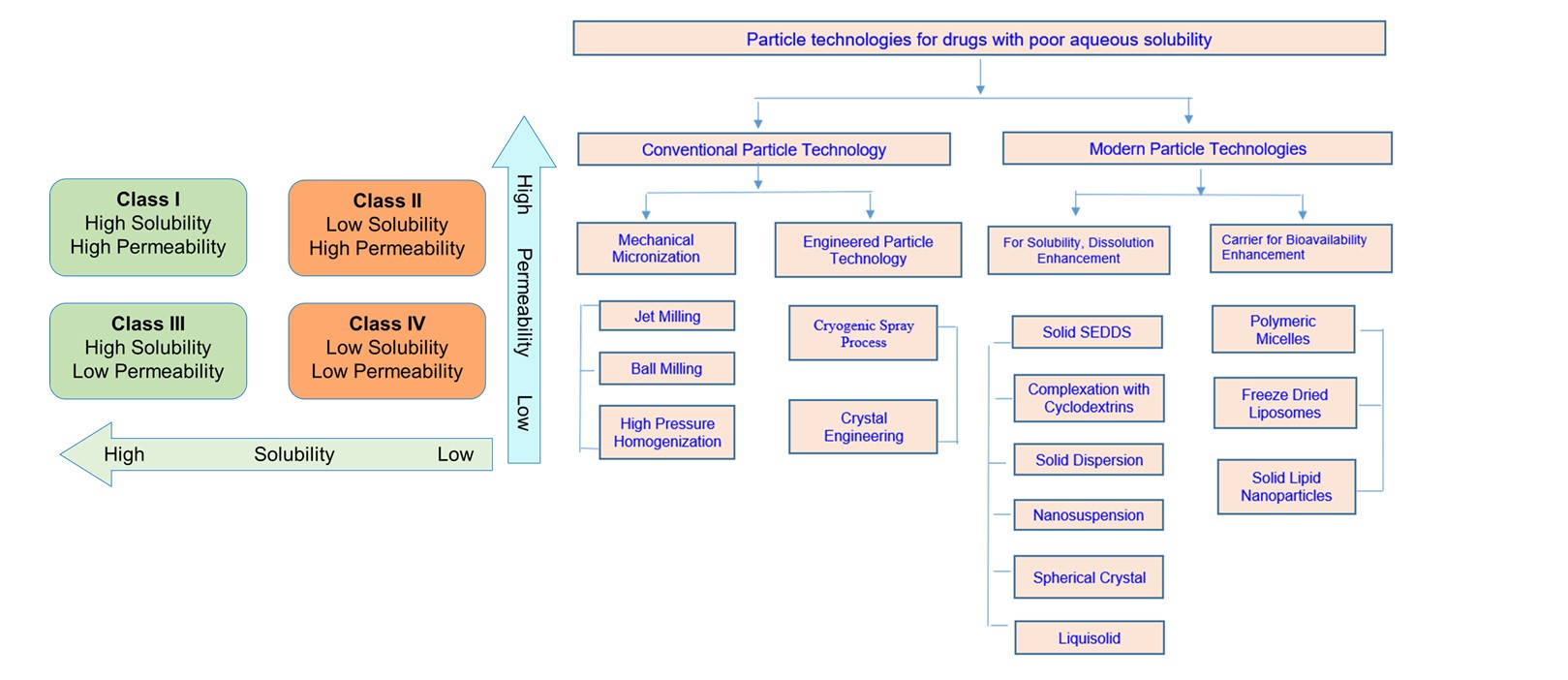
Drug solubility is the maximum concentration of the drug solute dissolved in the solvent under specific conditions of temperature, pH, and pressure. The solubility of a drug in a saturated solution is a static feature. In contrast, the rate of dissolution is a dynamic property more closely related to bioavailability. The rate and extent of drug absorption, as well as its bioavailability, are determined by solubility, dissolution, and gastrointestinal permeability [1]. Oral administration of medications remains the preferred route due to its numerous benefits, including ease of administration, high patient concordance, and economic viability. For an orally administered drug to reach its site of action through systemic circulation, it must first dissolve in the gastrointestinal fluids. The number of poorly soluble drugs has been greatly increased by combinatorial chemistry, computational molecular modeling, and high-throughput screening in drug discovery. Around 40% of existing pharmaceutical drugs and about 70–90% of drugs in the research pipeline are found to be poorly water-soluble [2]. Drug absorption from the gastrointestinal (GI) tract after oral administration is governed by aqueous solubility, an essential property for any drug [3,4]. A key challenge for the pharmaceutical industry is improving the solubility and bioavailability of poorly soluble drugs. Particle-based approaches to enhance solubility, dissolution, and bioavailability differ from conventional techniques [5]. 1.1. Biopharmaceutics Classification System (BCS) The Biopharmaceutics Classification System (BCS) is a scientific framework used to categorize drugs based on their solubility and permeability characteristics. A drug compound is considered to be highly soluble when the highest dose strength is soluble in 250 mL or less of aqueous media within the pH range of 1–6.8 at a temperature of 37 ± 1 °C. The 250 mL volume estimate is derived from standard bioequivalence study protocols that recommend administering the drug product to fasting human volunteers with an 8-ounce glass of water. The permeability limit of any drug is determined by measuring the rate of mass transfer of a drug through the human intestinal membrane or non-human systems, such as animal or in vitro culture methods. A drug is highly permeable when ≥ 90% of the dose is absorbed in humans relative to an intravenous reference [6]. BCS is considered an essential tool in the development of oral drug products. The Biopharmaceutics Classification System (BCS) considers two primary physicochemical attributes of drugs, solubility and intestinal permeability, which determine the extent of absorption following oral administration of a solid dosage form and consequently influence its bioavailability [7]. BCS Class I drugs have high solubility and high permeability, so they are well absorbed from the gastrointestinal tract and have high bioavailability after oral administration. When dissolved, BCS class II medicines show poor water solubility, but are well absorbed from the GIT. Because the rate of in-vivo dissolution is often the rate-limiting step in the absorption of class II drugs, improving the solubility and dissolution properties might be helpful to enhance their bioavailability. BCS Class III drugs exhibit high solubility but low permeability, which limits their ability to traverse biological membranes. Bioavailability is limited by the rate of permeability; however, dissolution is expected to occur rapidly. The addition of absorption enhancers to immediate-release solid dosage formulations of Class III drugs is a viable approach to improve their permeability. Drugs in the BCS Class IV category exhibit low aqueous solubility and poor membrane permeability, making them unsuitable candidates for formulation development, as improving solubility and dissolution alone may not be sufficient to enhance bioavailability. Unfortunately, most newly developed drugs are poorly water-soluble and hydrophobic in nature, corresponding to Class II or Class IV compounds under the Biopharmaceutics Classification System (BCS) [8]. 1.2. Science of Pharmaceutical Powders Powder technology has evolved from an art to a science, with applications across the culinary, chemical, and pharmaceutical industries [9]. Powder technology is an essential practice in the pharmaceutical sector because most pharmaceutical active ingredients and excipients are available in powder form. Pharmaceutical manufacturing processes involve the modification of powder particle characteristics to improve the solubility and dissolution properties of formulated drug products. Pharmaceutical powder engineering is concerned with the analysis of formulations, additives, raw materials, and processes to obtain desired particle characteristics [10,11]. Pharmaceutical powder technology deals with surface engineering areas explored through surface chemistry and surface morphology. For efficient dosage form design and development, the physical and chemical properties of the powder are critical. Ultimately, these properties must be optimized to develop a formulation that is readily soluble in the gastrointestinal tract (GIT) and exhibits adequate bioavailability [12]. 1.3. Particle Technologies for Improving Drug Solubility Pharmaceutical particle technologies improve the aqueous solubility of poorly water-soluble drugs, which otherwise show low dissolution in GI fluids and reduced in vivo bioavailability after oral administration [13]. Physical modifications to drug substances—such as micronization and crystal-habit modification—are standard methods for increasing solubility [14]. Beyond traditional micronization, particle engineering employs nanotechnology-based processes to improve solubility [5]. This review focuses on several particle technologies, including traditional size-reduction approaches as well as recent, innovative methods for the production of oral formulations of drugs with low water solubility. A brief account of various pharmaceutical technologies is demonstrated in Figure 1 and Table 1 [14,15,16,17,18,19,20,21,22,23,24,25,26,27,28,29,30,31,32,33,34,35,36,37,38,39,40,41]. Particle technologies employed for improving solubility properties of poorly soluble drugs.
Particle Technology
Method
Drugs
Reference
Mechanical Micronization
Jet milling
Cilostazol
[15]
Dienogest
[16]
Itraconazole
[17]
Bosentan Hydrate
[18]
Ball milling
Danazol
[19]
High pressure homogenization (HPH)
spironolactone, budesonide and omeprazole
[14]
Prednisolone, Carbamazepine
[20]
Curcumin
[21]
Engineered Particle Technology
Cryogenic spray process
Tacrolimus
[22]
Carbamazepine
[5]
Itraconazole
[23]
Crystal engineering
Temozolomide
[24]
Modern Particle Technologies
For solubility & Dissolution EnhancementSolid SEDDS
Paclitaxel
[25]
Gliclazide
[26]
Bambuterol hydrochloride
[27]
Complexation with cyclodextrins
Flavonoids
[28]
Temozolomide
[29]
Solid dispersion
Aripiprazole
[30]
Nano Suspension
Loratadine
[31]
Naringenin
[32]
Spherical crystal
Naproxen
[33]
Liquisolid
Carbamazepine
[34]
Particle Technology for Bioavailability Enhancement
Polymeric micelles
Paclitaxel
[35]
Etoposide, Docetaxel, 17-AAG
[36]
Epirubicin
[37]
Freeze dried liposomes
Sirolimus (Rapamycin)
[38]
Prednisolone
[39]
Solid lipid nanoparticles
Irbesartan
[40]
Norfloxacin, Miconazole
[41]
The reduction of particle size is considered one of the easiest approaches to improve the solubility properties of poorly soluble drugs. When particle size is reduced, the resulting increase in surface area enhances the surface area-to-volume ratio, thereby increasing the portion of the drug exposed to the dissolution medium. Consequently, particle size reduction technologies are commonly employed to improve the bioavailability of such drugs [3]. Approaches such as polymorphism, salt formation, cocrystallization, and excipient addition can marginally increase solubility but do not reliably enhance bioavailability [42]. As described by the Noyes–Whitney equation, decreasing particle size (and increasing surface area) enhances dissolution rate [16]. When the particle size is in nanoscale, the solubility increases rapidly, as per the Ostwald-Freundlich Equation (Equation (1)) [3,43]. This is because reducing particle size increases solvation pressure, thereby enhancing solubility while simultaneously disrupting solute–solute interactions that influence the solubilization process [44].
Conventional particle size reduction is considered a basic comminution method. Several technologies—such as nanotechnology-based nanosizing—are widely used to develop formulations of poorly water-soluble drugs [42,45,46].
2.1. Mechanical Micronization
Micronization is a conventional particle size reduction technique commonly employed to enhance the solubility of drugs [42]. In the mechanical micronization technique, coarse drug powder is converted into ultrafine powder with a mean particle size of 2 to 5 µm, and a very small proportion of particles have a size below 1 µm. Although micronization does not alter the equilibrium solubility of a drug, it increases the dissolution rate by enlarging the drug’s surface area, thereby facilitating the dissolution and diffusion processes into the aqueous phase [47]. Mechanical size reduction methods, such as crushing, grinding, and milling of bigger particles, is used to reduce the size of drug particles. Pressure, friction, attrition, abrasion, and shearing are the primary mechanisms involved in the aforementioned methods of particle size reduction. The mechanical micronization of drug substances commonly employs jet mills, ball mills, and high-pressure homogenization, with jet mills being the most widely used technique [48]. These size reduction methods have been previously reported in various studies to increase the dissolution rate and bioavailability of poorly water-soluble drugs by reducing particle size and thereby increasing surface area.
2.2. Jet Milling
Drug particle size can be reduced from 20–100 μm to less than 10 μm by jet milling. A fluid jet mill uses the energy of the fluid to achieve ultrafine grinding of medicinal powders (high-pressure air) (Figure 2). It has various advantages, including a dry process, size reduction with narrow particle size distributions in the micron range, and the absence of contamination, making it excellent for heat-sensitive pharmaceuticals [49]. In a study conducted by Jinno et al., milling enhanced the in vitro dissolution rate of the poorly soluble drug cilostazol. A moderate increase in bioavailability was reported in cilostazol suspension produced by jet milling. However, in the same study, cilostazol nanocrystal suspension had much higher bioavailability, demonstrating that reducing the drug’s particle size to the nanometer (nm) range is more beneficial for boosting the bioavailability of drugs with limited water solubility [15]. Dienogest is a synthetic progesterone that is orally active and indicated in endometriosis, hysteromyoma, and uterine leiomyoma therapy. In the study conducted by Pankaj and co-researchers, Dienogest Oral Tablet is being developed using the micronization process, which typically involves size reduction of solid drug particles to 1 to 10 microns via attrition (Fluid Energy or Air Jet Mill) methods. Micronization of dienogest improved dissolution across multiple media compared with the non-micronized form [16].
2.3. Ball Milling
A ball mill is typically a cylinder-based grinding system that is utilized to grind and blend the bulk coarse material into nanosized particles using different-sized balls, rotating around a horizontal axis to grind pharmaceutical powders. Grinding media, such as ceramic balls, flint pebbles, or stainless-steel balls, are partially placed in the apparatus with the material to be pulverized (Figure 3). The quantity of balls and the starting material determines the volume of the vessel filling and the speed of the milling operation. Although there are differences in the literature, the balls and the starting material typically occupy ~50% and ~25% of the vessel volume, respectively [47].
Ball mills are classified into two groups depending on their mechanism: direct and indirect milling. In the first case, direct milling, the particles are directly influenced by rollers or mechanical shafts and transmit kinetic energy. In the second case, indirect milling, the kinetic energy is first transmitted to the mill body and then to the grinding medium. In the field of cellulose, ball mills are the most frequently used, and they can be further divided into three groups based on design: tumbler ball mills, vibratory mills, and planetary mills. A Tumbler mill consists of a cylinder revolving around its longitudinal axis, partially filled with steel balls. The method’s efficiency primarily depends on the mill diameter in this type of instrument. Larger diameters allow greater fall height and, as a result, higher energy to be transferred to the balls. In vibratory mills, the jar carrying the sample and the grinding medium is agitated back and forth at high vibrational frequencies. The vibratory frequency, vibration amplitude, and mass of the milling medium are all important parameters in this scenario. Finally, the vessels in a planetary mill are mounted on a revolving support disc that rotates around its own axis. Again, the size of the vessels is an important factor in the process’s efficiency because a longer distance allows for more kinetic energy and thus larger collisions [50]. A modernized variant of the ball mill can be called media milling. It is a typical wet-milling technique in which drug particles are subjected to conventional ball milling in an aqueous or non-aqueous liquid medium, ensuring sufficient dispersion. Grinding balls, also known as milling media, cause mechanical attrition and impaction of dispersed drug particles in media milling. They are made of a range of materials, including glass (yttrium-stabilized), zirconium oxide, ceramics, or strongly cross-linked polystyrene resins. Unlike ball milling, where the entire vessel rotates during operation, media milling keeps the vessel fixed [47]. Liversidge and Cundy reported in 1995 that a nanoparticulate formulation of a poorly water-soluble drug could be prepared by ball milling. When compared to an aqueous suspension of standard Danazol particles, Danazol, a poorly soluble medication, showed better bioavailability in beagle dogs [19]. Graeser et al. (2006) suggested that, when milled together with polymeric compounds, the size reduction achieved through the ball milling process is a critical factor in the preparation of amorphous drug powders. As the amorphous state is more readily soluble than the crystalline form due to higher Gibbs free energy, the preparation of the amorphous form is a critical approach to enhance drug dissolution [51].
2.4. High Pressure Homogenization
High-Pressure Homogenization (HPH) is a top-down technology commonly used for the preparation of nanosuspensions of drugs with low water solubility. The high-pressure homogenization technique is used for many poorly water-soluble drugs, such as spironolactone, budesonide, and omeprazole, to improve dissolution rate and bioavailability by producing nanosized particles [14]. Various disadvantages have been seen in traditional size reduction methods, such as amorphous transformation, polymorphic transformation, and metal contamination due to the high mechanical energy associated. So, to overcome these problems high pressure homogenization (HPH) technique is established [21]. Due to this cause, HPH is especially beneficial for the reduction of drug particles. A suitable liquid disperses the solids, which are then forced through a high-pressure homogenizer. This device functions as a narrow bottleneck through which the suspension passes at high velocity and subsequently experiences a rapid pressure drop, resulting in turbulent flow conditions and cavitation (Figure 4). The collision of the particles with each other accomplishes particle comminution. The drop in pressure and the number of passes through the homogenizer are two elements that affect homogenization in this process [14,52].
Even though traditional size-reduction methods are simple and convenient, they are not always appropriate, depending on the drug or the particle features to be micronized. Traditional size-reduction procedures are thought to have certain limitations, such as lower success rates due to their high energy requirements, the possibility of drug thermal and chemical degradation, and a lack of precision in particle size distribution [53]. Traditional milling procedures have limitations in managing form, size, morphology, surface characteristics, and electrostatic charge, and can result in agglomerates or different particle shapes [54]. Many particle engineering approaches have been formed and are utilized to acquire the appropriate particle size and characteristics in order to solve these limitations. 3.1. Cryogenic Spray Processes Cryogenic spray processes operate at extremely low temperatures to form nanosized, highly porous amorphous particles. Cryogenic spray processes are new methods for improving the dissolution rate of poorly soluble drugs by forming nanosized amorphous drug particles with high porosity at extremely low temperatures, which are then dried using freeze-drying, atmospheric freeze-drying, vacuum freeze-drying, and lyophilization to produce dry powder. Spray freezing on cryogenic fluids, spray freezing into vapor over liquid (SFV/L), and ultra-rapid freezing are all cryogenic spray techniques used to create smaller drug particles with better wettability [14]. Briefly, the drug and the carrier (mannitol, maltose, lactose, inositol, or dextran) are dissolved in water and atomized above the surface of a boiling, agitated cryogenic fluid. Further, the solution/dispersion is subjected to spray freezing in a cryogenic gas, followed by precipitation of particles in supercritical or compressed fluid CO2, resulting in frozen solid particles [55]. The spray freezing into vapor over liquid (SFV/L) technique produces fine, highly wettable drug particles through the rapid freezing of drug solutions in cryogenic fluid vapors, followed by subsequent removal of the frozen solvent. The atomized droplets typically begin to freeze in the vapor phase during SFV/L before they enter the cryogenic liquid. In the unfrozen regions of the atomized droplet, the drug is supersaturated as the solvent freezes, allowing fine drug particles to nucleate and grow. The feed solution is atomized by a nozzle above the boiling refrigerant, and the resulting droplets freeze instantly upon contact with the cryogen. The solvent is removed from the frozen powder by lyophilization. Liquid nitrogen, chlorofluorocarbons, and halocarbons are the cryogenic media utilized in the traditional spray freezing into vapor technique. However, the downside of this method is the use of chlorofluorocarbons, as they deplete the ozone layer, and when alternatives to chlorofluorocarbons (such as hydrofluoroalkane) are used, it can reduce the potency of the powder formulation, as they can solubilize the active pharmaceutical ingredient (API) [55]. Use of nitrogen vapors may lead to a wide distribution of particle sizes and non-micronized dry powders due to gradual agglomeration and solidification of droplets, as atomization occurs into the nitrogen vapor above the liquid gas [8]. Ultra-rapid freezing: Ultra-rapid freezing is a novel cryogenic technology that involves the use of solid cryogenic substances to produce nano-sized drug particles with high surface area and improved surface morphology. When a drug solution is sprayed on the surface of a solid cryogenic substance, it results in instantaneous freezing followed by subsequent lyophilization (for solvent removal) to form a drug powder with increased solubility. The phase separation and crystallization of the pharmaceutical ingredients are prevented by ultra-fast freezing [23]. Solid dispersions of Tacrolimus using poloxamer 407 prepared by an Ultra-rapid Freezing (URF) process show a 1.5-fold increase in AUC. This might be due to enhanced supersaturation characteristics offered by the URF process, which leads to increased oral absorption of tacrolimus [22]. 3.2. Pharmaceutical Crystal Engineering Crystal Engineering can be defined as ‘understanding of intermolecular interactions with respect to crystal packing and the use of such knowledge in the design of particles with the desired physical and chemical properties. Crystal engineering technology can be applied to enhance drug solubility by controlled crystallization processes like formation of nanocrystals, co-crystals, metastable polymorphs, high-energy amorphous forms, ultrafine particles, etc [56]. Co-crystal formation can be a better option than salt formation of neutral compounds or weakly ionizable groups [57]. A key problem for Temozolomide, an antitumor drug, is discoloration due to hydrolytic degradation at room temperature within a few weeks. In laboratory conditions, Temozolomide cocrystals with oxalic acid, salicylic acid, and succinic acid demonstrated outstanding stability for up to one year, and in addition to that, the succinic acid cocrystal also remains stable in long-term stability studies without signs of discoloration [24]. Drug nanocrystals are crystals of drugs smaller than one μm without any matrix content [58]. The application of crystal engineering in pharmaceutical science is nano co-crystallization, which can also be applied to improve the dissolution rate and bioavailability of drugs. In a study, baicalein–nicotinamide (BE–NCT) nanococrystals were prepared using a high-pressure homogenization process and evaluated both in vitro and in vivo. BE-NCT nanococrystals outperform Baicalein (BE) coarse powder in an in vitro dissolving test by more than 2-fold. BE-NCT nanococrystals (6.02-fold) had a considerably larger integrated AUC0-t than BE coarse powder (1-fold), BE-NCT cocrystals (2.87-fold), and BE nanocrystals (2.87-fold) after oral administration (3.32-fold) [59]. Wet milling, indirect sonication, and ultrasonic melt precipitation are some of the solvent-free drug crystal engineering techniques that can be applied. Using the self-emulsifying excipient gelucire 44/14, all three approaches were examined for Febantel, and all reduced the size of the drug crystals and improved the drug’s dissolution [60]. 3.3. Solid Self-Emulsifying Drug Delivery Systems Solid self-emulsifying drug delivery systems (S-SEDDS) are gaining popularity as a new particle technology for improving the solubility of lipophilic drugs. S-SEDDS technology is groundbreaking because it provides a cost-effective alternative to traditional liquid SEDDS for the formulation of pharmaceuticals with low aqueous solubility. The SEDDS is an isotropic mixture of oils and surfactants, with or without cosolvents, that creates an oil-in-water emulsion spontaneously when gently agitated with water. Because the free energy required to create an emulsion is less than the entropy, it forms acceptable oil-in-water emulsions with only modest agitation, such as GI motility, when it enters the GI media. S-SEDDS are made by employing various solidification processes to combine liquid or semisolid self-emulsifying (SE) materials with powders or nanoparticles (e.g., spray drying, melt granulation, adsorption to solid carriers, or melt extrusion) [61]. S-SEDDS are solid at room temperature and can be utilized in SE capsules, SE solid dispersions, dry emulsions, SE pellets and tablets, SE microspheres, SE nanoparticles, SE suppositories, and SE implants, among other dosage forms. S-SEDDS are commonly made as liquids or as soft gelatin capsules, which are more convenient than regular liquid SEDDs. By producing solid SEDDS, the advantages of SEDDS (i.e., higher solubility and bioavailability) are combined with those of solid dosage forms, such as lower processing costs, simpler process management, greater stability, reproducibility, and greater patient compliance [62]. Gliclazide solid-SEDDS morphology, as observed by scanning electron microscopy, showed spherical granular particles, suggesting strong flow capability. X-ray diffraction studies have confirmed the solubilization of the drug in lipid excipients and/or into its amorphous form. In vitro dissolution tests have demonstrated increased drug release from solid-SEDDS compared to the plain drug and marketed formulations [26]. Some critical aspects of S-SEDDS, such as vegetable oils degradation, glyceride-associated physical aging, and drug and excipient reactions, must be addressed when formulating future S-SEDDS formulations [63]. Studies have demonstrated the limits of S-SEDDS, such as heavy adsorption and physical connection of the drug with the carriers, which cause delayed or partial drug release from S-SEDDS [64]. 3.4. Complexation with Cyclodextrins Cyclodextrins are a type of starch made up of (1,4)-linked a-D-glucopyranose units with a center lipophilic chamber and an outside hydrophilic surface. Cyclodextrins consist of cyclic structures containing six, seven, eight, nine, or ten (or more) D-glucopyranose units linked through (1,4)-glycosidic bonds [65]. Cyclodextrins do not penetrate lipophilic membranes because they are large molecules [66]. Cyclodextrin molecules are shaped like truncated cones with a central hydrophobic cavity and a hydrophilic surface, so cyclodextrin can integrate a wide range of compounds to form host-guest complexes [67]. The apparent solubility of many lipophilic drugs is reported to be increased by the preparation of non-covalent inclusion complexes with cyclodextrins. Cyclodextrins are crystalline complexing compounds that are used in pharmaceutical formulations to boost API solubility, bioavailability, stability, mask drug color and taste, and prevent gastrointestinal discomfort. Inclusion complexes are created when the “guest” molecule, which usually includes a drug, that partially or entirely goes inside the “host’s cavity.” As a host, cyclodextrins provide a suitable space for contact due to the hydrophobic cavity. The outer sphere of cyclodextrins is water-compatible, allowing hydrogen bonding interactions. Cyclodextrins form inclusion complexes with a wide range of hydrophobic compounds because they modify the physicochemical and biological properties of drug molecules [68,69,70]. Various methods are used for preparation of drug cyclodextrin complex such as freeze drying, spray drying, co-precipitation of a cyclodextrin/drug solution, kneading, extrusion and grinding of slurry of drug and cyclodextrin, and each of these methods have different outcomes in terms of particle size, amount of complex formation, and the degree of amorphous nature of the final product [68]. Flavonoid compounds have limited aqueous solubility, which hinders their oral administration, also decreasing the bioavailability and pharmacological activities. Dos Santos Lima et al. developed a formulation that improves the solubility and bioavailability of the flavonoids by using the cyclodextrin inclusion complexation method. Pharmacokinetic study results show that the bioavailability of flavonoid compounds, complexed with cyclodextrins, was extensively improved when compared to uncomplexed flavonoids [29]. Cyclodextrins are effective as complexing agents for poorly soluble anti-cancer medicines, improving their solubility, dissolution, and hence drug bioavailability [71]. The use of amphiphilic cyclodextrin in the production of highly loaded nanostructured systems to improve the parenteral administration of poorly soluble medicines such as bifonazole and clotrimazole has also been documented. An innovative approach to creating nanospheres for the intravenous formulation of poorly soluble pharmaceuticals is to combine amphiphilic cyclodextrin with drug inclusion complexes [72]. 3.5. Solid Dispersion Solid dispersions can be defined as ‘the dispersion of one or more drugs in an inert carrier at solid state prepared by the melting method, solvent method, and/or melting solvent method’. First-generation solid dispersion or Eutectic mixtures: The eutectic mix can be prepared by rapid solidification of a melted physical mixture of the drug and the carrier [73]. Crystalline carriers like urea and sugars are used to prepare this type of dispersion. First-generation dispersion is more thermodynamically stable and hence retard the release of the drug [74]. Second generation solid dispersion or amorphous precipitation: Drugs with low carrier solubility or high melting point can be forced solubilized into amorphous carriers such as PVP, PEG, Cellulose derivatives, etc., to prepare a second-generation dispersion. Based on the physical state of the drug in dispersion, this can be classified as amorphous solid suspensions or amorphous solid solutions [glass solutions]. As a drug is forced to solubilize to form a dispersion, the major disadvantage of the method is drug precipitation and recrystallization, which affect the in vitro or in vivo drug release. Third-generation solid dispersion or Solid solution: Third-generation dispersion contains carriers with surface activity and self-emulsifying properties, such as Poloxamer 408, Tween 80, and Gelucire 44/14 [74]. The advantages of solid dispersion techniques are: Reduced particle size, which results in increased dissolution by increasing surface area, improved wettability that increases solubility and hence bioavailability, an Amorphous state of the drug helps to improve solubility, and enhanced porosity. Drawbacks of this technique are instability of formulation due to moisture content, difficulty in incorporating it into dosage forms, and difficulty in handling. Ticagrelor, a BCS class IV drug when formulated into a solid dispersion using the solvent evaporation method, shows a 34-fold increase in drug release as compared to the commercial product in distilled water. Peak plasma concentration (Cmax) and relative bioavailability of solid dispersion formulation and pure drug were found to be 238.09 ± 25.96% and 219.78 ± 36.33%, respectively [75]. 3.6. Nanosuspension Nanosuspensions are defined as a nanosized aqueous dispersion of poorly soluble drug in aqueous or nonaqueous liquid media such as liquid PEG or oils with an average particle size ranging between 200 and 600 nm, and stabilized by surfactant, polymer, or both [76,77]. Two types of methods are used in the formulation of nanosuspensions: Top-down methods like Wet milling, Dry milling, High Pressure Homogenization, and co-grinding Bottom-up methods like Antisolvent precipitation method, Liquid emulsion technique, and Sono-precipitation method. These methods are followed by various solidification techniques like freeze-drying, spray-drying, and spray-freezing. Nanosuspensions demonstrate a number of advantages, such as improved aqueous solubility and bio-availability, a simple production method, and can be incorporated in various dosage forms like tablets, capsules, pellets, etc., lowering fasted/fed variability in drug absorption and distribution. 3.7. Spherical Crystals Spherical crystallization is a technique that enables the direct transformation of crystalline drugs into compact spherical agglomerates, thereby enhancing their flowability, solubility, and compactability. This technique is used for particle size enlargement, applying crystallization and agglomeration with a bridging liquid. Particle orientation is influenced by crystal habit; therefore, it can modify a drug molecule’s physical stability, solubility, and dissolution profile. It would be reasonable to expect that spherical crystallization could improve the manufacturability and dissolution performance of drugs. The precipitated crystals can be agglomerated into more or less spherical particles of 300-500 μm using this approach, eliminating the need for binders during the final synthesis phase. Spherical crystallization has been shown to improve the solubility profile of some drugs that are poorly water-soluble. Briefly, a saturated drug solution in a good solvent is poured into a poor solvent according. Small amounts of a third solvent, known as the bridging liquid, are then added to moisten the crystal surface and facilitate the creation of liquid bridges between the drug crystals, resulting in spherical agglomerates. The affinity between the drug and the good solvent should be high. In addition, the bridging liquid should not be miscible with the bad solvent. Agglomeration growth can be divided into four stages: Zones of flocculation, zero growth, rapid growth, and constant size (Figure 5) [78,79]. Maghsoodi and colleagues produced Naproxen agglomerates using a simple spherical crystallization process, which showed better micromeritics and dissolution rate properties. Because of their enhanced solubility, the agglomerates were found to have enhanced anti-inflammatory action in rats than the pure drug [33]. 3.8. Liquisolid Compacts Liquisolid technique refers to the process of converting liquid pharmaceuticals into seemingly dry, non-adherent, free-flowing, and compressible powder mixtures by combining them with suitable excipients, also known as carriers and coating ingredients. The liquid medicine is first absorbed into the carrier’s internal architecture. When the inside of the carrier is saturated with liquid medication, a liquid layer forms on the carrier particles’ surface, which the tiny coating materials quickly adsorb [80]. This method can produce liquisolid tablets or capsules with pH-independent drug release profiles. Furthermore, the high flowability and compressibility of liquisolid powder make large-scale production viable. This approach works well for water-insoluble low-dose medications, but its fundamental drawback is the inability to incorporate water-insoluble high-dose drugs into liquisolid systems. As these medications require a substantial volume of liquid vehicle, large amounts of carrier and coating material are necessary to produce a liquid-solid powder with good flow and compressible qualities. This may cause the tablet’s weight to exceed the limit, making it difficult for patients to swallow. Several approaches to overcoming the barrier as mentioned above have been documented. For example, increasing the viscosity of liquid pharmaceuticals with additives (such as PVP and PEG 35000) can reduce the amount of carrier and coating material needed. Organic solvents employed in the liquisolid technique should be orally safe, with water-miscible, high-boiling-point solvents, such as PEG 400, preferred. To absorb liquid medication, carriers should be porous materials with a large specific surface area and a high liquid absorption capacity. As a carrier, various grades of cellulose, starch, and lactose can be employed. As coating materials, however, only excipients with very tiny particle size and high adsorptive properties, such as silica powder, can be utilized. Remeth et al. developed carbamazepine liquisolid compacts using carriers such as Neusilin®, Fujicalin®, and PEG [34]. 3.9. Polymeric Micelles The ability of a copolymer to self-assemble into nanoscale aggregates with a hydrophilic shell and a hydrophobic center characterizes polymeric micelles. The hydrophobic polymeric micelle’s core provides a home for water-insoluble pharmaceuticals, while the hydrophilic shell effectively isolates the drugs from the outside environment and prevents their rapid degradation [81,82,83]. Block copolymer micelles are further classified based on the intermolecular forces that drive the separation of the core segment from the aqueous environment, such as amphiphilic micelles (formed by hydrophobic interactions), poly-ion complex micelles (formed by electrostatic interactions), and metal complexation micelles. The shape of the micelle is determined by the length of the hydrophobic center and the hydrophilic corona. Micelles are spherical when the hydrophilic segment is longer than the core block, but when the core segment is longer than the corona-forming chains, different non-spherical structures, such as rods and lamellae, arise [84]. Polymeric micelles offer several advantages as drug carriers for poorly soluble drugs, including stability, safety, and affordability. Through the enhanced permeability and retention (EPR) effect of the micelle-encapsulated drug, it is feasible to target organs or tissues of interest. For site-specific targeting of polymer micelles, thermo-sensitive or pH-sensitive block co-polymers can be prepared, as well as a vector molecule such as an antibody, peptide, lectin, saccharide, hormone, or some low molecular weight compounds that can be attached to the surface of micelles to help target specific ligands at specific sites of interest can be employed [85]. Polymeric micelles can spontaneously collect in tumors due to the EPR effect; hence, they are used in tumor targeting by integrating an anticancer antibody onto the micelle’s surface. High solubility, increased bioavailability, and long-term stability of anticancer drugs such as Paclitaxel can be achieved by dialysis of the molecule into hydrotropic polymer micelles [35]. A new polymeric micelle framework for solubilizing and improving the bioavailability of anticancer medicines that are poorly soluble: 17-allylamino-17-demethoxygeldanamycin, paclitaxel, etoposide, docetaxel, and 17-allylamino-17-demethoxygeldanamycin are investigated by researchers [36]. By introducing the hydrophobic polymer into the micellar core for interlacing the monomers and stabilizing the micelle structure, Wen and colleagues created polymer-stabilized micelles. Medicines loaded in polymer-stabilized micelles exhibit lower clearance, higher plasma concentration, and poor volume distribution than drugs loaded in non-polymer-stabilized micelles, according to in vivo pharmacokinetic studies. Micelles stabilized by polymers can limit rapid drug clearance by strengthening the micellar structure and increasing the amount of accessible drug in plasma, expanding the range of medicinal applications for micelles [86]. Quader et al. formulated cyclic-Arg-Gly-Asp (cRGD) micellar nanomedicines that loaded Epirubicin, a potent anti-glioblastoma drug, via a pH-sensitive hydrazone bond for effective treatment of glioblastoma multiforme. These cRGD-installed epirubicin-loaded polymeric micelles (cRGD-Epi/m) penetrated U87MG cell-derived 3D-spheroids faster and deeper than the non-cRGD-installed micelles, possibly via a cRGD-integrin mediated pathway. By distributing high amounts of Epirubicin throughout the tumor tissue in vivo, the cRGD-installed micelles significantly reduced the growth of an orthotropic glioblastoma multiforme [37]. 3.10. Freeze Dried Liposomes Liposomes are phospholipid vesicles that consist of a phospholipid bilayer surrounding an aqueous compartment and can dissolve lipophilic drugs in their lipid domain. As a drug carrier for drug delivery systems, because both hydrophilic and lipophilic compounds can be carried, liposomes have attracted greater interest [87]. Liposomes are phospholipid vesicles with one or more bilayers surrounding an aqueous core; they can incorporate hydrophilic drugs (aqueous core) and lipophilic drugs (bilayer)that contain or have phospholipids and cholesterol. Liposomes have an amphiphilic phospholipid bilayer, which closely resembles the mammalian cell membrane, allowing efficient liposome-cell membrane interactions and subsequently efficient cellular uptake. Phospholipid is an important essential component that gives liposomes their distinct features, such as how they encapsulate substances and how they are functionalized in the body [88]. Liposome qualities are influenced by size, surface charge, number of lamellae, bilayer rigidity, surface modification, and preparation process, among other factors [89]. They deliver a versatile, adaptable technology for improving drug solubility due to their biphasic characteristics and diverse nature and composition [90]. Drug encapsulation or liposome trapping can alter the properties of free drugs, affecting pharmacokinetics and pharmacodynamics, and can also help reduce toxicity and, in some instances, boost therapeutic efficacy [91]. However, one of the significant drawbacks of using liposomes as drug delivery vehicles is their inability to maintain stability during storage [38]. The freeze-drying approach is used to stabilize the liposomal formulations, resulting in dry powders with greater stability while keeping the drug’s efficacy. The stability of freeze-dried Prednisolone sodium phosphate-loaded long-circulating liposomes was examined in relation to cryoprotectant type and concentration. Trehalose was found to be superior in maintaining the structural integrity and permeability properties of the liposome bilayers at a 5:1, carbohydrate to lipid molar ratio, ensuring the desired characteristics of the final product: a porous cake that is easy to reconstitute, a similar size to the liposomes before freeze-drying, a high % of encapsulated drug, and a low residual moisture content [39]. After freeze-drying, the liposomal formulation was shown to have improved solubility and physicochemical stability. As a result, pharmaceuticals can be made with liposomes, a polymer, and a cryoprotectant, then freeze-dried to produce a dry, lyophilized powder. In some circumstances, polymers such as PEG are utilized to solubilize the drug in the liposomal solution. The aqueous solubility of a PEGylated liposomal formulation has been reported to be improved [92]. 3.11. Solid Lipid Nanoparticles Solid Lipid nanoparticles (SLNs) are made of a solid lipid matrix consisting of a drug covered by a monolayer of surfactant. Solid lipids used for SLNs formation are mono/di/tri-triglycerides, fatty acids, steroids, and waxes. Poloxamer, polysorbate 20 or 80, phosphatidyl choline, soy or egg lecithin, poloxamine, sodium dodecyl sulfate, sodium oleate, sodium taurocholate, sodium glycocholate, sorbitan monolaurate or monooleate, and butanol are all surfactants used to stabilize the lipid dispersion. High-pressure homogenization (hot/cold homogenization), Ultrasonic/high-speed homogenization (probe/bath ultra-sonication), Solvent evaporation method, Solvent emulsification-diffusion method, Supercritical fluid method, Microemulsion-based method, Double emulsion method, Precipitation Technique, Film-ultrasound dispersion using a membrane contractor, and using a solvent injection technique are employed in the preparation of SLNs [41]. The interest in SLN as a novel particle technology has recently increased due to its potential as an alternative carrier system to conventional colloidal carriers such as emulsions, liposomes, and polymeric micro and nanoparticles, as well as its ability to be used in a variety of drug delivery applications [20]. SLN technology has various benefits and downsides, according to Mehnert and Mader, including improved drug targeting, greater drug stability, reduced carrier biotoxicity, and the ability to incorporate both lipophilic and hydrophilic drugs into the carrier. However, some disadvantages of SLN, such as limited drug-loading capacity and stability issues during storage or administration (gelation, particle size increase, SLN drug ejection), cannot be overlooked [93]. Soma and colleagues used glyceryl monostearate to prepare Irbesartan solid lipid nanoparticles using a solvent emulsification process followed by probe sonication. The formulation was then tested in Wistar rats to investigate pharmacokinetics. In Wistar rats, irbesartan-loaded SLN with a particle size of 523.7 nm and a 73.8% entrapment efficiency demonstrated good bioavailability and optimum stability. The SLN produced via solvent emulsification with glyceryl monostearate improves the drug’s bioavailability [40]. Miconazole SLNs formulation shows an increase in oral bioavailability 2.5-fold and antifungal activity of miconazole against candidiasis compared to the capsule formulation [41].
The future perspective of solubility enhancement techniques in pharmaceuticals emphasizes a shift toward advanced, eco-friendly, and highly efficient approaches, including nanotechnology, supercritical fluid technology, and interdisciplinary strategies. Future advancements will emphasize nanotechnology — particularly nanocrystals and lipid-based nanocarriers —and supercritical fluid technologies, as well as solid dispersion systems, to address issues associated with poorly soluble medications. The shift towards sustainable practices, including the adoption of supercritical CO2 rather than organic solvents, is expected to grow, driven by regulatory standards and sustainability aspirations. Moreover, a growing trend is the integration of computational methods with machine learning (ML) to predict and optimize strategies to enhance solubility. ML models, such as support vector machines and deep learning algorithms, can effectively predict solubility and bioavailability, facilitate drug development and reduce the number of experimental trials required. Thus, advancements in this domain will be driven by collaborative efforts among pharmaceutical scientists, computational chemists, engineers, and regulatory specialists. The integration of experimental and computational techniques is anticipated to yield more efficient, safer, and more targeted strategies to improve solubility.
To improve drug water solubility, many pharmaceutical particle technologies have been used. There are two types of particle technologies: traditional techniques and current particle technologies. Mechanical micronization and Engineered particle methods are two common approaches. Mechanical micronization methods are convenient and straightforward for reducing particle size and increasing surface area, thereby improving the solubility and dissolution of poorly soluble drugs. However, they have drawbacks, such as high energy requirements, the potential for drug thermal and chemical degradation, and poor control over particle size distribution. Mechanical micronization methods have limitations; thus, engineered particle techniques are more acceptable. They provide a homogeneous particle size distribution, increased solubility and dissolution of poorly soluble pharmaceuticals, and physical modification of drug particles, such as changes in crystalline state. Each particle technology has distinct advantages and applications for enhancing the water solubility of poorly water-soluble drugs. The selection of an appropriate technique should be based on the physicochemical properties of the drug substance and the requirements of the intended dosage form.
GIT
Gastrointestinal Tract
BCS
Biopharmaceutics Classification System
HPH
High Pressure Homogenization
API
Active Pharmaceutical Ingredient
S-SEDDS
Solid Self-Emulsifying Drug Delivery Systems
PVP
Polyvinyl Pyrrolidone
PEG
Polyethylene Glycol
EPR
Enhanced Permeability and Retention
SLN
Solid Lipid Nanoparticle
Conceptualization, writing—original draft preparation, figure preparation: R.P.; writing—review and editing, supervision: K.P. All authors have read and agreed to the published version of the manuscript.
The authors declare no conflicts of interest.
The study did not receive any external funding and was conducted using only institutional resources.
Declared none.
[1] Tsume, Y.; Mudie, D.M.; Langguth, P.; Amidon, G.E.; Amidon, G.L. The Biopharmaceutics Classification System: Subclasses for in Vivo Predictive Dissolution (IPD) Methodology and IVIVC. Eur. J. Pharm. Sci. 2014, 57, 152–163. [CrossRef]
[2] Kumari, L.; Choudhari, Y.; Patel, P.; Das Gupta, G.; Singh, D.; Rosenholm, J.M.; Bansal, K.K.; Das Kurmi, B. Advancement in Solubilization Approaches: A Step towards Bioavailability Enhancement of Poorly Soluble Drugs. Life 2023, 13, 1099. [CrossRef]
[3] Williams, H.D.; Trevaskis, N.L.; Charman, S.A.; Shanker, R.M.; Charman, W.N.; Pouton, C.W.; Porter, C.J.H. Strategies to Address Low Drug Solubility in Discovery and Development. Pharmacol. Rev. 2013, 65, 315–499. [CrossRef] [PubMed]
[4] Krishnaiah, Y.S.R. Pharmaceutical Technologies for Enhancing Oral Bioavailability of Poorly Soluble Drugs. J. Bioequiv. 2010, 2, 028–036. [CrossRef]
[5] Hu, J.; Johnston, K.P.; Williams, R.O., 3rd. Spray Freezing into Liquid (SFL) Particle Engineering Technology to Enhance Dissolution of Poorly Water Soluble Drugs: Organic Solvent versus Organic/Aqueous Co-Solvent Systems. Eur. J. Pharm. Sci. 2003, 20, 295–303. [CrossRef]
[6] Papich, M.G.; Martinez, M.N. Applying Biopharmaceutical Classification System (BCS) Criteria to Predict Oral Absorption of Drugs in Dogs: Challenges and Pitfalls. AAPS J. 2015, 17, 948–964. [CrossRef] [PubMed]
[7] Reddy, B.B.K.; Karunakar, A. Biopharmaceutics Classification System: A Regulatory Approach. Dissolution Technol. 2011, 18, 31–37. [CrossRef]
[8] Kawabata, Y.; Wada, K.; Nakatani, M.; Yamada, S.; Onoue, S. Formulation Design for Poorly Water-Soluble Drugs Based on Biopharmaceutics Classification System: Basic Approaches and Practical Applications. Int. J. Pharm. 2011, 420, 1–10. [CrossRef]
[9] Leuenberger, H.; Lanz, M. Pharmaceutical Powder Technology—From Art to Science: The Challenge of the FDA’s Process Analytical Technology Initiative. Adv. Powder Technol. 2005, 16, 3–25. [CrossRef]
[10] Finke, J.H.; Kwade, A. Powder Processing in Pharmaceutical Applications-In-Depth Understanding and Modelling. Pharmaceutics 2021, 13, 128. [CrossRef] [PubMed]
[11] Davé, R.N.; Bilgili, E.; Cuitino, A.; Jallo, L. Special Issue on Pharmaceutical Powders: Towards Developing Understanding of the Influence of Materials and Processes on Product Performance. Powder Technol. 2013, 236, 1–4. [CrossRef]
[12] Dressman, J.B.; Vertzoni, M.; Goumas, K.; Reppas, C. Estimating Drug Solubility in the Gastrointestinal Tract. Adv. Drug Deliv. Rev. 2007, 59, 591–602. [CrossRef] [PubMed]
[13] Khadka, P.; Ro, J.; Kim, H.; Kim, I.; Kim, J.T.; Kim, H.; Cho, J.M.; Yun, G.; Lee, J. Pharmaceutical Particle Technologies: An Approach to Improve Drug Solubility, Dissolution and Bioavailability. Asian J. Pharm. Sci. 2014, 9, 304–316. [CrossRef]
[14] Savjani, K.T.; Gajjar, A.K.; Savjani, J.K. Drug Solubility: Importance and Enhancement Techniques. ISRN Pharm. 2012, 2012, 195727. [CrossRef] [PubMed]
[15] Jinno, J.I.; Kamada, N.; Miyake, M.; Yamada, K.; Mukai, T.; Odomi, M.; Toguchi, H.; Liversidge, G.G.; Higaki, K.; Kimura, T. Effect of Particle Size Reduction on Dissolution and Oral Absorption of a Poorly Water-Soluble Drug, Cilostazol, in Beagle Dogs. J. Control. Release 2006, 111, 56–64. [CrossRef]
[16] Pant, P.; Bansal, K.; Rao, P.R.T.; Padhee, K.; Sathapathy, A.; Kochhar, P.S. Micronization: An Efficient Tool for Dissolution Enhancement of Dienogest. Int. J. Drug Dev. Res. 2011, 3, 329–333.
[17] Karashima, M.; Sano, N.; Yamamoto, S.; Arai, Y.; Yamamoto, K.; Amano, N.; Ikeda, Y. Enhanced Pulmonary Absorption of Poorly Soluble Itraconazole by Micronized Cocrystal Dry Powder Formulations. Eur. J. Pharm. Biopharm. 2017, 115, 65–72. [CrossRef]
[18] Lee, H.J.; Kang, J.H.; Lee, H.G.; Kim, D.W.; Rhee, Y.S.; Kim, J.Y.; Park, E.S.; Park, C.W. Preparation and Physicochemical Characterization of Spray-Dried and Jet-Milled Microparticles Containing Bosentan Hydrate for Dry Powder Inhalation Aerosols. Drug Des. Devel. Ther. 2016, 10, 4017–4030. [CrossRef] [PubMed]
[19] Liversidge, G.G.; Cundy, K.C. Particle Size Reduction for Improvement of Oral Bioavailability of Hydrophobic Drugs: I. Absolute Oral Bioavailability of Nanocrystalline Danazol in Beagle Dogs. Int. J. Pharm. 1995, 125, 91–97. [CrossRef]
[20] Müller, R.H.; Mäder, K.; Gohla, S. Solid Lipid Nanoparticles (SLN) for Controlled Drug Delivery—A Review of the State of the Art. Eur. J. Pharm. Biopharm. 2000, 50, 161–177. [CrossRef]
[21] Homayouni, A.; Sohrabi, M.; Amini, M.; Varshosaz, J.; Nokhodchi, A. Effect of High Pressure Homogenization on Physicochemical Properties of Curcumin Nanoparticles Prepared by Antisolvent Crystallization Using HPMC or PVP. Mater. Sci. Eng. C 2019, 98, 185–196. [CrossRef]
[22] Overhoff, K.A.; McConville, J.T.; Yang, W.; Johnston, K.P.; Peters, J.I.; Williams, R.O., 3rd. Effect of Stabilizer on the Maximum Degree and Extent of Supersaturation and Oral Absorption of Tacrolimus Made by Ultra-Rapid Freezing. Pharm. Res. 2008, 25, 167–175. [CrossRef] [PubMed]
[23] Purvis, T.; Mattucci, M.E.; Crisp, M.T.; Johnston, K.P.; Williams, R.O., 3rd. Rapidly Dissolving Repaglinide Powders Produced by the Ultra-Rapid Freezing Process. AAPS PharmSciTech 2007, 8, E58. [CrossRef] [PubMed]
[24] Babu, N.J.; Sanphui, P.; Nangia, A. Crystal Engineering of Stable Temozolomide Cocrystals. Chem. Asian J. 2012, 7, 2274–2285. [CrossRef] [PubMed]
[25] Cho, H.Y.; Kang, J.H.; Ngo, L.; Tran, P.; Lee, Y.B. Preparation and Evaluation of Solid-Self-Emulsifying Drug Delivery System Containing Paclitaxel for Lymphatic Delivery. J. Nanomater. 2016, 2016, 3642418. [CrossRef]
[26] Deshmukh, S.R.; Bakhle, S.S.; Upadhye, K.P.; Dixit, G.R. Formulation and Evaluation of Solid Self-Emulsifying Drug Delivery System of Gliclazide. Int. J. Pharm. Pharm. Sci. 2016, 8, 144–151. [CrossRef]
[27] Saggar, S.; Upadhayay, A.; Goswami, M. Formulation and Evaluation of Solid Self-Emulsifying Drug Delivery System of Bambuterol Hydrochloride. Indian J. Pharm. Sci. 2019, 81, 661–672. [CrossRef]
[28] dos Santos Lima, B.; Shanmugam, S.; de Souza Siqueira Quintans, J.; José Quintans-Júnior, L.; de Souza Araújo, A.A. Inclusion Complex with Cyclodextrins Enhances the Bioavailability of Flavonoid Compounds: A Systematic Review. Phytochem. Rev. 2019, 18, 1337–1359. [CrossRef]
[29] Gürten, B.; Yenigül, E.; Sezer, A.D.; Malta, S. Complexation and Enhancement of Temozolomide Solubility with Cyclodextrins. Braz. J. Pharm. Sci. 2018, 54, e17513. [CrossRef]
[30] McFall, H.; Sarabu, S.; Shankar, V.; Bandari, S.; Murthy, S.N.; Kolter, K.; Langley, N.; Kim, D.W.; Repka, M.A. Formulation of aripiprazole-loaded pH-modulated solid dispersions via hot-melt extrusion technology: In vitro and in vivo studies. Int. J. Pharm. 2019, 554, 302–311. [CrossRef]
[31] Alshweiat, A.; Csóka, I.; Tömösi, F.; Janáky, T.; Kovács, A.; Gáspár, R.; Sztojkov-Ivanov, A.; Ducza, E.; Márki, Á.; Szabó-Révész, P.; et al. Nasal Delivery of Nanosuspension-Based Mucoadhesive Formulation with Improved Bioavailability of Loratadine: Preparation, Characterization, and in Vivo Evaluation. Int. J. Pharm. 2020, 579, 119166. [CrossRef]
[32] Singh, M.K.; Pooja, D.; Ravuri, H.G.; Gunukula, A.; Kulhari, H.; Sistla, R. Fabrication of Surfactant-Stabilized Nanosuspension of Naringenin to Surpass Its Poor Physiochemical Properties and Low Oral Bioavailability. Phytomedicine 2018, 40, 48–54. [CrossRef]
[33] Maghsoodi, M.; Hassan-Zadeh, D.; Barzegar-Jalali, M.; Nokhodchi, A.; Martin, G. Improved Compaction and Packing Properties of Naproxen Agglomerated Crystals Obtained by Spherical Crystallization Technique. Drug Dev. Ind. Pharm. 2007, 33, 1216–1224. [CrossRef]
[34] Dias, R.J.; Mali, K.K.; Ghorpade, V.S.; Havaldar, V.D.; Mohite, V.R. Formulation and Evaluation of Carbamazepine Liquisolid Compacts Using Novel Carriers. Indian J. Pharm. Edu. Res. 2017, 51, s69–s78. [CrossRef]
[35] Lee, S.C.; Huh, K.M.; Lee, J.; Cho, Y.W.; Galinsky, R.E.; Park, K. Hydrotropic Polymeric Micelles for Enhanced Paclitaxel Solubility: In Vitro and in Vivo Characterization. Biomacromolecules 2007, 8, 202–208. [CrossRef]
[36] Shin, H.C.; Alani, A.W.; Rao, D.A.; Rockich, N.C.; Kwon, G.S. Multi-Drug Loaded Polymeric Micelles for Simultaneous Delivery of Poorly Soluble Anticancer Drugs. J. Control. Release 2009, 140, 294–300. [CrossRef]
[37] Quader, S.; Liu, X.; Chen, Y.; Mi, P.; Chida, T.; Ishii, T.; Miura, Y.; Nishiyama, N.; Cabral, H.; Kataoka, K. cRGD Peptide-Installed Epirubicin-Loaded Polymeric Micelles for Effective Targeted Therapy against Brain Tumors. J. Control. Release 2017, 258, 56–66. [CrossRef]
[38] Ghanbarzadeh, S.; Valizadeh, H.; Zakeri-Milani, P. The Effects of Lyophilization on the Physico-Chemical Stability of Sirolimus Liposomes. Adv. Pharm. Bull. 2013, 3, 25–29. [CrossRef]
[39] Sylvester, B.; Porfire, A.; Van Bockstal, P.J.; Porav, S.; Achim, M.; Beer, T.; Tomuţă, I. Formulation Optimization of Freeze-Dried Long-Circulating Liposomes and In-Line Monitoring of the Freeze-Drying Process Using an NIR Spectroscopy Tool. J. Pharm. Sci. 2018, 107, 139–148. [CrossRef]
[40] Soma, D.; Attari, Z.; Reddy, M.S.; Damodaram, A.; Koteshwara, K.B.G. Solid Lipid Nanoparticles of Irbesartan: Preparation, Characterization, Optimization and Pharmacokinetic Studies. Braz. J. Pharm. Sci. 2017, 53, e15012. [CrossRef]
[41] Raza, A.; Sime, F.B.; Cabot, P.J.; Maqbool, F.; Roberts, J.A.; Falconer, J.R. Solid Nanoparticles for Oral Antimicrobial Drug Delivery: A Review. Drug Discov. Today 2019, 24, 858–866. [CrossRef]
[42] Leleux, J.; Williams, R.O., 3rd. Recent Advancements in Mechanical Reduction Methods: Particulate Systems. Drug Dev. Ind. Pharm. 2014, 40, 289–300. [CrossRef]
[43] Manca, M.L.; Lai, F.; Pireddu, R.; Valenti, D.; Schlich, M.; Pini, E.; Ailuno, G.; Fadda, A.M.; Sinico, C. Impact of Nanosizing on Dermal Delivery and Antioxidant Activity of Quercetin Nanocrystals. J. Drug Del. Sci. Technol. 2020, 55, 101482. [CrossRef]
[44] Junghanns, J.U.A.; Müller, R.H. Nanocrystal Technology, Drug Delivery and Clinical Applications. Int. J. Nanomed. 2008, 3, 295–309. [CrossRef]
[45] Al-Kassas, R.; Bansal, M.; Shaw, J. Nanosizing Techniques for Improving Bioavailability of Drugs. J. Control. Release 2017, 260, 202–212. [CrossRef]
[46] Slámová, M.; Prausová, K.; Epikaridisová, J.; Brokešová, J.; Kuentz, M.; Patera, J.; Zámostný, P. Effect of Co-Milling on Dissolution Rate of Poorly Soluble Drugs. Int. J. Pharm. 2021, 597, 120312. [CrossRef]
[47] Loh, Z.H.; Samanta, A.K.; Heng, P.W.S. Overview of Milling Techniques for Improving the Solubility of Poorly Water-Soluble Drugs. Asian J. Pharm. Sci. 2015, 10, 255–274. [CrossRef]
[48] Han, X.; Ghoroi, C.; To, D.; Chen, Y.; Davé, R. Simultaneous Micronization and Surface Modification for Improvement of Flow and Dissolution of Drug Particles. Int. J. Pharm. 2011, 415, 185–195. [CrossRef]
[49] Strobel, A.; Köninger, B.; Romeis, S.; Schott, F.; Wirth, K.E.; Peukert, W. Assessing Stress Conditions and Impact Velocities in Fluidized Bed Opposed Jet Mills. Particuology 2020, 53, 12–22. [CrossRef]
[50] Piras, C.C.; Fernández-Prieto, S.; de Borggraeve, W.M. Ball Milling: A Green Technology for the Preparation and Functionalisation of Nanocellulose Derivatives. Nanoscale Adv. 2019, 1, 937–947. [CrossRef]
[51] Graeser, K.A.; Patterson, J.E.; Zeitler, J.A.; Rades, T. The Role of Configurational Entropy in Amorphous Systems. Pharmaceutics 2010, 2, 224–244. [CrossRef]
[52] Keck, C.M.; Müller, R.H. Drug Nanocrystals of Poorly Soluble Drugs Produced by High Pressure Homogenisation. Eur. J. Pharm. Biopharm. 2006, 62, 3–16. [CrossRef]
[53] Sosna, T.; Mikeska, M.; Dutko, O.; Martynková, G.S.; Škrlová, K.; Barabaszová, K.Č.; Dčedková, K.; Peikertová, P.; Plachá, D. Micronization of Ibuprofen Particles Using Supercritical Fluid Technology. J. Nanosci. Nanotechnol. 2019, 19, 2814–2820. [CrossRef]
[54] Rasenack, N.; Müller, B.W. Micron-Size Drug Particles: Common and Novel Micronization Techniques. Pharm. Dev. Technol. 2004, 9, 1–13. [CrossRef]
[55] Rogers, T.L.; Hu, J.; Yu, Z.; Johnston, K.P.; Williams, R.O., 3rd. A Novel Particle Engineering Technology: Spray-Freezing into Liquid. Int. J. Pharm. 2002, 242, 93–100. [CrossRef]
[56] Varshosaz, J.; Ghassami, E.; Ahmadipour, S. Crystal Engineering for Enhanced Solubility and Bioavailability of Poorly Soluble Drugs. Curr. Pharm. Des. 2018, 24, 2473–2496. [CrossRef]
[57] Blagden, N.; de Matas, M.; Gavan, P.T.; York, P. Crystal Engineering of Active Pharmaceutical Ingredients to Improve Solubility and Dissolution Rates. Adv. Drug Deliv. Rev. 2007, 59, 617–630. [CrossRef]
[58] Joshi, K.; Chandra, A.; Jain, K.; Talegaonkar, S. Nanocrystalization: An Emerging Technology to Enhance the Bioavailability of Poorly Soluble Drugs. Pharm. Nanotechnol. 2019, 7, 259–278. [CrossRef]
[59] Pi, J.; Wang, S.; Li, W.; Kebebe, D.; Zhang, Y.; Zhang, B.; Qi, D.; Guo, P.; Li, N.; Liu, Z. A Nano-Cocrystal Strategy to Improve the Dissolution Rate and Oral Bioavailability of Baicalein. Asian J. Pharm. Sci. 2019, 14, 154–164. [CrossRef]
[60] da Fonseca Antunes, A.B.; De Geest, B.G.; Vervaet, C.; Remon, J.P. Solvent-Free Drug Crystal Engineering for Drug Nano- and Micro Suspensions. Eur. J. Pharm. Sci. 2013, 48, 121–129. [CrossRef]
[61] Tang, B.; Cheng, G.; Gu, J.C.; Xu, C.H. Development of Solid Self-Emulsifying Drug Delivery Systems: Preparation Techniques and Dosage Forms. Drug Discov. Today 2008, 13, 606–612. [CrossRef]
[62] Milović, M.; Djuriš, J.; Djekić, L.; Vasiljević, D.; Ibrić, S. Characterization and Evaluation of Solid Self-Microemulsifying Drug Delivery Systems with Porous Carriers as Systems for Improved Carbamazepine Release. Int. J. Pharm. 2012, 436, 58–65. [CrossRef] [PubMed]
[63] Yan, Y.D.; Kim, J.A.; Kwak, M.K.; Yoo, B.K.; Yong, C.S.; Choi, H.G. Enhanced Oral Bioavailability of Curcumin via a Solid Lipid-Based Self-Emulsifying Drug Delivery System Using a Spray-Drying Technique. Biol. Pharm. Bull. 2011, 34, 1179–1186. [CrossRef] [PubMed]
[64] Kang, M.J.; Jung, S.Y.; Song, W.H.; Park, J.S.; Choi, S.U.; Oh, K.T.; Choi, H.K.; Choi, Y.W.; Lee, J.; Lee, B.J.; et al. Immediate Release of Ibuprofen from Fujicalin®-Based Fast-Dissolving Self-Emulsifying Tablets. Drug Dev. Ind. Pharm. 2011, 37, 1298–1305. [CrossRef] [PubMed]
[65] Brewster, M.E.; Loftsson, T. Cyclodextrins as Pharmaceutical Solubilizers. Adv. Drug Deliv. Rev. 2007, 59, 645–666. [CrossRef]
[66] Singh, A.; Worku, Z.A.; Van den Mooter, G. Oral Formulation Strategies to Improve Solubility of Poorly Water-Soluble Drugs. Expert Opin. Drug Deliv. 2011, 8, 1361–1378. [CrossRef]
[67] Campos, C.A.; Lima, B.S.; Trindade, G.G.G.; Souza, E.P.B.S.S.; Mota, D.S.A.; Heimfarth, L.; Quintans, J.S.S.; Quintans-Júnior, L.J.; Sussuchi, E.M.; Sarmento, V.H.V.; et al. Anti-Hyperalgesic and Anti-Inflammatory Effects of Citral with β-Cyclodextrin and Hydroxypropyl-β-Cyclodextrin Inclusion Complexes in Animal Models. Life Sci. 2019, 229, 139–148. [CrossRef]
[68] Carrier, R.L.; Miller, L.A.; Ahmed, I. The Utility of Cyclodextrins for Enhancing Oral Bioavailability. J. Control. Release 2007, 123, 78–99. [CrossRef]
[69] Rasheed, A.; Kumar, C.K.A.; Sravanthi, V.V.N.S.S. Cyclodextrins as Drug Carrier Molecule: A Review. Sci. Pharm. 2008, 76, 567–598. [CrossRef]
[70] Gidwani, B.; Vyas, A. A Comprehensive Review on Cyclodextrin-Based Carriers for Delivery of Chemotherapeutic Cytotoxic Anticancer Drugs. Biomed Res. Int. 2015, 2015, 198268. [CrossRef]
[71] Memişoğlu, E.; Bochot, A.; Ozalp, M.; Sen, M.; Duchêne, D.; Hincal, A.A. Direct Formation of Nanospheres from Amphiphilic Beta-Cyclodextrin Inclusion Complexes. Pharm. Res. 2003, 20, 117–125. [CrossRef]
[72] Chiou, W.L.; Riegelman, S. Pharmaceutical Applications of Solid Dispersion Systems. J. Pharm. Sci. 1971, 60, 1281–1302. [CrossRef]
[73] Tekade, A.R.; Yadav, J.N. A Review on Solid Dispersion and Carriers Used Therein for Solubility Enhancement of Poorly Water Soluble Drugs. Adv. Pharm. Bull. 2020, 10, 359–369. [CrossRef] [PubMed]
[74] Thakur, D.; Sharma, R. Solid Dispersion a Novel Approach for Enhancement of Solubility and Dissolution Rate: A Review. J. Pharm. Sci. Bioscientific Res. 2019, 9, 200–207. [CrossRef]
[75] Kim, S.J.; Lee, H.K.; Na, Y.G.; Bang, K.H.; Lee, H.J.; Wang, M.; Huh, H.W.; Cho, C.W. A Novel Composition of Ticagrelor by Solid Dispersion Technique for Increasing Solubility and Intestinal Permeability. Int. J. Pharm. 2019, 555, 11–18. [CrossRef] [PubMed]
[76] Chin, W.W.; Parmentier, J.; Widzinski, M.; Tan, E.H.; Gokhale, R. A Brief Literature and Patent Review of Nanosuspensions to a Final Drug Product. J. Pharm. Sci. 2014, 103, 2980–2999. [CrossRef]
[77] Jacob, S.; Nair, A.B.; Shah, J. Emerging Role of Nanosuspensions in Drug Delivery Systems. Biomater. Res. 2020, 24, 3. [CrossRef]
[78] Patil, S.V.; Sahoo, S.K. Improvement in Compressibility, Flowability and Drug Release of Glibenclamide by Spherical Crystallization with Additives. Dig. J. Nanomater. Biostruct. 2011, 6, 1463–1477.
[79] Kovačič, B.; Vrečer, F.; Planinšek, O. Spherical Crystallization of Drugs. Acta Pharm. 2012, 62, 1–14. [CrossRef] [PubMed]
[80] Lu, M.; Xing, H.; Jiang, J.; Chen, X.; Yang, T.; Wang, D.; Ding, P. Liquisolid Technique and Its Applications in Pharmaceutics. Asian J. Pharm. Sci. 2017, 12, 115–123. [CrossRef]
[81] Zhou, Y.; Wen, H.; Gu, L.; Fu, L.; Guo, J.; Du, L.; Zhou, X.; Yu, X.; Huang, Y.; Wang, H. Aminoglucose-Functionalized, Redox-Responsive Polymer Nanomicelles for Overcoming Chemoresistance in Lung Cancer Cells. J. Nanobiotechnol. 2017, 15, 87. [CrossRef]
[82] Wang, Q.; Liu, Y.; Pu, C.; Zhang, H.; Tan, X.; Gou, J.; He, H.; Yin, T.; Zhang, Y.; Wang, Y.; et al. Drug-Polymer Interaction, Pharmacokinetics and Antitumor Effect of PEG-PLA/Taxane Derivative TM-2 Micelles for Intravenous Drug Delivery. Pharm. Res. 2018, 35, 208. [CrossRef]
[83] Torchilin, V.P. Targeted Polymeric Micelles for Delivery of Poorly Soluble Drugs. Cell. Mol. Life Sci. 2004, 61, 2549–2559. [CrossRef]
[84] Gaucher, G.; Dufresne, M.H.; Sant, V.P.; Kang, N.; Maysinger, D.; Leroux, J.C. Block Copolymer Micelles: Preparation, Characterization and Application in Drug Delivery. J. Control. Release 2005, 109, 169–188. [CrossRef]
[85] Lukyanov, A.N.; Torchilin, V.P. Micelles from Lipid Derivatives of Water-Soluble Polymers as Delivery Systems for Poorly Soluble Drugs. Adv. Drug Deliv. Rev. 2004, 56, 1273–1289. [CrossRef]
[86] Wen, S.N.; Chu, C.H.; Wang, Y.C.; Huang, H.Y.; Wang, Y.J.; Lin, J.Y.; Lu, H.T.; Wang, S.J.; Yang, C.S. Polymer-Stabilized Micelles Reduce the Drug Rapid Clearance in Vivo. J. Nanomater. 2018, 2018, 5818592. [CrossRef]
[87] Kargar, M.; Moghimipour, E.; Ramezani, Z.; Handali, S. Application Potential of Liposomal Delivery Systems Prepared by Lipids Extracted from E. coli Cultures. Annu. Res. Rev. Biol. 2014, 4, 1319–1329. [CrossRef]
[88] Hussain, A.; Singh, S.; Sharma, D.; Webster, T.J.; Shafaat, K.; Faruk, A. Elastic Liposomes as Novel Carriers: Recent Advances in Drug Delivery. Int. J. Nanomedicine 2017, 12, 5087–5108. [CrossRef] [PubMed]
[89] Olusanya, T.O.B.; Haj Ahmad, R.R.; Ibegbu, D.M.; Smith, J.R.; Elkordy, A.A. Liposomal Drug Delivery Systems and Anticancer Drugs. Molecules 2018, 23, 907. [CrossRef] [PubMed]
[90] Mohammed, A.R.; Weston, N.; Coombes, A.G.A.; Fitzgerald, M.; Perrie, Y. Liposome Formulation of Poorly Water Soluble Drugs: Optimisation of Drug Loading and ESEM Analysis of Stability. Int. J. Pharm. 2004, 285, 23–34. [CrossRef]
[91] Zhang, J.A.; Anyarambhatla, G.; Ma, L.; Ugwu, S.; Xuan, T.; Sardone, T.; Ahmad, I. Development and Characterization of a Novel Cremophor EL Free Liposome-Based Paclitaxel (LEP-ETU) Formulation. Eur. J. Pharm. Biopharm. 2005, 59, 177–187. [CrossRef] [PubMed]
[92] Yang, T.; Cui, F.D.; Choi, M.K.; Cho, J.W.; Chung, S.J.; Shim, C.K.; Kim, D.D. Enhanced Solubility and Stability of PEGylated Liposomal Paclitaxel: In Vitro and in Vivo Evaluation. Int. J. Pharm. 2007, 338, 317–326. [CrossRef] [PubMed]
[93] Mehnert, W.; Mäder, K. Solid Lipid Nanoparticles: Production, Characterization and Applications. Adv. Drug Deliv. Rev. 2001, 47, 165–196. [CrossRef] [PubMed]
Disclaimer/Publisher’s Note: The views expressed in this article are those of the author(s) and do not necessarily reflect the views of the publisher or editors. The publisher and editors assume no responsibility for any injury or damage resulting from the use of information contained herein.
We use cookies to improve your experience on our site. By continuing to use our site, you accept our use of cookies. Learn more