


 ACCESS
Review Article
ACCESS
Review Article
Volume 2, Article ID: 2025.0021

Nidal Wanis Elshereksi
nidalwanis@gmail.com


Fathie Kundie
fathie13@gmail.com


Mohamed M. Aboras
mohamed.milad@cmtben.edu.ly


Zainal Arifin Ahmad
srzainal@usm.my

1 Department of Dental Technology, College of Medical Technology, Misurata, Libya
2 Department of Dental Technology, College of Medical Technology, Benghazi, Libya
3 School of Materials and Mineral Resources Engineering, Universiti Sains Malaysia, 14300 Nibong Tebal, Penang, Malaysia
* Author to whom correspondence should be addressed
Received: 28 Jul 2025 Accepted: 16 Dec 2025 Available Online: 17 Dec 2025
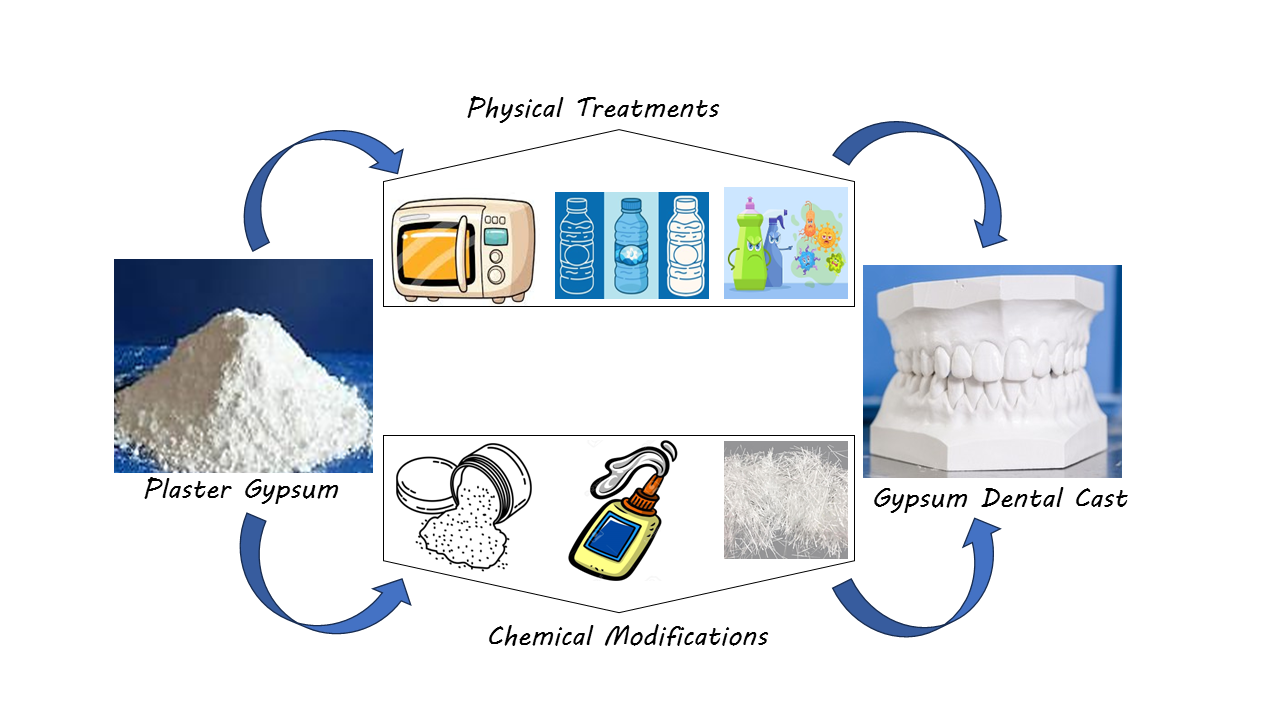
Despite the widespread use of gypsum materials in dental applications, these materials have some limitations, including low compressive strength, inadequate surface hardness, and dimensional instability. Therefore, this paper reviews the current systems for modifying dental gypsum and discusses the characteristics of the resulting gypsum materials. Additionally, the work examines the effects of physical and chemical treatments on the performance of dental gypsum. While the physical treatment relied on controlling the drying system, mixing water, and using disinfectants, the chemical modifications came from incorporating various additives. An electronic search for data published between 2000 and 2024 was conducted using the Web of Science, ScienceDirect, Scopus, PubMed, and Google Scholar databases. The keywords included gypsum materials, dental plaster, stone models, gypsum composites, slurry water, setting expansion, and chemical disinfection. A total of 426 records were retrieved from the various databases, of which 307 were screened, resulting in 46 that were relevant to the research objectives. The modifications through physical methods were inadequate in producing satisfactory products. However, adding polymeric and fibrous additives led to significant improvements in the mechanical properties of the resulting gypsum. Positive results were achieved by incorporating different types of ceramic fillers, which enhanced the compressive strength of gypsum composites. Despite the promising benefits of this technique, it has not been extensively used in practice.
Disclaimer : This is not the final version of the article. Changes may occur when the manuscript is published in its final format.