

 ACCESS
Review Article
ACCESS
Review Article
Volume 2, Article ID: 2025.0025

Faridul Islam Ovi
ovislam1612@gmail.com


Rownak Jahan Shova
rownakjahan1612@gmail.com

M Hasinur Rahman
mhrahman1997@yahoo.co.nz


Nayon Chandra Ghosh
nayonghosh55@gmail.com
1 1Department of Nanomaterials and Ceramic Engineering, Bangladesh University of Engineering and Technology, Dhaka-1000, Bangladesh
2 Department of Textile Management, Bangladesh University of Textiles, Dhaka, Bangladesh
3 Department of Primary Industries and Regional Development (DPIRD), Government of Western Australia, Northam, WA 6441, Australia
4 Gopalganj Textile Engineering College, Ghonapara, Gopalgonj, Bangladesh
* Author to whom correspondence should be addressed
Received: 08 Sep 2025 Accepted: 26 Dec 2025 Available Online: 28 Dec 2025
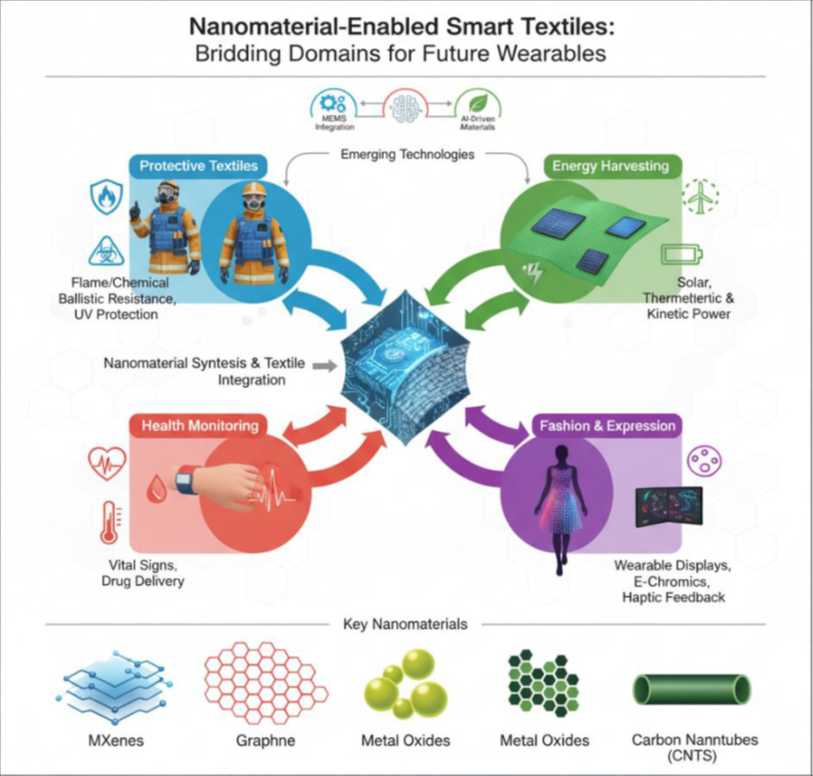
Smart textiles offer an innovative integration of nanotechnology, materials science, and wearable electronics, providing unparalleled capabilities above those of traditional textiles. This thorough review covers recent breakthroughs in advanced textile innovations based on engineered nanomaterials, particularly discussing ground-breaking uses of these materials in health, energy, military, and consumer applications. We critically review all four categories, including: 1. Protective textiles with flame-resistant nanocoatings, antibacterial nanoparticles, and UV-blocking semiconductor nanoparticles; 2. Energy-harvesting technologies based on piezoelectric, triboelectric, and thermoelectric nanomaterials, particularly designed for self-powered electronics; 3. Physiological monitoring interfaces with graphene sensors and optical fibers, intended for immediate biomedical monitoring and tracking; 4. Active materials with color-changing, shape-memory, and thermal-responsive properties.
The review points out advances in material science, such as MXene-containing textiles for electromagnetic shielding, phase change materials for dynamic thermal control, and plasmonic nanostructures for interactive displays. We also describe scalable processing technologies, including electrospinning of conductive polymers, roll-to-roll processing of solar cells based on textiles, and atomic layer deposition of nanocomposite thin films.
The emerging themes of biocompatibility in electronics, AI-based adaptive technologies, and sustainable nanotextiles are all seen as key domains of research and development in next-generation innovative textiles. This publication, with over 230 research findings included, aims to offer research professionals and industry insiders not only insight into what can be accomplished today, but also foresight into what may be accomplished in the integration of smart textiles into daily practice
Disclaimer : This is not the final version of the article. Changes may occur when the manuscript is published in its final format.