

 ACCESS
Review Article
ACCESS
Review Article
Volume 3, Article ID: 2026.0027

Amudhavalli Victor
amudhavalli.pharmacy@sathyabama.ac.in

Rakshita Hari
rakshihari21@gmail.com

Habeeba Rihana
habeebarihana0@gmail.com

1 Department of Pharmaceutical Chemistry, School of Pharmacy, Sathyabama Institute of science and technology, Jeppiar Nagar, Chennai- 600 119, Tamilnadu, India.
2 Department of Pharmaceutical Chemistry, School of Pharmacy, Sathyabama Institute of science and technology, Jeppiar Nagar, Chennai- 600 119, Tamilnadu, India
* Author to whom correspondence should be addressed
Received: 25 Oct 2025 Accepted: 28 Apr 2026 Available Online: 28 Apr 2026
The term Digital Twin (DT) is widely used in the industry to create digital replicas of real -world systems or objects. The active, two-way connection between the digital entity and physical counterpart permits for real time updates. DT is the strategic integration of digital technology into all areas of a business or organization. It isn't just about upgrading software; it’s a fundamental change in how a business operates and delivers value to its customers.
Digital Twin technology is emerging as a transformative paradigm in biomaterials science, bridging the gap between computational modeling and real-world clinical application. This paper explores the integration of DTs to move beyond traditional “one size fits-all” approaches toward predictive design and personalized healthcare.
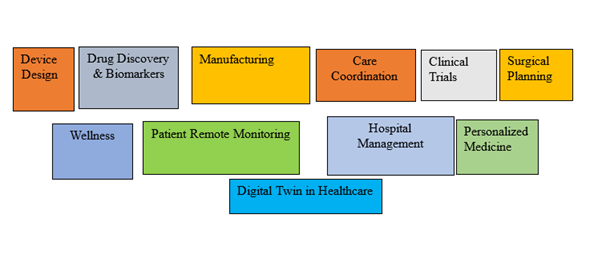
It is able to forecast disturbances associated with the operation of the physical object. With the potential to transform patient diagnosis and treatment, the apparent uses of DTs in healthcare and medicine are very alluring opportunities. However, it is challenging to accomplish the intended purposes due to issues like biological heterogeneity, ethical considerations, and technical barriers. Some challenges might be lessened by developments in the meta verse, embodied AI agents, and multi-modal deep learning techniques. Here, we go over the fundamental ideas behind DTs, the prerequisites for applying them in medicine, and their present and future applications in healthcare. In order to promote research in this area, we also offer our viewpoint on five characteristics of a healthcare DT system. This review highlights how advancing DT maturity will enable a shift from reactive medical interventions to proactive, data- driven material engineering, ultimately enhancing patient outcomes and accelerating the translation of lab scale innovations to the clinic.
Disclaimer : This is not the final version of the article. Changes may occur when the manuscript is published in its final format.