


 ACCESS
Perspective
ACCESS
Perspective
Volume 2, Article ID: 2026.0019

Robert Groysman
rgroysman@covidinstitute.org

The COVID Institute, Plano, Texas, USA
Received: 22 Aug 2026 Available Online: 29 Sep 2026
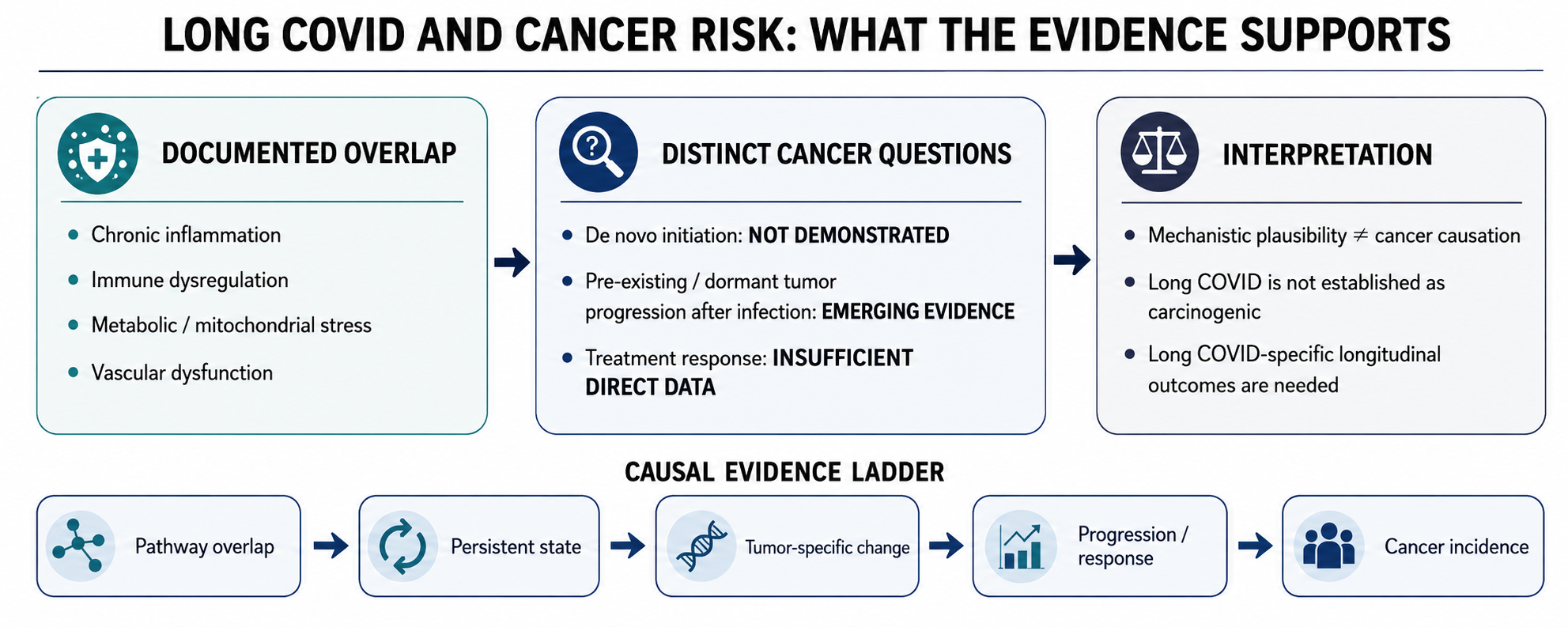
Long COVID is associated with persistent immune, inflammatory, vascular, and metabolic abnormalities that overlap with cancer-relevant pathways. These observations have prompted hypotheses about cancer, but de novo incidence, recurrence or progression of pre-existing disease, and treatment efficacy, toxicity, and tolerance (including treatment modification or interruption) are distinct outcomes and require separate evaluation.
This Perspective assesses those outcomes separately. Direct Long COVID-specific evidence is insufficient to determine whether de novo cancer incidence is increased, unchanged, decreased, or subgroup-specific. Experimental and observational studies after respiratory viral infection raise credible questions about dormant or established malignancy, but they are not equivalent to evidence from clinically characterized Long COVID cohorts. Evidence regarding anticancer treatment outcomes is also limited and heterogeneous.
Pandemic-era and SARS-CoV-2 infection cohorts provide context but cannot substitute for longitudinal studies comparing clinically defined Long COVID with matched recovered controls. Apparent post-pandemic cancer trends may reflect screening and diagnostic disruption; the long latency of many cancers also limits biological inference from short follow-up. Outcome-specific follow-up should specify the Long COVID definition, baseline cancer risk, latency, and cancer endpoints. Current evidence therefore supports uncertainty about the direction or magnitude of any Long COVID-specific effect on cancer incidence, recurrence, progression, or treatment efficacy, toxicity, and tolerance.
Disclaimer: This is not the final version of the article. Changes may occur when the manuscript is published in its final format.