

 ACCESS
Research Article
ACCESS
Research Article
Volume 2, Article ID: 2026.0012
Anju Augustine
anjuaugustine2109@gmail.com
Naomi Vincent
naomincathy@gmail.com

Shruti Joshi
shruti@cftri.res.in

1 Dissertation student, University of Mysore, Karnataka 570005, India
2 PhD Scholar, CFTRI under University of Mysore, Karnataka 570005, India
3 Principal Scientist, Department of Grain Science Technology, CSIR-Central Food Technology Research Institute, Mysore, Karnataka 570005, India.
* Author to whom correspondence should be addressed
Received: 27 Nov 2025 Accepted: 17 Apr 2026 Available Online: 17 Apr 2026 Published: 10 Jun 2026
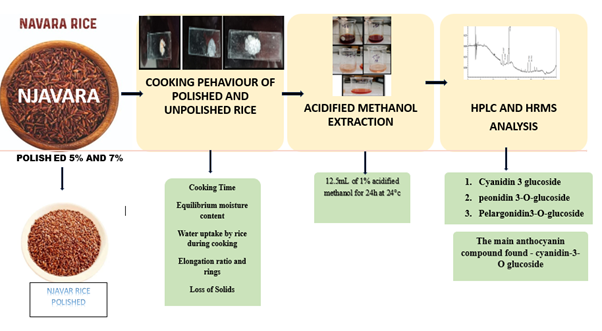
The aim of this study was to assess how rice polishing properties affect the nutritional value and anthocyanin composition and cooking performance of Njavara rice which grows as a traditional red rice variety in Kerala's Indian region. Red rice exists as unpolished rice which was examined together with 5% polished rice and 7% polished rice including their bran components. Red rice contains the highest nutritional value because it holds 8.565 mg GAE/g of total phenolic content which exceeds the 8.180 mg GAE/g found in 5% polished rice and 7.537 mg GAE/g found in 7% polished rice. Total anthocyanin content was highest in the 7% bran fraction (8.28 ± 0.06 mg/100 g), followed by red rice (6.81 ± 0.05 mg/100 g), 5% bran fraction (4.56 ± 0.08 mg/100 g), 5% polished rice (3.51 ± 0.02 mg/100 g), and 7% polished rice (2.53 ± 0.03 mg/100 g). The cooking properties showed red rice needed the longest cooking duration of 45 minutes while 5% polished rice needed 35 minutes and 7% polished rice needed 30 minutes with respective elongation ratios of 1.11, 1.18, and 1.21. The protein content was higher in red rice (9.42 ± 0.15%) as compared 9.23 ± 0.56% found in 5% polished rice and 8.12 ± 0.48% present in 7% polished rice. The research shows that polishing reduced bioactive compounds and antioxidant potential while decreasing cooking time and increasing solid loss during cooking.
Disclaimer: This is not the final version of the article. Changes may occur when the manuscript is published in its final format.