


 ACCESS
Review Article
ACCESS
Review Article
Volume 2, Article ID: 2026.0013

Daniel Etim Jacob
danieljacob@uniuyo.edu.ng

Imaobong Daniel Jacob
imaobongjacob@uniuyo.edu.ng

Koko Sunday Daniel
kokodaniel@uniuyo.edu.ng

Pius Agaji Oko
okopius@unical.edu.ng

1 Forestry and Wildlife Department, University of Uyo, Uyo 520101, Nigeria
2 Department of Forestry and Wildlife Management, University of Calabar, Calabar 540271, Nigeria
* Author to whom correspondence should be addressed
Received: 13 Jan 2026 Accepted: 25 Jun 2026 Available Online: 26 Jun 2026
|
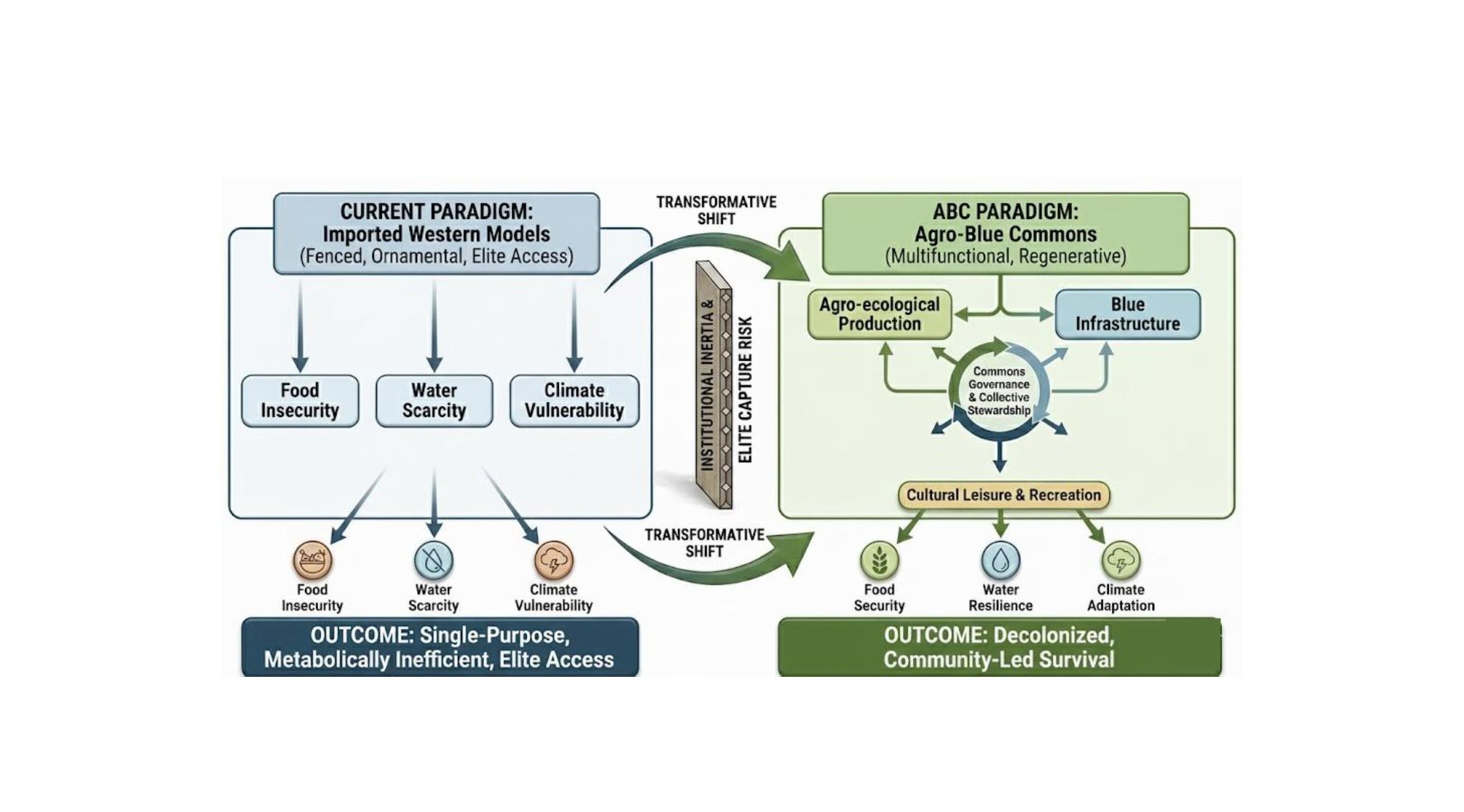
Recreational planning in the Global South is frequently constrained by Western models that prioritize ornamental aesthetics over local socio-ecological crises, resulting in metabolically inefficient and exclusionary landscapes. This paper proposes the Agro-Blue Commons (ABC): a reframed infrastructure that integrates food production, sustainable water management, and communal leisure. The framework is validated through a qualitative meta-synthesis of four illustrative prototypes in Lagos, Mumbai, Rajasthan, and Nairobi, selected via purposive sampling to represent diverse biomes and climate-vulnerable informality archetypes. These cases were evaluated using a diagnostic Multi-Criteria Assessment (MCA) focused on metabolic circularity, governance polycentricity, and socio-spatial accessibility. Drawing on non-colonial Northern precedents—such as Goetel’s socialized nature and Krakow’s health-integrated gardens—the ABC model treats recreation as a survival metabolism. The study explores how intersectional governance, including labor-for-resource credits, and anti-gentrification strategies like "Just Green Enough" can transition ornamental spaces into productive commons. Results demonstrate that triadic integration (food–water–leisure) enhanced by polycentric stewardship increases urban resilience and reduces resource dependency. However, systemic change requires addressing municipal barriers, specifically institutional inertia and insecure land tenure, to prevent the speculative displacement of marginalized communities. By situating the model within established planning frameworks—such as Mumbai’s DP 2034 and Nairobi’s Urban Agriculture Act—the ABC framework provides a decolonized, actionable roadmap for the resilient 21st-century city. |
Disclaimer: This is not the final version of the article. Changes may occur when the manuscript is published in its final format.