
APA Style
Saja Hamaideh, Amin N. Olaimat. (2026). Sustainable Strategies to Reduce Food Loss and Waste Across the Supply Chain: A Forward-Looking Perspective. Sustainable Food Connect, 2 (Article ID: 0015). https://doi.org/10.69709/SustainFoodConn.2026.786754MLA Style
Saja Hamaideh, Amin N. Olaimat. "Sustainable Strategies to Reduce Food Loss and Waste Across the Supply Chain: A Forward-Looking Perspective". Sustainable Food Connect, vol. 2, 2026, Article ID: 0015, https://doi.org/10.69709/SustainFoodConn.2026.786754.Chicago Style
Saja Hamaideh, Amin N. Olaimat. 2026. "Sustainable Strategies to Reduce Food Loss and Waste Across the Supply Chain: A Forward-Looking Perspective." Sustainable Food Connect 2 (2026): 0015. https://doi.org/10.69709/SustainFoodConn.2026.786754.
ACCESS
Editorial
Volume 2, Article ID: 2026.0015

Saja Hamaideh
sajas@hu.edu.jo
Amin N. Olaimat
aminolaimat@hu.edu.jo
Department of Clinical Nutrition and Dietetics, Faculty of Applied Medical Sciences, The Hashemite University, Zarqa 13133, Jordan
* Author to whom correspondence should be addressed
Received: 15 Jan 2026 Accepted: 01 Aug 2026 Available Online: 03 Aug 2026
This article is part of the Special Issue Valorization of Food Waste for Sustainable Nutrition and Food Processing
Food waste and loss (FLW) is a significant problem that affects every stage of the food production process and concerns all stakeholders in the food supply chain, including wholesalers, producers, farmers, and consumers. Achieving worldwide food sustainability and security depends on effective food waste management, which is indispensable to ensuring that people, families, and nations have ongoing access to food. This editorial discusses the different definitions of FLW, the consequences and impact of FLW alongside relevant statistical insights and causes, and outlines effective actions for consumers, communities, governments, private sectors, data collectors, and researchers to reduce FLW and thereby improve food and nutrition security worldwide.
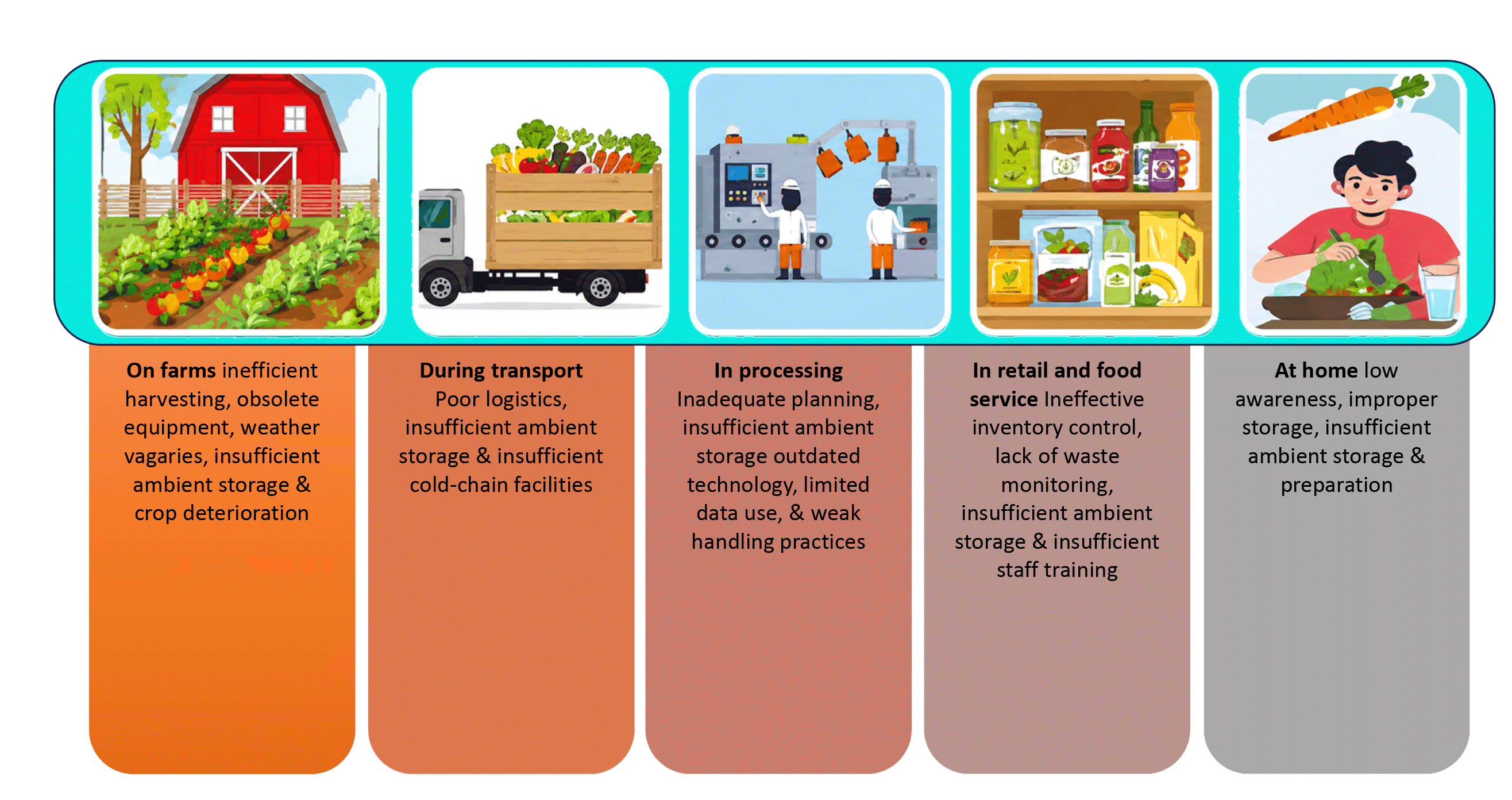
A standardized definition of food loss and waste (FLW) did not exist until recently [1,2]; previously, both academic literature and policy texts employed a wide array of disparate definitions [2]. This gap lay in the methods used to analyze FLW, including how accurately it was measured at the national, regional, and international levels. To address this conceptual ambiguity, the Food and Agriculture Organization (FAO) defines FLW as a “decrease in quantity or quality of food along the food supply chain” [3]. Under this framework, food losses occur throughout the supply chain from post-harvest to the retail stage, whereas food waste primarily occurs during retail and consumption [1,4]. Other reports have broadened the concept to include both quantitative and qualitative food losses occurring before harvesting [2]. The United Nations Environment Programme (UNEP), meanwhile, has offered a more precise definition of food waste in its Food Waste Index Report 2021, encompassing both edible food and non-edible portions that exit the human food supply chain within the retail, food service, and household sectors [2,5]. Ultimately, FLW is driven by a multitude of interrelated factors that can take place at any stage of the supply chain, as summarized in Chart 1 [6].
Globally, approximately a third of the food produced worldwide is wasted [4,7]. More specifically, according to the latest 2024 UNEP statistics, about 13.2% of the food produced worldwide is lost within the supply chain between harvest and the point before retail, while an additional 19% goes to waste at the retail, food service, and household levels [8]. Based on the UNEP Food Waste Index Report, stark disparities exist in household food waste globally. The Maldives (207 kg/capita) and Syria (172 kg/capita) record the highest annual rates, whereas nations with high-confidence data, such as Russia (33 kg/capita) and Mongolia (41 kg/capita), exhibit significantly lower footprints. Meanwhile, Japan and the UK serve as successful models, with reduced per capita food waste by 31% and 18%, respectively, through targeted policy interventions [9]. This staggering waste stands in stark contrast to global food insecurity: while an estimated 222 million tons of food are wasted annually in the developed world alone [7], approximately 2 billion people worldwide struggle to access nutritious meals, and over 820 million suffer from chronic hunger. FLW consequently carries grave moral and ethical ramifications [2].
Global efforts to curtail FLW have gained significant momentum, with novel frameworks highlighting actionable, data-driven, and collaborative interventions [2]. In this context, both the public and private sectors play pivotal roles in implementing proactive measures and innovations to address the FLW challenge [4]. Table 1 summarizes these action-driven approaches to mitigating FLW. Action-driven approaches to mitigate FLW [2]. Future climate variability is anticipated to become more frequent and intense, potentially exacerbating post-harvest losses. Droughts and floods are examples of extreme weather phenomena that can devastate livestock and crops and harm supply chain infrastructure. Unpredictable rainfall can hinder drying procedures, cause losses in harvested produce, and foster moisture-dependent infections [10]. In addition, elevated temperatures and increased humidity are expected to drive a rise in outbreaks of transboundary pests and diseases, potentially causing significant losses in agricultural, livestock, aquaculture, and forestry goods [10]. Conversely, wasted food also contributes to climate change: methane, a greenhouse gas 27–30 times more potent than carbon dioxide, is released when food decomposes in landfills. Once in the atmosphere, methane retains solar heat for about 12 years and accounts for roughly 20% of greenhouse gas emissions worldwide. When the greenhouse gas emissions associated with the use of natural resources are also taken into account, the impact on climate change is substantial. Implementing an effective food waste treatment system has been shown to prevent approximately 11% of the world’s greenhouse gas emissions [11]. In conclusion, FLW can arise at any stage of the food supply chain and encompasses interconnected yet conceptually distinct issues shaped by diverse definitions in the international literature. Its consequences extend far beyond physical depletion, generating serious economic, environmental, and social challenges that directly threaten global food and nutrition security. Despite significant regional and value-chain variation, these challenges underscore the need for coordinated, evidence-based, and scalable solutions. Meaningful progress toward FLW minimization relies on unified measurement standards, technological and behavioral innovation, and collaborative, stage-specific actions that prioritize sustainability and equitable food-system resilience.Approaches
Implementation Details
Intensifying efforts toward practical application
To achieve SDG 12.3, which calls for halving per capita global food waste at the retail and consumer levels and reducing food losses by 2030, national, regional, and international leaders must demonstrate a greater commitment to action.
Using global knowledge to localize the issue
Data gaps obscure FLW differences across regions. Low-income countries lose food mainly during production and processing, whereas high-income countries waste more at retail and consumption. Urbanization is increasing waste in developing regions, requiring tailored solutions.
Advancing food loss and waste data and intelligence
Data collection and analysis efforts should be intensified and extended to weather prediction systems to uncover the root drivers of FLW.
Promoting scientific inquiry and innovation
Research should focus on efficient machinery and integrate scientific, technological, and behavioral perspectives. Scaling digital monitoring and analytical tools could be considered essential to accelerate tracking and the development of effective solutions.
Strengthening community involvement
Food recovery organizations, youth activists, and public awareness campaigns promote responsible consumption.
Strengthening the role of government
Public organizations should implement fiscally sustainable national initiatives and set achievable reduction targets.
Promoting private-sector partnerships
Commercial value is generated by reducing FLW through advanced packaging and weatherproof storage, supported by financial investment.
Increasing cooperation across sectors
Effective FLW minimization requires long-term collaboration between governmental, corporate, and social groups.
Expanding the agenda at international forums
FLW minimization should be a priority for international conferences and summits.
Increasing public communication
Public figures and targeted media outreach can help mainstream sustainable food policies and shift public opinion.
FAO
Food and Agriculture Organization
FLW
Food Loss and Waste
UNEP
United Nations Environment Programme
Conceptualization, visualization, writing—review & editing, supervision: A.N.O; Visualization, writing—original draft, writing—review & editing: S.H. Both authors have read and agreed to the published version of the manuscript.
The authors declare no conflicts of interest regarding this manuscript. One of the authors (A.N. Olaimat) serves as the Editor-in-Chief of Sustainable Food Connect, the journal in which this article is published. To ensure transparency and avoid any potential conflict of interest, this author was excluded from all editorial handling, peer-review assignment, and decision-making related to this manuscript. The peer-review process and editorial assessment were managed independently by an editor with no reporting relationship to the Editor-in-Chief, ensuring that the review was conducted without any influence.
The authors would like to thank Hashemite University for providing the necessary support.
AI-assisted tools were used solely for grammar checking and language editing. No AI tools were used to generate, rephrase, or alter the scientific content of this manuscript. The authors retain full responsibility for the accuracy, originality, and integrity of the presented work.
[1] Cattaneo, A.; Sánchez, M.V.; Torero, M.; Vos, R. Reducing Food Loss and Waste: Five Challenges for Policy and Research. Food Policy 2021, 98, 101974. [CrossRef] [PubMed]
[2] Von Braun, J.; Sorondo, M.S.; Steiner, R. Reduction of Food Loss and Waste: The Challenges and Conclusions for Actions. In Science and Innovations for Food Systems Transformation; von Braun, J., Afsana, K., Fresco, L.O., Hassan, M.H.A., Eds.; Springer: Cham, Switzerland, 2023, pp. 569–578. [CrossRef] [PubMed]
[3] Food and Agriculture Organization of the United Nations (FAO). The State of Food and Agriculture 2019; FAO: Rome, Italy, 2019. Available online: https://www.fao.org/family-farming/detail/en/c/1245425 (accessed on 13 March 2026).
[4] Olabode, O.; Kumar, N.; De, D. Food Loss and Waste Management in the Retail Food Supply Chain: Methods and Framework to Achieve Environmental Sustainability. J. Environ. Manag. 2025, 387, 125718. [CrossRef] [PubMed]
[5] United Nations Environment Programme (UNEP). Food Waste Index Report 2021; UNEP: Nairobi, Kenya, 2021. Available online: https://wedocs.unep.org/handle/20.500.11822/35280 (accessed on 26 March 2026).
[6] Goodwin, L. The Global Benefits of Reducing Food Loss and Waste, and How to Do It; World Resources Institute: Washington, DC, USA, 2023. Available online: https://www.wri.org/insights/reducing-food-loss-and-food-waste (accessed on 20 April 2026).
[7] Wani, N.R.; Rather, R.A.; Farooq, A.; Padder, S.A.; Baba, T.R.; Sharma, S.; Mubarak, N.M.; Khan, A.H.; Singh, P.; Ara, S. New Insights in Food Security and Environmental Sustainability through Waste Food Management. Environ. Sci. Pollut. Res. 2024, 31, 17835–17857. [CrossRef] [PubMed]
[8] Food and Agriculture Organization of the United Nations (FAO). Food Loss and Food Waste; FAO: Rome, Italy, 2022. Available online: https://www.fao.org/policy-support/policy-themes/food-loss-and-food-waste/en (accessed on 1 April 2026).
[9] United Nations Environment Programme (UNEP). Food Waste Index Report 2024 Appendix; UNEP: Nairobi, Kenya, 2024. Available online: https://wedocs.unep.org/items/423eafe4-e4e8-47c0-b261-dbd3701be842 (accessed on 22 June 2026).
[10] Food and Agriculture Organization of the United Nations (FAO). Food Loss and Waste; FAO: Rome, Italy, 2015. Available online: https://www.fao.org/platforms/green-agriculture/areas-of-work/consumption-food-loss-and-waste/food-loss-and-waste/ (accessed on 9 January 2025).
[11] Poore, J.; Nemecek, T. Reducing Food’s Environmental Impacts through Producers and Consumers. Science 2018, 360, 987–992. [CrossRef] [PubMed]
Disclaimer/Publisher’s Note: The views expressed in this article are those of the author(s) and do not necessarily reflect the views of the publisher or editors. The publisher and editors assume no responsibility for any injury or damage resulting from the use of information contained herein.
This is not the final version of the article. Changes may occur when the manuscript is published in its final format.
©2026 Copyright by the Authors.
Licensed as an open-access article distributed under the terms and conditions of the CC BY 4.0 license
We use cookies to improve your experience on our site. By continuing to use our site, you accept our use of cookies. Learn more