

APA Style
Ayesha Abdul Qadir, Ghulam Murtaza, Zia Ur Rahman Farooqi, Umair Riaz, Predrag Ilić. (2026). Effect of Incubation Time and Soil Moisture Contents on Lead Speciation in Sewage Sludge Amended Soil. Sustainable Food Connect, 2 (Article ID: 0014). https://doi.org/10.69709/SustainFoodConn.2026.133443MLA Style
Ayesha Abdul Qadir, Ghulam Murtaza, Zia Ur Rahman Farooqi, Umair Riaz, Predrag Ilić. "Effect of Incubation Time and Soil Moisture Contents on Lead Speciation in Sewage Sludge Amended Soil". Sustainable Food Connect, vol. 2, 2026, Article ID: 0014, https://doi.org/10.69709/SustainFoodConn.2026.133443.Chicago Style
Ayesha Abdul Qadir, Ghulam Murtaza, Zia Ur Rahman Farooqi, Umair Riaz, Predrag Ilić. 2026. "Effect of Incubation Time and Soil Moisture Contents on Lead Speciation in Sewage Sludge Amended Soil." Sustainable Food Connect 2 (2026): 0014. https://doi.org/10.69709/SustainFoodConn.2026.133443.
ACCESS
Research Article
Volume 2, Article ID: 2026.0014

Ayesha Abdul Qadir
ayeshaqadir808@gmail.com
Ghulam Murtaza
gmurtazauaf@gmail.com
Zia Ur Rahman Farooqi
ziaa2600@gmail.com
Umair Riaz
umair.riaz@mnsuam.edu.pk
Predrag Ilić
predrag.ilic@institutzei.net
1 Institute of Soil and Environmental Sciences, University of Agriculture, Faisalabad 38040, Pakistan
2 Institute of Surface-Earth System Science, Tianjin University, 92 Weijin Road, Tianjin 300072, China
3 Yunnan Provincial Key Lab of Soil Carbon Sequestration and Pollution Control, Faculty of Environmental Science and Engineering, Kunming University of Science and Technology, Kunming 650500, China
4 Yunnan International Joint Laboratory for Emission Reduction and Carbon Sequestration in Agricultural Soils, Kunming 650500, China
5 Department of Climate Change, Muhammad Nawaz Shareef University of Agriculture, Multan 66000, Pakistan
6 PSRI Institute for Protection and Ecology of the Republic of Srpska, Vidovdanska 43, Banja Luka 78000, Bosnia and Herzegovina
* Author to whom correspondence should be addressed
Received: 25 Sep 2025 Accepted: 16 Jul 2026 Available Online: 16 Jul 2026
This article is part of the Special Issue Persistent Chemical Contaminants and Organic Pollutants in Food Systems: Insights into Food Safety and Human Health
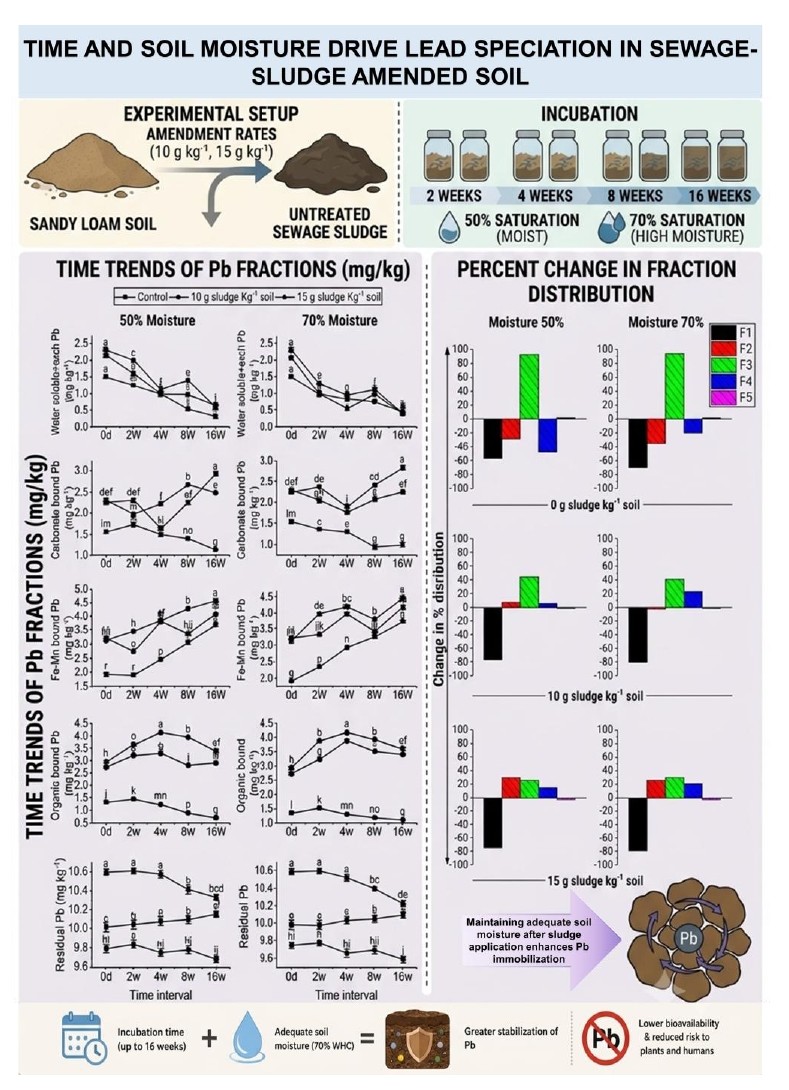
The application of sewage sludge to agricultural soils is increasingly recognized as a sustainable approach for waste disposal, nutrient recycling, and soil fertility improvement. However, sewage sludge may also introduce potentially toxic elements (PTEs), particularly lead (Pb), into soil systems, where the associated environmental risk depends largely on chemical speciation rather than total concentration alone. Lead in sewage sludge-amended soils poses a potential threat to food sustainability through crop uptake and subsequent entry into the human food chain. This study investigated the effects of incubation time and soil moisture on Pb fractionation in sewage sludge-amended soil under controlled experimental conditions. Sandy loam soil, amended with untreated sewage sludge at rates of 10 and 15 g kg−1 soil, was incubated for 16 weeks under two moisture conditions (50% and 70% saturation percentage). Soil samples were collected after 2, 4, 8, and 16 weeks and subjected to sequential extraction to determine exchangeable (F1), carbonate-bound (F2), Fe–Mn oxide-bound (F3), organic-bound (F4), and residual (F5) Pb fractions. Sewage sludge application significantly increased total Pb concentration relative to the unamended control, with higher application rates producing greater Pb accumulation. Across all treatments, Pb was predominantly associated with F5, followed by F3 and F4. With increasing incubation time, Pb was progressively redistributed from more labile forms, particularly F1, into less bioavailable fractions such as F3 and F4. Higher soil moisture (70%) accelerated the decline in exchangeable Pb (F1) and enhanced Pb stabilization compared with 50% moisture, whereas F5 remained relatively constant throughout the incubation period. These results indicate that both aging time and soil moisture regulate Pb transformation in sludge-amended soils. Maintaining high soil moisture levels may promote the transformation of Pb into stable geochemical forms, thereby reducing its mobility and bioavailability and mitigating potential environmental risks.
Sewage sludge is a by-product of municipal and industrial wastewater treatment processes and is widely recognized as a valuable source of organic matter and essential nutrients for soil amendment. As a pretreatment step before land application, sewage sludge is typically stabilized through processes such as anaerobic digestion, composting, lime stabilization, or thermal drying to reduce pathogen content and improve its handling characteristics [1,2]. The application of sewage sludge in agriculture has received widespread attention for its ability to recycle nutrients, improve soil fertility, and serve as an environmentally sustainable disposal method [3]. However, to prevent soil pollution and potential environmental risks, the land application of sludge is strictly regulated, with clear restrictions on the concentration and cumulative application of heavy metals [4,5]. Despite its agronomic benefits, sewage sludge often contains a range of potentially toxic elements (PTEs), including cadmium (Cd), lead (Pb), nickel (Ni), and chromium (Cr) [5,6]. Pb concentrations in sewage sludge vary widely depending on the source, typically ranging from 50 to 300 mg kg−1 in treated biosolids [7]. Compared with other PTEs, Pb has attracted particular attention because of its environmental persistence, strong adsorption capacity for soil components, and tendency toward long-term accumulation [8,9]. Unlike micronutrients such as Zn and Cu, Pb has no known biological function and is highly toxic even at relatively low concentrations, potentially causing neurotoxicity and damage to vital organs in the human body [10]. Long-term use of sewage sludge containing high concentrations of Pb may lead to sustained Pb accumulation in soil, with adverse effects on soil quality, crop safety, and human health. Pb can be absorbed by plants and accumulate in edible tissues, thereby entering the food chain; this not only reduces the quality of agricultural products but may also pose a serious threat to human health and further affect food security and the sustainable development of agriculture. The environmental risk posed by Pb depends not only on its total content but is also closely related to its chemical speciation, since this determines its mobility, bioavailability, and reactivity [11,12]. Aging processes play a crucial role in determining Pb behavior in soil systems: in the initial stage of sludge application, Pb usually combines with easily decomposable organic matter and exists in a more available form; however, over time, Pb gradually undergoes transformation through processes such as adsorption, complexation, precipitation, and diffusion [13]. To better understand the transformation processes of Pb in soil, researchers typically classify it into distinct operationally defined forms, including exchangeable, carbonate-bound, Fe–Mn oxide-bound, organic matter-bound, and residual forms [14]. Among these, exchangeable Pb has high mobility and bioavailability, making it easier for plants to absorb, whereas residual Pb is relatively stable and usually difficult to release or utilize under natural conditions [15,16]. The distribution of Pb among these forms is influenced by soil physicochemical properties such as pH, ion composition, and cation exchange capacity, while environmental factors such as soil moisture status and redox conditions also play an important role [9]. Owing to the strong adsorption capacity of oxide minerals, the Fe–Mn oxide-bound state can fix substantial amounts of Pb, while the organic matter-bound state reflects Pb forming relatively stable complexes with organic ligands [9,11]. However, these associations are dynamic; for example, Pb bound to organic matter may be released under oxidizing conditions due to decomposition processes [17]. Similarly, changes in soil moisture can affect redox conditions and thereby influence Pb redistribution among fractions [18]. In contrast, residual Pb is primarily incorporated into the mineral lattice, where it is generally more stable over the short to medium term and exhibits relatively low activity [19]. Given the increasing use of sewage sludge in agriculture and the environmental significance of Pb, understanding its transformation and redistribution in amended soils under varying environmental conditions is essential. This study was therefore designed to (i) evaluate total Pb concentration and its fractionation in soil amended with sewage sludge at different application rates over time, and (ii) assess the influence of moisture levels on Pb transformation and redistribution among different geochemical fractions.
An incubation pot experiment was conducted in a growth room at the Institute of Soil and Environmental Sciences (ISES), University of Agriculture Faisalabad (UAF). The experiment was designed to study the effects of incubation time and moisture content on the chemical speciation of Pb in sewage sludge-amended soil. 2.1. Collection and Preparation of Soil and Sewage Sludge Bulk soil was collected from the top fertile layer (20 cm) of a farm area at UAF, air-dried, and passed through a 2-mm sieve. After drying, 300 g capacity pots covered with parafilm and fitted with 2–3 holes for proper gaseous exchange were each filled with 200 g of soil. Dried sewage sludge, sieved through a 2-mm sieve, was collected from the I-9 Sector, Islamabad Wastewater Treatment Plant, Pakistan. Detailed characteristics of the sewage sludge are presented in Table 1. Properties of sewage sludge used in the experiment. 2.2. Treatment Layout The incubation experiment was laid out as a completely randomized design with three replications of each treatment, conducted under controlled laboratory conditions. Soil samples were incubated at a constant temperature of 25 ± 2 °C. Soil moisture levels were maintained at the designated treatments (50% and 70% of saturation percentage) throughout the incubation period through periodic weighing and replenishment of water losses with deionized water. Samples were incubated in a well-ventilated environment to avoid excessive humidity buildup. Treatments were divided into two sets, corresponding to soil saturation percentages (SP) of 50% and 70%. The controls consisted of unamended soil at 50% and 70% SP, while the second and third treatments in each set involved 50% and 70% SP with 10 and 15 g kg−1 application of sewage sludge, respectively. Moisture content was controlled gravimetrically by weighing the pots at regular intervals and replenishing water losses with deionized water throughout the incubation period. To determine the initial distribution of Pb fractions across soil components and provide a baseline for subsequent changes, homogenized soil samples (10 g) were collected from each treatment at the start of the experiment (Week 0). Additional samples were collected after 2, 4, 8, and 16 weeks of incubation to measure Pb concentration in different soil fractions using sequential extraction. 2.3. Soil Analysis Soil pH was measured using a portable pH meter (model HM-12P) after calibration with buffer solutions of pH 4 and 9. Soil and sewage sludge EC were measured using a Lovibond Model SensoDirect Con200 conductivity meter, after obtaining the saturated paste extract via positive pressure through a filter press. Soluble cations and anions were determined using the methods described in the US Salinity Laboratory Staff protocols (Table 2). Properties of soil used for pot experiment. Note: EC: electrical conductivity; TSS: total soluble salts; SAR: sodium adsorption ratio; CEC: cation exchange capacity; OM: organic matter; ESP: exchangeable sodium percentage. 2.4. Metals Analysis Lead concentrations were determined using an atomic absorption spectrophotometer (Thermo Electron AA, Solar-Series, Waltham, USA) following acid digestion with HNO3 and HCl (USEPA Method 3050B). Quality assurance and quality control procedures included calibration with standard solutions, analysis of reagent blanks, triplicate sample analyses, and periodic verification of instrument performance during Pb determination, ensuring analytical accuracy and precision. 2.5. Sequential Extraction for Pb Fractionation Sequential Pb fractionation was performed according to the Tessier protocol [20], with modifications, operationally separating Pb into five fractions: exchangeable, carbonate-bound, Fe–Mn oxide-bound, organic-bound, and residual (Table 3). Sequential extraction procedure for Pb fractionation in soils. 2.6. Extraction Recovery Assessment of Pb The completeness of the sequential extraction procedure was evaluated by comparing the sum of Pb recovered across fractions F1–F5 with the independently measured total Pb concentration. Recovery (%) was calculated as: Recovery values were used to assess the completeness of the sequential extraction procedure. 2.7. Statistical Analyses Experimental data were analyzed using a three-way analysis of variance (ANOVA) to evaluate the effects of incubation time, sewage sludge application rate, moisture level, and their interactions. Treatment means were compared using the least significant difference (LSD) test at a significance level of p ≤ 0.05. All statistical analyses were performed using Statistix version 8.1 software, and graphical illustrations were prepared using OriginLab software.Parameter
Unit
Value
pH
-
7.6
Organic matter
%
32
EC1:10 (sewage sludge: water)
dS m−1
3.7
Nitrogen
%
0.95
Phosphorus
%
0.24
Potassium
%
0.27
Total Pb
mg kg−1
88.71
Exchangeable Pb
mg kg−1
4.65
Carbonate bound Pb
mg kg−1
7.46
Fe and Mn oxide bound Pb
mg kg−1
10.67
Organic bound Pb
mg kg−1
22.76
Residual Pb
mg kg−1
40.56
Parameter
Value
Textural class
Sandy loam
Sand %
74.48
Silt %
12.28
Clay %
13.24
Saturation percentage (%)
29.13
pHs
7.7
ECe (dS m−1)
2.01
TSS (mmolc L−1)
14.3
Ca2+ + Mg2+ (mmolc L−1)
13.10
CO32− (mmolc L−1)
-
HCO3− (mmolc L−1)
2.20
Cl–(mmolc L−1)
4.5
SO42− (mmolc L−1)
13.4
Na+ (mmolc L−1)
4.12
K+ (mmolc L−1)
0.6
SAR (mmol L−1)1/2
1.60
Calcium carbonate %
1.72
Nitrogen %
0.06
Phosphorus (mg kg−1)
5.3
CEC (cmolc kg−1)
5.42
OM %
0.68
Exchangeable Ca2+ + Mg2+ (cmolc kg−1)
3.85
Exchangeable Na+ (cmolc kg−1)
0.20
Exchangeable K+ (cmolc kg−1)
0.25
ESP %
4.65
Total Pb (mg kg−1)
18.62
Exchangeable Pb (mg kg−1)
1.53
Carbonate bound Pb (mg kg−1)
1.57
Fe–Mn oxide-bound Pb (mg kg−1)
1.95
Organic bound Pb (mg kg−1)
1.37
Residual Pb (mg kg−1)
10.02
Fraction
Notation
Extractant & Conditions
Exchangeable
F1
1 g soil + 8 mL 1 M MgCl2 (pH 7), shaken for 1 h at RT, then centrifuged at 10,000 rpm for 30 min
Carbonate-bound
F2
Residue + 8 mL 1 M NaOAc (pH 5, adjusted with HOAc), shaken for 6 h at RT, then centrifuged
Fe–Mn oxide-bound
F3
Residue + 20 mL 0.04 M NH2OH·HCl in 25% HOAc, heated at 96 °C for 6 h
Organic-bound
F4
Residue + 3 mL 0.02 M HNO3 + 5 mL 30% H2O2 (pH 2), heated at 85 °C for 2 h; the procedure was repeated, followed by the addition of 3 mL 3.2 M NH4OAc in 20% HNO3 and shaking for 30 min
Residual
F5
Residue + 8 mL HNO3 + 2 mL HCl, heated near boiling for 45 min
At the start of the experiment, the exchangeable fraction (F1) was 1.53, 2.17, and 2.34 mg kg−1 at both moisture levels (50% and 70%) in the unamended control and the 10 and 15 g sludge kg−1 soil treatments, respectively. After 2 weeks of incubation, Pb concentration decreased by approximately 16%, 24%, and 13% in T1, T2, and T3, respectively, relative to Day 0 at 50% moisture. At 70% moisture, decreases of 33%, 53%, and 43% were recorded for T1, T2, and T3, respectively. After 16 weeks of incubation, the F1 concentration decreased by 56.20% in the control (T1) at 50% moisture and by 69.29% at 70% moisture, relative to the initial concentration. With 10 g sludge kg−1 soil, F1 decreased by 77.88% at 50% moisture and by 80.73% at 70% moisture relative to the initial Pb concentration. At the higher sewage sludge rate (15 g kg−1 soil), decreases of 73.50% and 79.05% were observed at 50% and 70% SP, respectively. The carbonate-bound fraction of Pb (F2), in response to sewage sludge application at different rates (10 and 15 g sludge kg−1 soil) under varying moisture regimes (50% and 70% SP), is shown in Figure 1. At the start of incubation, F2 concentrations (mg kg−1) in T1, T2, and T3 were 1.57, 2.33, and 2.27, respectively. In the control treatment, F2 decreased by 35.95% and 38.18% at 50% and 70% moisture, respectively, after 16 weeks of incubation. In treatment T2 (10 g sludge kg−1 soil), F2 first decreased and then increased relative to the initial (Day 0) concentration; after 16 weeks, increases of approximately 7.72% and 1.78% were observed at 50% and 70% moisture, respectively. Similarly, in treatment T3 (15 g sludge kg−1 soil), increases of approximately 29.95% and 25.99% were observed at 50% and 70% moisture, respectively, after 16 weeks of incubation. In the control treatment, F3 increased gradually over time at both moisture levels, whereas sludge-amended treatments exhibited a more variable trend. At 50% moisture, F3 concentrations were 3.72, 4.61, and 4.12 mg kg−1 in T1, T2, and T3, respectively, after 16 weeks of incubation; at 70% moisture, the corresponding values were 3.76, 4.51, and 4.22 mg kg−1. The organic-bound Pb fraction (F4) was 1.37 mg kg−1 in T1 and T4. In soil amended with sewage sludge at 10 g sludge kg−1 soil at 50% SP (T2) and 70% SP (T5), F4 was 2.76 mg kg−1; at 15 g sludge kg−1 soil (T3 and T6), F4 was 2.98 mg kg−1. The F4 concentration increased at both moisture levels across all treatments after 2 weeks of incubation, reaching its maximum after 4 weeks. At 4 weeks, F4 was 1.26 and 1.31 mg kg−1 in T1 and T4, respectively; 3.32 and 3.92 mg kg−1 in T2 and T5, respectively; and 4.18 and 4.22 mg kg−1 in T3 and T6, respectively. After 16 weeks of incubation, F4 in the control treatments decreased by approximately 47.44% and 18.97% at 50% and 70% moisture, respectively, relative to the initial (Day 0) concentration. In the sludge-amended treatments, by contrast, F4 concentration increased by up to 6.15%, 14.76%, 24.27%, and 21.47% in T2, T3, T5, and T6, respectively. The residual Pb fraction (F5) was only marginally affected by moisture level and time; after 16 weeks of incubation, F5 concentrations were 10.16, 9.69, 10.34, 10.1, 9.62, and 10.24 mg kg−1 in T1, T2, T3, T4, T5, and T6, respectively. Total Pb concentration in the unamended soil (T1 and T4) ranged between 18.32 and 18.59 mg kg−1. In treatments amended with 10 g sludge per kg soil (T2 and T5), Pb concentration ranged from 22.31 to 22.57 mg kg−1, while treatments with 15 g sewage sludge per kg soil showed higher total Pb content, ranging from 23.81 to 24.09 mg kg−1. Pb concentration in sludge-amended soil was consistently higher than in the control soil and increased with increasing sludge application rate (Table 4). Effect of moisture, sewage sludge rate, and incubation time on total Pb concentration (mg kg−1). Values are presented as mean ± standard error (SE, n = 3). Different letters indicate significant differences among treatment combinations (moisture × sludge rate × time) at p ≤ 0.05. 3.1. Changes in Percent Distribution of Pb Fractions The effect of sewage sludge application on the percentage distribution of Pb among different chemical fractions after 16 weeks of incubation under two moisture regimes (50% and 70% of water-holding capacity) is presented in Figure 2. Distinct shifts in Pb partitioning were observed depending on both sludge amendment rate and soil moisture level. The exchangeable fraction (F1) of Pb decreased across all treatments, with a more pronounced reduction under 70% moisture compared with 50%. Among the sludge-amended soils, the decline was most substantial in the treatment receiving 10 g sludge kg−1 soil, suggesting greater immobilization of Pb into less labile forms. The carbonate-bound fraction (F2) decreased in the control treatment, whereas it increased in the sludge-amended treatments. The decrease in this fraction was greater at 70% moisture than at 50%. The magnitude of the increase in this fraction was greater at 50% moisture with 15 g sludge per kg soil than at 70% moisture. The Fe–Mn oxide-bound fraction (F3) increased across all treatments, with the magnitude of the increase greater in the control than in the sludge-amended treatments. This suggests that, in the absence of organic inputs, Pb tends to stabilize preferentially in Fe–Mn oxide forms. The organic-bound Pb fraction (F4) decreased in the control, with a greater magnitude of decrease under 50% moisture than under 70% moisture. In the sludge-amended treatments, by contrast, this fraction increased, with a greater magnitude of increase at 70% moisture than at 50%. The residual fraction (F5) showed only minor changes overall. In control soils, a slight increase was observed, particularly at 50% moisture, whereas in sludge-amended treatments, a modest decline was recorded, particularly under 70% moisture. Overall, after 16 weeks of incubation, Pb in sludge-amended soils was progressively redistributed from F1 into the less labile carbonate-bound (F2), Fe–Mn oxide-bound (F3), and organic-bound F4 fractions. The residual fraction (F5) remained relatively stable throughout the incubation period, indicating that it was minimally affected by soil moisture. 3.2. Extraction Recovery of Pb The recovery of Pb, based on the sum of sequential extraction fractions (F1–F5) relative to total Pb concentration, ranged from 88.14% to 90.72%, with an average recovery of approximately 89.5%. This result indicates acceptable completeness and good analytical reliability of the sequential extraction procedure.
Moisture Level
Sludge Rate
(g kg−1)Symbol
Week 0
Week 2
Week 4
Week 8
Week 16
50
0
T1
18.43 ± 0.05 lm
18.33 ± 0.05 mn
18.55 ± 0.03 k
18.42 ± 0.04 lmn
18.39 ± 0.02 lmn
50
10
T2
22.40 ± 0.02 ij
22.31 ± 0.03 j
22.45 ± 0.05 hi
22.51 ± 0.03 gh
22.57 ± 0.02 g
50
15
T3
23.97 ± 0.04 cd
23.81 ± 0.03 f
24.05 ± 0.03 abc
24.07 ± 0.02 ab
23.92 ± 0.03 de
70
0
T4
18.35 ± 0.05 lmn
18.43 ± 0.05 l
18.59 ± 0.05 k
18.41 ± 0.03 lmn
18.32 ± 0.03 n
70
10
T5
22.31 ± 0.03 j
22.38 ± 0.05 ij
22.55 ± 0.04 g
22.43 ± 0.04 hi
22.57 ± 0.02 g
70
15
T6
23.84 ± 0.03 ef
23.97 ± 0.02 cd
23.98 ± 0.03 bcd
24.09 ± 0.03 a
23.93 ± 0.05 de
4.1. Redistribution of Pb Among Geochemical Fractions The sequential extraction results showed that, following sewage sludge application, Pb in the soil gradually transformed from a more available form to a more stable form over time, with this trend broadly consistent under both the 50% and 70% SP moisture conditions. However, under higher moisture content, the process of Pb transformation and redistribution was more rapid, indicating that although soil moisture does not alter the overall trend of Pb aging, it significantly affects its transformation rate [21-23]. The exchangeable fraction (F1) of Pb decreased significantly with time under all treatments, reaching a decrease of 56–80% after 16 weeks, with a greater decrease under 70% SP than under 50% SP. This indicates that higher soil moisture content may be more conducive to the transformation of Pb from a labile to a stable form, promoting its fixation in the soil [24]. This may occur because higher water content enhances the wetting effect on the surface of soil particles, making it easier for Pb ions to come into contact with adsorption sites in the soil and become fixed. Although this study did not monitor soil pH during the incubation period, previous studies suggest that a wetter environment may alter soil pH and increase the negative charge on colloid surfaces by affecting soil buffering capacity and related biogeochemical processes, thereby further promoting Pb adsorption [25]. However, this mechanism remains theoretical in the absence of direct measurements. A previous study [26] found that amendments enhancing surface reactivity can generally reduce exchangeable Pb across diverse systems, supporting the general pattern observed here. The carbonate-bound Pb fraction (F2) showed differing trends: it decreased in the control soil, whereas in the sewage sludge-treated soils it showed an increasing trend, particularly under the 15 g kg−1 treatment, with an increase of 26–30% after 16 weeks. This difference may relate to organic matter and dissolved inorganic carbon in the sewage sludge promoting the formation of Pb carbonate complexes. F2 exhibited a non-monotonic pattern of first decreasing and then increasing over time, which contrasts with the irregular fluctuations observed in Pb-spiked soil [27]. This difference may arise because microbial respiration in sewage sludge-treated soil continuously produces carbonates, a process absent in the nitrate-addition system. Similar patterns of F2 change have also been reported in a previous study [28], attributed to dynamic changes in soil chemical properties under different moisture conditions and the kinetic limitations of carbonate precipitation. The Fe–Mn oxide-bound fraction (F3) increased progressively across all treatments, consistent with Pb's known affinity for hydrous Fe and Mn oxides [29]. The increase in F3 was more pronounced in the control soil than in the sewage sludge treatments, indicating that occupation of oxide surfaces by organic ligands competes with Pb adsorption. This competitive adsorption phenomenon involving organic matter has been confirmed in multiple studies on soil organic amendments [23,25]. The organic-bound Pb fraction (F4) showed a decreasing trend (18–47%) in some control soils, likely related to the mineralization and decomposition of native soil organic matter; in some sewage sludge-treated soils, F4 increased by 6–24% and reached its highest value after 4 weeks of incubation before stabilizing. This indicates that initial complexation between Pb and active organic components occurs rapidly, whereas further transformation toward more stable forms proceeds relatively slowly. Under 70% SP conditions, F4 content was relatively high, suggesting that the wetting effect of water may be the main factor promoting the formation of metal-organic complexes, potentially related to enhanced microbial activity under higher moisture conditions [30,31]. As oxidation-reduction potential was not measured in this study, inferences regarding reducing conditions are based primarily on the existing literature. The residual Pb fraction (F5) showed little change throughout the incubation period, consistent with its stable form fixed within mineral structures over geological timescales [28,32]. 4.2. Role of Soil Moisture in Pb Transformation Kinetics Soil moisture has a significant impact on Pb transformation rates, with faster Pb redistribution under 70% SP than under 50% SP. This difference may relate to three aspects. First, higher moisture content more fully wets soil micropores, increasing contact between Pb ions and reactive soil surfaces and enhancing their interaction with active sites [33]. Second, under 70% SP conditions, higher soil moisture content can support greater microbial activity and promote organic matter decomposition, thereby enhancing Pb fixation through microbially produced organic ligands [34]. In this study, the increase in F4 content under the 70% SP treatment further suggests that organic matter-mediated Pb fixation may dominate under this condition; however, this process is not necessarily stable. During later stages of crop growth or seasonal drying, if the soil reverts to an aerobic environment, Pb originally bound to organic matter may be released again. A previous study has shown that, under oxidative conditions, mineralization of organic matter can lead to the release of bound Pb back into the soil environment [35,36]. This study also found that F4 tended to stabilize after week 4, suggesting that some Pb may have transformed into relatively stable organic complexes. However, since the ratio of labile to stable organic carbon was not analyzed in this study, further research on this process is still needed. Third, moisture influences the stability of Fe and Mn oxides. Under high moisture conditions, a reducing environment may gradually develop in the soil. Research on paddy soils has shown that changes in redox conditions can affect Cd solubility through the dissolution and reprecipitation of Fe oxides [37]; although the cited study focuses mainly on Cd, the redox mechanisms involved may also help explain the behavioral changes of Pb in soil. The observed increasing trend of F3 under 70% SP suggests that the immobilization effect of Pb may outweigh the impact of Fe–Mn oxide instability; however, this inference still requires verification through direct measurement of redox potential. Although pH, Eh, and dissolved organic carbon were not directly measured during the incubation period, the results still provide important insights into the transformation behavior of Pb in sewage sludge-amended soil. Future research combining continuous monitoring of these parameters with further analysis of microbial activity and organic carbon components would help to more clearly elucidate the underlying mechanisms of Pb redistribution and transformation.
This study demonstrated that Pb in sewage sludge-treated soil gradually transformed from a labile to a more stable geochemical form during short-term incubation, and that soil moisture significantly affects this transformation process and its rate. At higher water content (70% SP), Pb transforms more rapidly into relatively stable forms such as the carbonate-bound, Fe–Mn oxide-bound, and organic matter-bound fractions, although the overall transformation trend remains consistent with that observed at lower water content (50% SP). This change may relate to enhanced soil surface interactions, increased microbial activity, and the effects of redox changes on oxide stability; however, direct measurements of pH, redox potential (Eh), and dissolved organic carbon are still needed to more accurately elucidate these mechanisms. From a practical standpoint, in the early stage of sewage sludge application, reasonable irrigation or short-term maintenance of high soil moisture content may help reduce the bioavailability of Pb, thereby lowering its accumulation risk in plants. This is particularly important for ensuring food security, as reduced Pb availability in soil can limit crop uptake and thus its entry into the food chain, reducing potential harm to human health. However, as this study is based only on short-term (16-week) incubation results, further research is needed on the long-term stability of Pb under different environmental conditions and the potential for its reactivation. To improve the accuracy of environmental risk assessment and promote the sustainable management of sewage sludge, it is recommended that the different chemical forms of Pb (speciation) be analyzed and monitored alongside total metal concentrations.
AI
Artificial Intelligence
ANOVA
Analysis of Variance
CEC
Cation Exchange Capacity
EC
Electrical Conductivity
Eh
Redox Potential
ESP
Exchangeable Sodium Percentage
F1
Exchangeable Fraction
F2
Carbonate-bound Fraction
F3
Fe–Mn Oxide-bound Fraction
F4
Organic Matter-bound Fraction
F5
Residual Fraction
ISES
Institute of Soil and Environmental Sciences
LSD
Least Significant Difference
OM
Organic Matter
Pb
Lead
PTEs
Potentially Toxic Elements
RT
Room Temperature
SAR
Sodium Adsorption Ratio
SE
Standard Error
SP
Saturation Percentage
T1–T6
Treatment Codes
TSS
Total Soluble Salts
UAF
University of Agriculture Faisalabad
U.S. EPA
United States Environmental Protection Agency
Conceptualization, methodology, software, formal analysis, investigation, resources, data curation, visualization, and writing—original draft preparation: A.A.Q.; Supervision and writing—review and editing: G.M.; Formal analysis and writing—review and editing: Z.U.R.F.; Writing—review and editing: U.R.; Writing—review and editing: P.I. All authors have read and agreed to the published version of the manuscript.
All data supporting the findings of this study are included within the manuscript. Additional supporting data are available from the corresponding author upon reasonable request.
The authors declare no conflicts of interest.
The study did not receive any external funding and was conducted using only institutional resources.
The authors acknowledge the use of OriginLab software for preparing the graphical illustrations presented in this manuscript.
During preparation of this work, the authors used ChatGPT (https://chatgpt.com) to help improve the English language of the manuscript and to generate ideas for the figures. The authors take full responsibility for the accuracy, originality, integrity, and scientific content of the manuscript.
[1] Kacprzak, M. Chapter 13—Sewage Sludge as a Source of Organic to Be Used as Soil Improvement. In Water Management and Circular Economy; Zamparas, M.G., Kyriakopoulos, G.L., Eds.; Elsevier: Amsterdam, The Netherlands, 2023, pp. 303–316. [CrossRef]
[2] Hassen, W.; Hassen, B.; El Ouaer, M.; Kouki, S.; Hassen, A. Treatment and Utilization of Sewage Sludge. In Wastewater Treatment Plants: Processes, Assessment, Design and Operation; Souabi, S., Anouzla, A., Yadav, S., Singh, V.P., Yadava, R.N., Eds.; Springer: Cham, Switzerland, 2025, pp. 535–578. [CrossRef]
[3] Chen, H.; Yang, H.; Shi, X.; Wang, X.; Dou, S.; Wang, X.; Su, Y.; Huang, X.; Deng, A.; Song, Z.; et al. Research Landscape and Emerging Pathways of Sewage Sludge Application for Soil Carbon Sequestration. Curr. Res. Environ. Sustain. 2026, 11, 100333. [CrossRef]
[4] Delibacak, S.; Voronina, L.; Morachevskaya, E.; Ongun, A.R. Use of Sewage Sludge in Agricultural Soils: Useful or Harmful. Eurasian J. Soil Sci. 2020, 9, 126–139. [CrossRef]
[5] Li, X.; Yuan, S.-J.; Cai, C.; Li, X.-W.; Wu, H.-B.; Shen, D.; Dong, B.; Xu, Z.-X. A 20-Year Shift in China's Sewage Sludge Heavy Metals and Its Feasibility of Nutrient Recovery in Land Use. Environ. Pollut. 2024, 341, 122907. [CrossRef] [PubMed]
[6] Gao, S.; Dong, Y.; Jia, Q.; Wu, S.; Bai, J.; Cui, C.; Li, Y.; Zou, P.; An, M.; Du, X.; et al. Hazards of Toxic Metal(loid)s: Exploring the Ecological and Health Risk in Soil–Crops Systems with Long-Term Sewage Sludge Application. Sci. Total. Environ. 2024, 948, 174988. [CrossRef] [PubMed]
[7] Olejnik, D. Evaluation of the Heavy Metals Content in Sewage Sludge from Selected Rural and Urban Wastewater Treatment Plants in Poland in Terms of Its Suitability for Agricultural Use. Sustainability 2024, 16, 5198. [CrossRef]
[8] Srivastava, P.; Bolan, N.; Casagrande, V.; Benjamin, J.; Adejumo, S.A.; Sabir, M.; Farooqi, Z.U.R.; Saifullah; Sarkar, A. Lead in Soils: Sources, Bioavailability, Plant Uptake, and Remediation. In Appraisal of Metal(loids) in the Ecosystem; Kumar, V., Sharma, A., Setia, R., Eds.; Elsevier: Amsterdam, The Netherlands, 2022, pp. 331–360. [CrossRef]
[9] Saleh, H.; Braida, W.; Zhang, Z.; Datta, R.; Sarkar, D. Geochemical Fate of Lead in Contaminated Residential Soils Following Application of Amendments for Lead Immobilization. Front. Chem. 2026, 14, 1742013. [CrossRef] [PubMed]
[10] Collin, M.S.; Venkatraman, S.K.; Vijayakumar, N.; Kanimozhi, V.; Arbaaz, S.M.; Stacey, R.G.S.; Anusha, J.; Choudhary, R.; Lvov, V.; Tovar, G.I.; et al. Bioaccumulation of Lead (Pb) and Its Effects on Human: A Review. J. Hazard. Mater. Adv. 2022, 7, 100094. [CrossRef]
[11] Macías, R.; Ramos, M.S.; Guerrero, A.L.; Farfán, M.G.; Mitchell, K.; Avelar, F.J. Contamination Assessment and Chemical Speciation of Lead in Soils and Sediments: A Case Study in Aguascalientes, México. Appl. Sci. 2022, 12, 8592. [CrossRef]
[12] Yu, Z.; Li, X.; Wu, P.; Han, Z.; Zhu, J.; Chen, M.; Chen, Z. Effect of Lead Zinc Mineralization Area on Heavy Metals Accumulation and Geochemical Fractions of Agricultural Soils in Southwest China. Sci. Rep. 2025, 15, 19196. [CrossRef] [PubMed]
[13] Mertz, S.; Le Forestier, L.; Bataillard, P.; Devau, N. Leaching of Trace Metals (Pb) from Contaminated Tailings Amended with Iron Oxides and Manure: New Insight from a Modelling Approach. Chem. Geol. 2021, 579, 120356. [CrossRef]
[14] Saleh, H.; Sarkar, D.; Mustafa, K.; Zhang, Z.; Larson, S.; Datta, R. Impact of Soil Particle Size on Lead Distribution, Geochemical Speciation, and Bioaccessibility in Lead Paint-Contaminated Residential Soils. Environ. Geochem. Health 2025, 47, 312. [CrossRef] [PubMed]
[15] Zheng, S.A.; Zheng, X.Q.; Chen, C. Transformation of Metal Speciation in Purple Soil as Affected by Waterlogging. Int. J. Environ. Sci. Technol. 2013, 10, 351–358. [CrossRef]
[16] Zhou, B.; Liao, Y.; Zheng, X.; Wang, Z.; Li, Q.; Chen, M. The Effects of Amendments on Cd and Pb under Different Fertilizer Application Conditions. Sci. Rep. 2025, 15, 5385. [CrossRef] [PubMed]
[17] Cui, S.; Liu, L.; Zhang, F.; Fu, Q.; Ma, C.; Ding, Y. Compositional Evolution of Dissolved Organic Matter Mobilized by Straw Incorporation and Its Climate-Driven Interactions with Lead in Cold-Region Black Soil: Decoding Mechanisms through PARAFAC and Complexation Modeling. Carbon Res. 2025, 4, 56. [CrossRef]
[18] Shentu, J.; Li, X.; Han, R.; Chen, Q.; Shen, D.; Qi, S. Effect of Site Hydrological Conditions and Soil Aggregate Sizes on the Stabilization of Heavy Metals (Cu, Ni, Pb, Zn) by Biochar. Sci. Total. Environ. 2022, 802, 149949. [CrossRef] [PubMed]
[19] Danala Danga, S.; Ekengele Nga, L.; Tiki, D.; Mamdem, L.E.; Djangue Moustapha, B.; Ibrahim, B.A.; Hamadou, A.; Sounya, J.B.; Ndi, P.C.; Bitom, D.L. Speciation and Bioavailability of Potentially Toxic Element in Soils and Sediments of Mining Areas in Meiganga Adamawa Plateau (Cameroon). Environ. Geochem. Health 2025, 47, 398. [CrossRef] [PubMed]
[20] Tessier, A.; Campbell, P.G.C.; Bisson, M. Sequential Extraction Procedure for the Speciation of Particulate Trace Metals. Anal. Chem. 1979, 51, 844–851. [CrossRef]
[21] Sánchez-Martín, M.J.; Lorenzo, L.F.; Rodríguez-Cruz, M.S.; Arienzo, M. Heavy Metals in Sewage Sludge Amended Soils Determined by Sequential Extractions as a Function of Incubation Time of Soils. Geoderma 2007, 142, 262–273. [CrossRef]
[22] Han, Q.; Fu, G.; Liu, K.; Adnan, M.; Liu, S.; Wang, M.; Jiang, F.; Wang, M. Chemical Speciation and Transformation of Heavy Metals in Soil and Groundwater: Implications for Ecotoxicology and Remediation. J. Environ. Chem. Eng. 2025, 13, 119858. [CrossRef]
[23] Parvin, A.; Moniruzzaman, M.; Hossain, K.; Saha, B.; Parvin, A.; Suchi, P.D.; Hoque, S. Chemical Speciation and Potential Mobility of Heavy Metals in Organic Matter Amended Soil. Appl. Environ. Soil Sci. 2022, 2022, 2028860. [CrossRef]
[24] Lu, H.; Yang, Y.; Huang, K.; Huang, G.; Hu, S.; Pan, D.; Liu, T.; Li, X. Transformation Kinetics of Exogenous Lead in an Acidic Soil during Anoxic-Oxic Alteration: Important Roles of Phosphorus and Organic Matter. Environ. Pollut. 2023, 335, 122271. [CrossRef] [PubMed]
[25] Vuong, T.X.; Stephen, J.; Minh, T.B.; Nguyen, T.T.T.; Duong, T.H.; Pham, D.T.N. Chemical Fractionations of Lead and Zinc in the Contaminated Soil Amended with the Blended Biochar/Apatite. Molecules 2022, 27, 8044. [CrossRef] [PubMed]
[26] Nie, X.; Huang, X.; Li, M.; Lu, Z.; Ling, X. Advances in Soil Amendments for Remediation of Heavy Metal-Contaminated Soils: Mechanisms, Impact, and Future Prospects. Toxics 2024, 12, 872. [CrossRef] [PubMed]
[27] Lu, A.; Zhang, S.; Shan, X.-Q. Time Effect on the Fractionation of Heavy Metals in Soils. Geoderma 2005, 125, 225–234. [CrossRef]
[28] Zheng, S.; Zhang, M. Effect of Moisture Regime on the Redistribution of Heavy Metals in Paddy Soil. J. Environ. Sci. 2011, 23, 434–443. [CrossRef] [PubMed]
[29] Yang, Z.; Zeng, G.; Liu, L.; He, F.; Arinzechi, C.; Liao, Q.; Yang, W.; Si, M. Simultaneous Immobilization of Lead, Cadmium and Arsenic in Soil by Iron-Manganese Modified Biochar. Front. Environ. Sci. 2023, 11, 1281341. [CrossRef]
[30] Zapusek, U.; Lestan, D. Functioning and Toxicity of Artificial Soil Mixtures with Metal-Bearing Sewage Sludge. Ecol. Eng. 2011, 37, 1977–1982. [CrossRef]
[31] Tang, H.; Xiang, G.; Xiao, W.; Yang, Z.; Zhao, B. Microbial Mediated Remediation of Heavy Metals Toxicity: Mechanisms and Future Prospects. Front. Plant Sci. 2024, 15, 1420408. [CrossRef] [PubMed]
[32] Zeng, Y.; Farooq, T.H.; Yuan, C.; Li, W.; Farooq, A.; Wang, G.; Fang, Y.; Wang, J.; Yan, W. Organic-Based Remediation of Heavy Metal-Contaminated Soils in the Taojia River Basin Affected by Long-Term Non-Ferrous Mining and Logging Activities. Front. Plant Sci. 2025, 16, 1486575. [CrossRef] [PubMed]
[33] Li, Z.; Wu, L.; Zhang, H.; Luo, Y.; Christie, P. Effects of Soil Drying and Wetting-Drying Cycles on the Availability of Heavy Metals and Their Relationship to Dissolved Organic Matter. J. Soils Sediments 2015, 15, 1510–1519. [CrossRef]
[34] Bian, H.; Li, C.; Zhu, J.; Xu, L.; Li, M.; Zheng, S.; He, N. Soil Moisture Affects the Rapid Response of Microbes to Labile Organic C Addition. Front. Ecol. Evol. 2022, 10, 857185. [CrossRef]
[35] Bataillard, P.; Cambier, P.; Picot, C. Short-Term Transformations of Lead and Cadmium Compounds in Soil after Contamination. Eur. J. Soil Sci. 2003, 54, 365–376. [CrossRef]
[36] Liu, M.; Zhu, J.; Yang, X.; Fu, Q.; Hu, H.; Huang, Q. Mineralization of Organic Matter during the Immobilization of Heavy Metals in Polluted Soil Treated with Minerals. Chemosphere 2022, 301, 134794. [CrossRef] [PubMed]
[37] Li, S.; Fei, Y.; Wang, C.; Sun, J.; Liang, J.; Feng, Y.; Yang, B.; Wang, M.; Shi, H.; Chen, S. Fe Oxides Simultaneously Improve Stability of Cd and Carbon in Paddy Soil: The Underlying Influence at Aggregate Level. J. Hazard. Mater. 2024, 477, 135392. [CrossRef] [PubMed]
Disclaimer/Publisher’s Note: The views expressed in this article are those of the author(s) and do not necessarily reflect the views of the publisher or editors. The publisher and editors assume no responsibility for any injury or damage resulting from the use of information contained herein.
This is not the final version of the article. Changes may occur when the manuscript is published in its final format.
©2026 Copyright by the Authors.
Licensed as an open-access article distributed under the terms and conditions of the CC BY 4.0 license
We use cookies to improve your experience on our site. By continuing to use our site, you accept our use of cookies. Learn more