

Peer review is the cornerstone of academic publishing, ensuring the quality, credibility, and validity of research. At Scifiniti Publishing, we maintain a rigorous, transparent, and independent evaluation process for all submitted manuscripts, aligned with the Ethical Principles of the Committee on Publication Ethics (COPE).
Editorials that contain substantive scientific content are subject to independent external peer review, whereas non-scientific editorials, including prefaces, welcome messages, issue introductions, journal announcements, and thematic issue introductions, are generally not subject to external peer review and instead undergo internal editorial assessment. All other manuscript types, including research articles, reviews, systematic reviews, and commentaries, undergo the standard peer review process, whether submitted to regular issues or Special Issues, in accordance with Scifiniti Publishing’s established criteria and procedures.
All submissions first undergo an initial technical assessment by the journal’s Managing Editor to ensure compliance with formatting requirements, ethical standards, and submission guidelines. Manuscripts that meet these criteria are then forwarded to the Editor-in-Chief (EiC) for editorial evaluation to determine their relevance to the journal’s scope and their suitability for peer review. In cases where a manuscript is submitted by the Editor-in-Chief, it is handled independently by another senior editor or an appropriate member of the Editorial Board to ensure an unbiased and impartial review process.
Based on the evaluation, the EiC may:
Manuscripts proceeding to peer review are evaluated by independent experts to ensure scholarly rigor, integrity, and adherence to COPE principles.
In line with our commitment to rigorous and ethical manuscript evaluation, Scifiniti Publishing upholds high standards for its reviewers. We expect all reviewers to conduct their assessments in a timely, objective, and transparent manner, in accordance with the Principles and Best Practices Established by the Committee on Publication Ethics (COPE).
To safeguard the quality, integrity, and credibility of the peer review process, all peer reviewers are required to meet clearly defined eligibility and professional criteria, ensuring that each evaluation reflects subject expertise, impartiality, and adherence to ethical standards.
The reviewers are expected to meet the following criteria:
Scifiniti Publishing is committed to a fair and unbiased peer-review process. Editors aim to invite reviewers with appropriate expertise while also considering diversity in geography, career stage, institutional background, disciplines, and perspectives where feasible. Recognizing that diversity strengthens the integrity and effectiveness of peer review, Scifiniti Publishing strives to engage reviewers from a broad range of regions and backgrounds to support a rigorous and balanced evaluation of submitted research.
In scholarly publishing, various peer review models are currently adopted by different publishers, including single-blind, double-blind, and open peer review systems.
At Scifiniti Publishing, we follow a single-blind peer review process, structured as follows:
Scifiniti Publishing journals do not operate under an open peer review model and therefore do not publicly disclose peer review reports on the journal website.
Authors may suggest potential reviewers during manuscript submission; however, suggested reviewers are not automatically assigned to their manuscript. All recommended reviewers undergo a rigorous evaluation to ensure they meet the established reviewer criteria, including expertise, objectivity, and absence of conflicts of interest, as outlined above.
While suggested reviewers may not be selected for the current manuscript, they may be considered for future manuscript assignments based on their qualifications and availability. To help maintain the fairness and integrity of the peer review process, authors are encouraged to disclose any potential conflicts of interest with their suggested reviewers.
Upon submission, a manuscript is initially assessed by the Editor-in-Chief and the editorial team to ensure it aligns with the journal’s aims and scope and meets the basic formatting requirements outlined in the Author Guidelines, and complies with the journal’s Editorial Policies and Ethical Oversight.
All supplementary material submitted with the manuscript is considered part of the submission and will be reviewed accordingly. Materials essential to support the results or conclusions are fully subjected to peer review, while additional or illustrative files are checked for completeness, accuracy, and compliance with ethical standards.
Reviewer Selection
The selection of reviewers is a careful and structured process to ensure expert and unbiased evaluation:
Reviewer Invitation
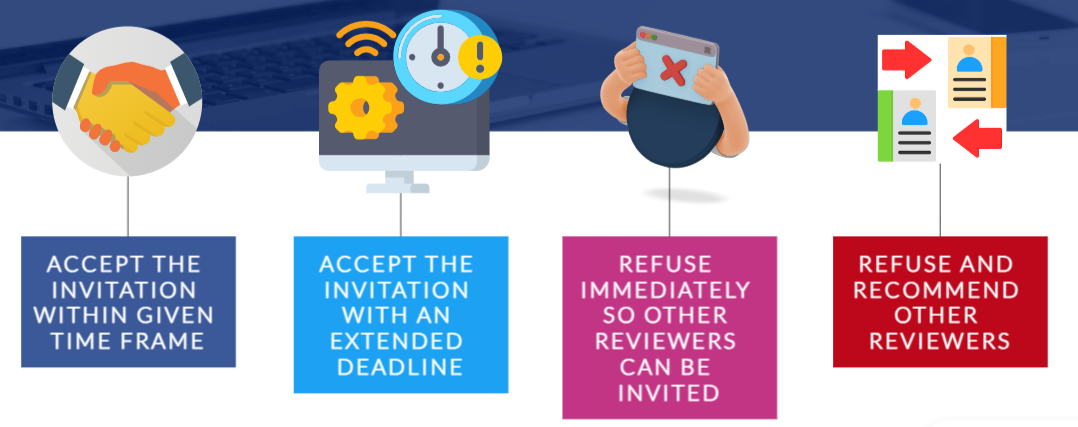 |
| Overview of the Reviewer Engagement Process |
Review Report Guidelines
During the manuscript review, reviewers are expected to provide detailed comments on each section of the manuscript, addressing the specific points outlined below. Reviewers may also provide confidential comments to the Editor, which are not shared with the authors and are visible only to the Editor-in-Chief and the Editorial Office. This ensures that sensitive feedback can be communicated while maintaining confidentiality throughout the review process. In cases of ethical concerns or suspected misconduct, reviewers should immediately halt the review and notify the Editorial Office for guidance.
Reviewers’ reports should generally include the following elements:
Reviewer Rating and Evaluation Checklist
During the peer review process, reviewers are expected to rate the manuscript on multiple aspects, including:
Reporting Guidelines
Some manuscripts may have specific reporting requirements depending on the study type. Authors should specify which reporting guidelines they have followed during submission, and reviewers should verify compliance and report any deviations. Recommended guidelines include:
Final Recommendation
As the culmination of the review, reviewers must provide a clear recommendation for the manuscript:
These recommendations are crucial in determining the manuscript’s outcome. Review reports are conveyed to the Editor-in-Chief or handling editor, who extracts essential suggestions for improvement and communicates them to the authors. Manuscripts requiring major revisions are re-evaluated by the same reviewers after submission of the revised version.
Rejection of articles may arise either due to scope or quality. If an article is found incongruent due to the scope of the journals, it may also be referred to another journal of similar scope, subject to mutual agreement of both author and Editor-in-Chief of the referred journal.
Scifiniti Publishing acknowledges reviewers’ voluntary efforts in conducting peer review of articles. To acknowledge their efforts, reviewers are awarded with:
We strongly support that peer review transparency and quality arise when reviewers remain completely neutral and have no association with any of the authors of the manuscript. The Editorial Office makes every effort to ensure that invited reviewers do not have any conflict of interest with the authors listed in the manuscript.
If an editor handling a manuscript, including the Editor-in-Chief, has a conflict of interest with any of the authors, they will not be involved in the peer review process for that manuscript. In such cases, the manuscript will be reassigned to another suitable editor to ensure an impartial and unbiased review process.
Authors are encouraged to disclose any potential conflicts of interest during manuscript submission. Authors may also provide a list of individuals with whom they have conflicts so that the Editorial Office can avoid inviting them as reviewers during the manuscript processing stage.
Reviewers are also encouraged to disclose any potential conflict, even if it is identified after accepting the review invitation, and refrain from continuing the review of the manuscript.
Conflict of interest can manifest in various forms, including but not limited to:
Cases related to conflicts of interest are addressed by the recommended protocol mentioned below, established by the Committee on Publication Ethics (COPE).
Since Scifiniti Publishing follows a single-blind peer review process, where reviewers know the authors’ identities but remain anonymous to them, the confidentiality of the manuscript at the reviewer’s end must be strictly maintained. All submitted manuscripts are treated as confidential by the journal and must not be shared outside the submission and review process without authorization. Reviewers are expected to uphold the highest standards of integrity, professional ethics, and confidentiality throughout the review process.
If a reviewer wishes to involve a co-reviewer, the proposed individual’s name and credentials must first be submitted to the Editorial Office for approval. The co-reviewer may only participate after the Editorial Office has confirmed their suitability and eligibility.
This guidance ensures that authors’ intellectual property is protected and that the integrity and fairness of the peer review process are preserved.
Reviewers are expected to review manuscripts within 2 weeks from the date of invitation. In case they are unable to review due to their prior commitments, they should immediately inform the editorial office for an extension in the deadline (if possible) or the selection of new reviewers. The average review time from the date of the first submission is 3-4 weeks; this may vary depending on reviewer availability and the complexity of the manuscript.
In the event of longer delays, authors will be informed of the reason and may choose to withdraw their manuscript if they wish. The Editorial Office strives to handle all manuscripts efficiently while allowing reasonable flexibility to ensure a thorough and fair review process.
The peer review process is essential for maintaining the quality, credibility, and integrity of scholarly publishing. To prevent potential manipulation of the review process, Scifiniti Publishing follows the guidelines established by the Committee on Publication Ethics (COPE) and carefully verifies potential reviewers before assigning manuscripts for review.
Potential manipulation may include practices such as the use of fabricated reviewer identities, reviewer accounts controlled by authors or third parties, undisclosed conflicts of interest, or coordinated review rings.
Any suspected cases of peer review manipulation are handled in accordance with the protocols and recommendations provided by COPE.
Reviewer citation manipulation is an unethical practice where reviewers recommend that authors cite their articles that are irrelevant to the topic in their citations. At the time of the review report submission, reviewers are recommended to suggest only those references that are relevant to the article. This practice compromises the integrity of the peer review process, which is meant to ensure the quality and impartiality of scientific publications. Editors are recommended to follow COPE Advice in case they come across any such case of citation manipulation.
Are you enthusiastic about becoming a Scifiniti Publishing reviewer? Please send us a request to register yourself by completing the Reviewers' Registration Form. Your profile will undergo evaluation by the Editor, and if it aligns with the journal's requirements, you will be assigned articles for review.