







Available Online: 26 Aug 2026
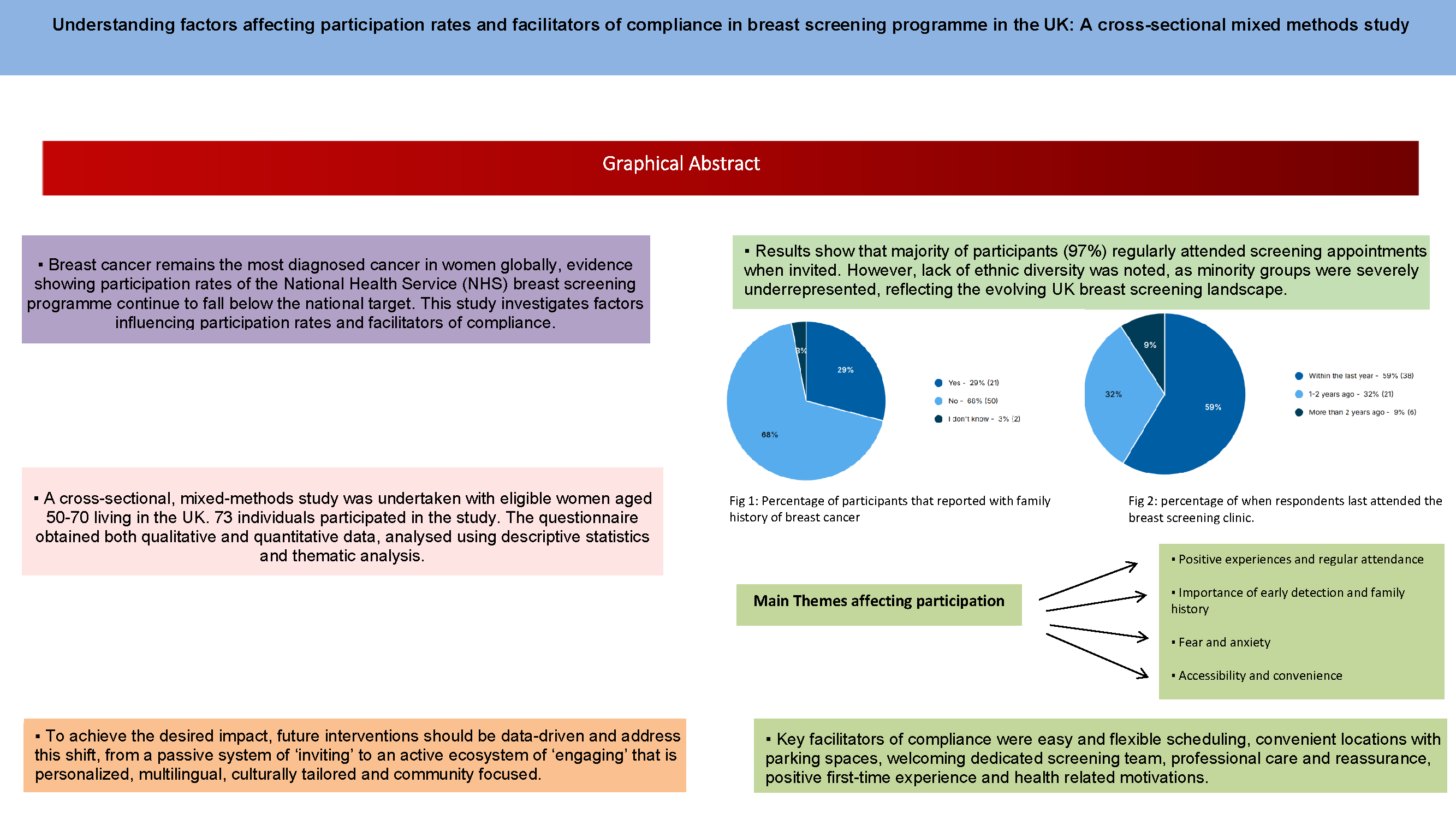
Understanding Factors Affecting Participation Rates and Facilitators of Compliance in Breast Screening Program in the UK: A Cross-Sectional Mixed Methods Study
Volume 1
Syed S. Hasan
Editor-in-Chief
Syed S. Hasan
Editor-in-Chief
Evidence Synthesis in Healthcare Connect is a peer-reviewed, open-access journal focused on advancing evidence synthesis to inform clinical practice, health policy, and systematic review methodology. It welcomes high-quality, interdisciplinary research that promotes transparency, innovation, and real-world impact in global healthcare.
Subscribe for research updates and exclusive content straight to your inbox
Open Access Policy:
All articles published in the journal Evidence Synthesis in Healthcare Connect are Gold Open Access, immediately available without any embargo period, and licensed under the Creative Commons Attribution 4.0 (CC BY 4.0) license. This license facilitates the unrestricted dissemination of articles, encouraging widespread sharing and utilization of valuable research contributions.
Publication Frequency:
Evidence Synthesis in Healthcare Connect follows a continuous publication model and is licensed under Creative Commons Attribution 4.0 (CC BY 4.0).
Publication Charges:
There will be no article processing charges (APCs) for submissions made by December 31, 2026, and all articles will be published as Open Access. Furthermore, the journal does not levy any additional fees on authors, including editorial processing charges, language editing fees, colour charges, submission fees, membership fees, or any other supplementary charges.
Subject Categories:
Clinical Practice, Health Care Services, Pharmaceutical Care
Article Template:
You are encouraged to use the template to format your article according to our guidelines. However, this is not mandatory, as our layout team will ensure all necessary adjustments are made after acceptance and prior to final publication.
Target Audience:
Evidence Synthesis in Healthcare Connect is intended for researchers, clinicians, and policy-makers who rely on high-quality evidence to inform healthcare decisions. The journal also serves methodologists and professionals advancing systematic review methodologies and tools.
Ethics Statement:
All articles published by Evidence Synthesis in Healthcare Connect adhere strictly to the ethical guidelines suggested by the Committee on Publication Ethics (COPE). We execute a stringent peer-review procedure that meticulously assesses the originality, quality, and precision of the research we disseminate. We employ advanced tools to scrutinize the legitimacy of submitted content and maintain a firm zero-tolerance stance toward instances of plagiarism, data manipulation, or inappropriate authorship. For further details, please review our comprehensive Editorial Policies & Ethical Oversight.
Available Online: 26 Aug 2026
Volume 1
Holly West
230604@hsu.ac.uk
Victor Chigbundu Nwaiwu
Victor.ChigbunduNwaiwu@hsu.ac.uk

Sherril Spencer
sherril.spencer@gmail.com
Published: 26 May 2026
Volume 1
Chia Siang Kow
chiasiang_93@hotmail.com
The global coronavirus disease 2019 (COVID-19) pandemic created unprecedented urgency for effective therapeutic interventions. During the early phase of the pandemic, when specific antivirals and vaccines were unavailable, hydroxychloroquine (HCQ) and ivermectin (IVM) emerged as widely promoted therapeutic candidates due to their reported in vitro antiviral activity, proposed mechanisms of action, and anecdotal clinical observations. Both drugs were rapidly incorporated..
Published: 20 May 2026
Volume 1
Fabrice Zobel Lekeumo Cheuyem
zobelcheuyem@gmail.com

Davy Roméo Takpando-Le-Grand
legrantak@yahoo.fr
Chabeja Achangwa
chabejaacha@yahoo.com
Lionel Berthold Keubou Boukeng
liokeu@yahoo.fr
Solange Dabou
solangedabs@gmail.com

Henri Donald Mutarambirwa
mutarahd2@gmail.com
Raissa Katy Noa Otsali
mballaotsalinoaraissakaty@gmail.com
Ariane Nouko
arianenouko@gmail.com
Michel Franck Edzamba
michel.medzamba@fmsb-uy1.cm
Martine Golda Mekouzou Tsafack
ptsafackgolda@yahoo.com
Armel Evouna Mbarga
evounarmel@gmail.com
Georges Nguefack-Tsague
nguefacktsague@gmail.com
This study incorporated 12 years of evidence (2010–2022) on Mpox epidemiology, vaccination, and clinical patterns in the Central African Republic (CAR), providing insights to inform targeted control strategies for this re-emerging threat. This systematic review and meta-analysis were conducted in accordance with PRISMA guidelines. Literature searches were performed using PubMed, Scopus, ScienceDirect, Web of Science, Embase, the Cochrane Library, and..
Published: 18 Mar 2026
Volume 1
Fabrice Zobel Lekeumo Cheuyem
zobelcheuyem@gmail.com
Constantine Tanywe Asahngwa
asahngwa@gmail.com
William Ndjidda Bakari
bakariwilliam@yahoo.fr
Chabeja Achangwa
chabejaacha@yahoo.com
Jessy Goupeyou-Youmsi
goupeyou.youmsi@gmail.com
Brian Ngongheh Ajong
ajong.brian@yahoo.com
Claude Axel Minkandi
minkandiclaude@gmail.com
Solange Dabou
solangedabs@gmail.com
Mohamadou Adama ,
bachiroudoc@yahoo.fr
Jude Tsafack Zefack
judetsafackz@gmail.com
Badou Guianga
guiangabadou@gmail.com
Jonathan Hangi Ndungo
ndungojonathan@gmail.com
Introduction: Monkeypox (Mpox) is an endemic disease in the Democratic Republic of Congo (DRC). Despite five decades of outbreaks, gaps persist in understanding the clinical patterns of Mpox and its coinfections with varicella-zoster virus (VZV) and human immunodeficiency virus (HIV) in this high-burden setting. This systematic review and meta-analysis were conducted to synthesize data on the clinical presentation of Mpox..
We use cookies to improve your experience on our site. By continuing to use our site, you accept our use of cookies. Learn more